 Ferndale
 Cordata's Exterior Climate Challenge
Homes in the Cordata area sit in one of the wetter, greener corners of Washington, and the exterior of a house here works harder than it would almost anywhere else in the country. Whatcom County's marine climate means long stretches of low-intensity rain from fall through spring, humidity that rarely lets up, and enough proximity to Bellingham Bay and the Salish Sea to carry a faint but real salt content in the air on windy days. None of that is dramatic on its own. The problem is cumulative: month after month of moisture sitting against wood trim, moss creeping across north-facing walls and rooflines, and salt-tinged air slowly working on anything not built to shed it.
We've worked on enough homes in this corridor to see the pattern. It's rarely one big failure — a storm, a flood, a single bad day. It's slow attrition: paint that needs recoating every few years, caulk joints that open up and let water behind the siding, roof edges and north walls that stay damp long after the rest of the house has dried out. A siding, roofing, window, and deck system that isn't built for that pattern will show it early, usually in the first five to ten years.
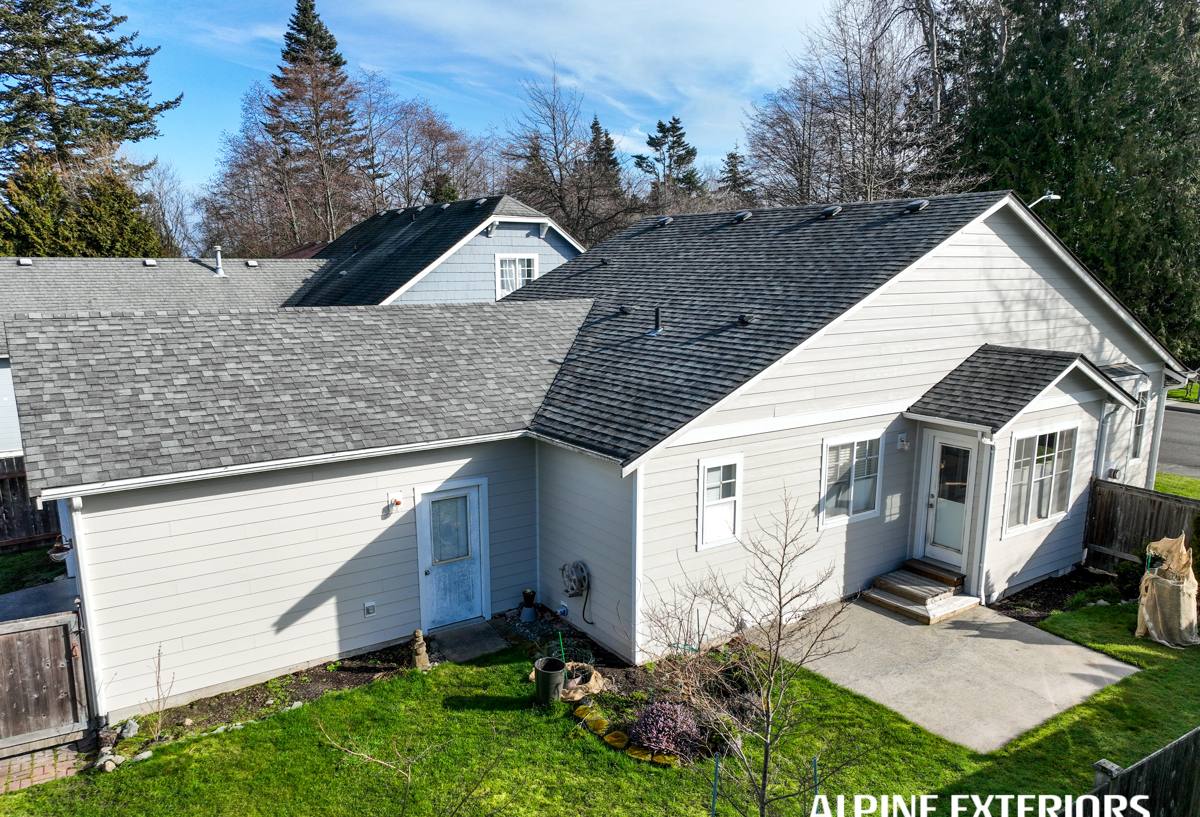
Why Siding Choice Matters More Here Than Most Places
In a dry climate, the difference between siding products is mostly cosmetic and financial. In Whatcom County, it's functional. Wood-based products — cedar, primed spruce, engineered wood siding like LP SmartSide — depend on an intact factory or field coating to keep moisture out. Once that coating is compromised at a cut edge, a nail hole, or a joint that wasn't sealed correctly, wood-based substrates absorb water and start to swell, delaminate, or rot from the inside out. In a climate with this much sustained dampness and moss growth, that failure point gets tested constantly, not occasionally.
Vinyl siding handles moisture differently — it doesn't rot — but it has its own weak points for this region: it expands and contracts more than fiber cement across our temperature swings, it can crack in cold snaps, and it fades and chalks under years of UV and salt air exposure with no realistic way to refinish it short of replacement. It also does very little to slow moss and algae growth, which is a real cosmetic and maintenance issue on shaded, damp elevations that are common on Cordata lots with mature trees.
This is the honest reasoning behind why we install only James Hardie fiber cement siding. It isn't that every other product is bad — cedar looks beautiful, vinyl is inexpensive, engineered wood has genuine strengths in drier climates. It's that for a marine climate with this much rain, humidity, and moss pressure, fiber cement's behavior under sustained moisture exposure is simply better matched to what the material has to survive here, year after year, with minimal upkeep.
What James Hardie Actually Offers
- Non-combustible core — fiber cement doesn't feed a fire the way wood-based products can.
- Climate-engineered HZ formulations — Hardie's HZ5 product line is engineered for regions with sustained moisture and freeze-thaw cycling, which matches Whatcom County's conditions well.
- ColorPlus factory finish — a baked-on finish applied under controlled conditions, which holds color and resists fading, chipping, and cracking far longer than field-applied paint.
- Moisture and moss resistance — fiber cement doesn't absorb water the way wood substrates do, so it doesn't provide the same foothold for moss and algae growth on shaded walls.
- A strong transferable warranty — meaningful for homeowners who may sell within the product's lifespan.
How We Handle Roofing, Windows, and Decks Alongside Siding
Siding doesn't work in isolation. Water that gets past a roof edge, a window flashing detail, or a deck ledger board will find its way behind even the best siding installation. That's why we treat the exterior as one connected system rather than four separate trades.
When we're on a Cordata property for a siding project, we're looking at the whole envelope: roof flashing at wall intersections, window head flashing and sill pans, and deck ledger connections where a house meets an exterior structure — all common points where water intrudes in this climate, regardless of how good the siding itself is. Where we find a roofing detail or a window installation that's feeding moisture into a wall assembly, we address it as part of the same conversation, not as a separate upsell down the road.
For decks specifically, our region's moss season and sustained dampness mean ledger connections, joist hardware, and any wood-to-wood contact points need real attention to drainage and ventilation — details that get skipped on a lot of builder-grade decks and show up as rot problems five or ten years later.
What a Project Looks Like, Start to Finish
A siding project on a Cordata home generally follows the same sequence regardless of the house's age or style:
- An on-site assessment of the existing siding, trim, flashing details, and any moisture or moss issues already visible.
- A written estimate that separates material, labor, and any additional scope (rotten sheathing, flashing repair, trim replacement) discovered during the walkthrough.
- Removal of existing siding and inspection of the sheathing and weather-resistive barrier underneath — this is where hidden moisture damage from years of prior exposure usually turns up.
- Installation of James Hardie panels or lap siding to manufacturer specification, including correct fastening, clearances, and joint treatment — details that matter more in a wet climate than in a dry one.
- Final trim, caulking, and a walkthrough before we consider the job finished.
Cost Factors Homeowners Should Understand
Every Cordata home is different, so we don't quote firm numbers without seeing the house, but the factors that move a siding project's cost are consistent:
| Factor | Why It Matters Here |
|---|---|
| Existing sheathing condition | Long-term moisture exposure common in this climate sometimes means sheathing repair is needed before new siding goes on |
| Siding profile (lap vs. panel vs. shingle) | Affects material and labor cost; profile choice also affects how the house sheds water |
| Trim and detail work | Homes with more corners, dormers, and window trim take longer to flash and finish correctly |
| Access and site conditions | Mature trees, sloped lots, and tight setbacks — common in established Cordata neighborhoods — affect staging and labor time |
| Scope beyond siding | Roofing, window, or deck work bundled into the same project can save on mobilization but adds to total cost |
Comparing Siding Materials for This Climate
| Material | Moisture Behavior | Maintenance | Moss/Algae Resistance |
|---|---|---|---|
| James Hardie fiber cement | Does not absorb and swell like wood substrates | Low — factory finish holds up for years | Better resistance than wood-based products |
| Vinyl | Doesn't rot, but seams and J-channels can trap moisture | Low, but fades/chalks over time and can't be refinished easily | Poor — provides little resistance to buildup |
| Cedar / primed spruce | Absorbs moisture readily once coating is compromised | High — needs recoating on a regular cycle | Poor — organic material is a natural host |
| Engineered wood (e.g., LP SmartSide) | Better than raw wood but still substrate-dependent on coating integrity | Moderate — coating maintenance still required | Moderate |
Signs Your Cordata Home's Exterior Needs Attention
- Persistent moss or dark streaking on north- or shade-facing walls that returns quickly after cleaning
- Paint or coating that's chalking, peeling, or needing recoating more often than every five to seven years
- Soft spots, bubbling, or visible swelling at siding seams, corners, or below windows
- Gaps opening up in caulked joints around trim, windows, or doors
- Roof-to-wall intersections or deck ledger areas that stay visibly damp longer than the rest of the exterior
- Window sills or trim showing soft wood or paint failure specifically at the sill, a common water-entry point
Why a Local Crew Matters
A siding crew that's used to installing in Arizona or inland climates will build to a different set of assumptions than one that works Whatcom County year-round. Flashing details, caulk joint spacing, ventilation behind siding, and even the timing of a project around our wet season all benefit from a crew that's dealt with this specific climate on real jobs, not just in a manual. We're a Ferndale-based crew working this region every week, which means we've seen how houses in the Cordata area age, where they tend to fail first, and what actually holds up here versus what looks fine on install day and struggles by year eight.
That local, repeated exposure to this climate is also why we don't spread ourselves across every siding product on the market. Standardizing on one system we trust, installed correctly, is more useful to a homeowner than a menu of options we'd have to hedge on.
Get a Straightforward Estimate
If your Cordata home's siding, roof, windows, or deck are showing wear from Whatcom County's rain and moss season, we're happy to take a look and give you an honest read on what's going on and what it would take to fix it. There's no pressure and no obligation — just fill out the form below to schedule a free estimate.