 Ferndale
 Marietta's Exterior Climate: What Homes Are Actually Up Against
Marietta sits close to the water on the edge of Ferndale, and that proximity shapes what happens to a house's exterior over time. Homes here deal with a combination that inland Whatcom County neighborhoods don't get in the same dose: salt-laden air moving off the bay, driving rain that comes in sideways during winter storms, and a moss season that can stretch for most of the year under the region's tree cover and cloud ceiling. None of these are dramatic events on their own. They're slow, cumulative pressure, and that's exactly what wears out the wrong siding material faster than most homeowners expect.
Salt air is corrosive to exposed metal fasteners and hardware, and it accelerates the breakdown of finishes that aren't formulated to resist it. Driving rain off the water doesn't just wet a wall — it drives moisture sideways into seams, laps, and any gap in the weather barrier, which is a different stress than the straight-down rain a siding product might be tested against. And moss, along with the algae and mildew that show up alongside it, thrives anywhere there's shade, moisture, and organic debris — which describes a lot of Marietta's tree-lined lots for a good chunk of the year.
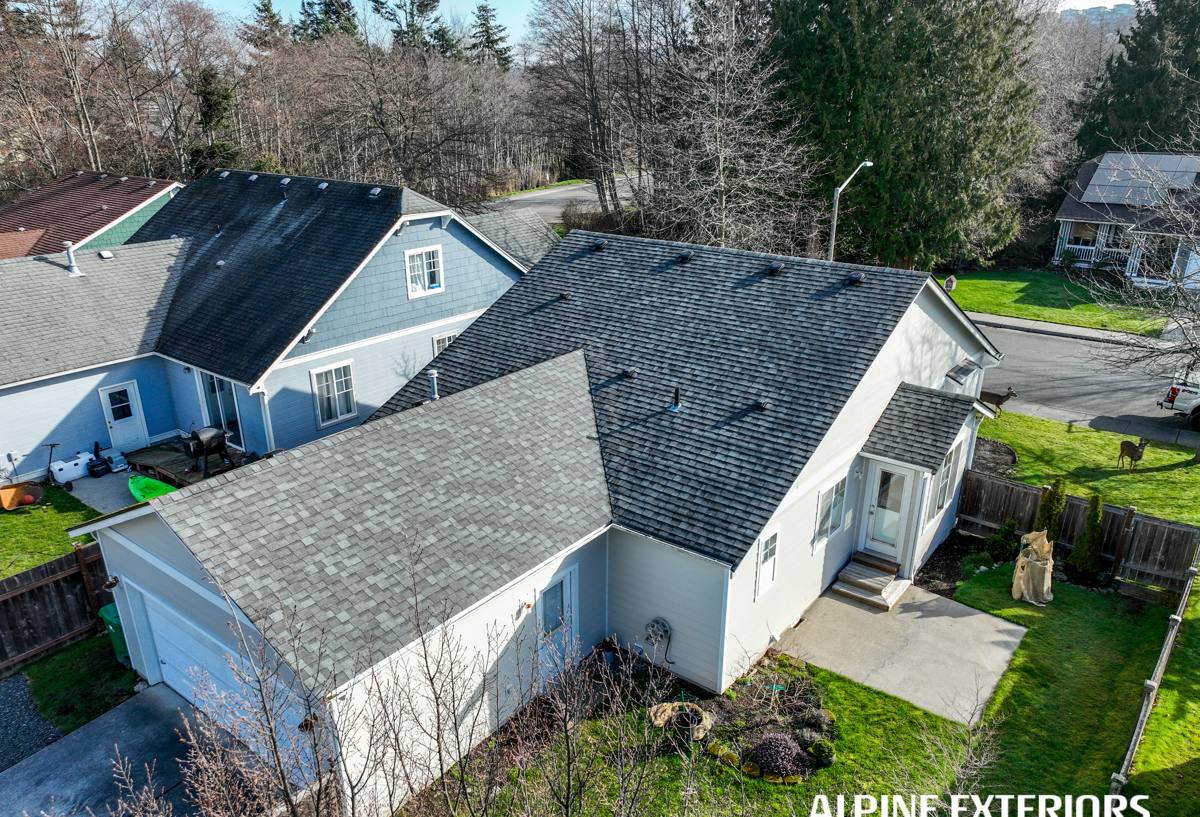
Where This Shows Up on a House
We see the same failure patterns repeat on homes in this part of Ferndale, and they're almost always tied to the same three conditions:
- North and west-facing walls that stay shaded and damp longer after a storm, where moss and mildew take hold first
- Lower courses of siding near grade or landscaping, where splashback and standing moisture do the most damage
- Corner boards, trim, and butt joints where water intrusion starts small and isn't visible until paint or caulking has already failed
- Fastener heads and flashing that corrode faster in salt-influenced air, leading to streaking and eventual loosening
None of this is unique to any one brand of siding — every exterior product on the market has to survive this environment. What differs enormously is how each material responds to it over ten, twenty, and thirty years.
Why We Only Install James Hardie in This Kind of Climate
We install James Hardie fiber cement siding exclusively — not vinyl, not LP SmartSide, not Cemplank or Allura, not primed spruce or cedar. That's a deliberate standard, not a limitation of what we're capable of installing. In a climate like Marietta's, the material choice matters more than almost any other decision in a siding project, and we'd rather stand behind one product system we trust completely than offer a menu of options with very different long-term outcomes.
Fiber cement is non-combustible and dimensionally stable, meaning it doesn't expand, contract, warp, or become brittle the way wood-based or vinyl products can when they cycle through wet winters and drier summers. Hardie's ColorPlus factory finish is baked on under controlled conditions rather than field-applied, which gives it a more consistent, weather-resistant bond than site-painted alternatives — a real advantage when a wall is going to spend months a year damp. And Hardie's HZ5 product line is engineered specifically for the freeze-thaw, moisture-heavy climate zones that include the Pacific Northwest, which is the zone rating we install to here.
We're not going to tell you other siding products are junk — that's not honest, and it's not how we approach this. Vinyl is inexpensive and low-maintenance in a lot of climates. LP SmartSide and engineered wood products have real fans and real strengths. Cedar has a look that some homeowners will always prefer. But when we weigh moisture behavior, maintenance burden, and how a product performs specifically in a place with salt air, heavy rain, and long damp shoulder seasons, fiber cement is what we're willing to warranty and put our name behind.
A Quick Look at Why the Alternatives Give Us Pause Here
| Material | Main Trade-Off in This Climate |
|---|---|
| Vinyl siding | Can warp or become brittle with temperature swings; seams and panels can allow moisture behind the cladding over time |
| LP SmartSide / engineered wood | Wood-strand core is more moisture-sensitive at cut edges and joints; requires consistent maintenance to prevent swelling |
| Primed spruce or cedar | Natural wood movement and higher maintenance need — repainting, caulking, and moisture monitoring on a shorter cycle |
| James Hardie fiber cement | Heavier and requires correct installation technique, but resists moisture, fire, and pests with a factory finish built for this zone |
How We Approach a Siding Project in Marietta
The starting point on almost every job here is a walk-around inspection focused on the moisture-prone areas we already know to check: north and west walls, grade-level courses, trim intersections, and anywhere flashing ties into windows, doors, or the roofline. We're looking for what's happening underneath the current siding, not just what it looks like from the driveway — because in a climate this wet, the damage that matters is usually behind the cladding, not on the surface of it.
From there, correct installation is what actually determines how long the siding performs, regardless of material. That means proper clearance from grade and hardscape, correctly lapped and sealed flashing at every penetration, manufacturer-spec fastening (not just "close enough"), and attention to the water-resistive barrier underneath — the house wrap and flashing details that do the real work of keeping driving rain out of the wall assembly. James Hardie's own installation guidelines are specific for a reason, and skipping steps is exactly how a good product ends up with a bad outcome ten years down the road.
Beyond Siding: Roofing, Windows, and Decks Face the Same Conditions
Siding isn't the only part of a Marietta home dealing with salt air, driving rain, and moss. The same conditions affect the rest of the exterior envelope, which is part of why we handle roofing, windows, and decks alongside siding rather than treating them as separate problems:
- Roofing: Moss buildup on a roof holds moisture against shingles and can shorten their service life; roof edges and valleys near the water take on more wind-driven rain than inland homes
- Windows: Flashing and sealant at window openings are one of the most common points of water intrusion — this is exactly where siding and window work need to be coordinated, not done independently
- Decks: Exposed, ground-level, and often shaded, decks face the same moss and moisture pressure as north-facing siding, and material choice matters just as much there
Handling these together means fewer seams between contractors, and fewer chances for one crew's work to undermine another's — a flashing detail at a window, for instance, has to work correctly with both the window installation and the siding around it.
What Drives Cost on a Marietta Siding Project
Every home is different, so we won't quote a number without seeing the house, but the factors that typically move the price on a Marietta-area siding job are fairly consistent:
| Factor | Why It Matters |
|---|---|
| Existing siding removal | Tear-off and disposal of old material, and repair of any sheathing damage found underneath |
| Home size and wall complexity | Square footage plus the number of corners, gables, and trim details affects labor time |
| Siding profile and finish | Lap width, panel style, and ColorPlus finish selection affect material cost |
| Moisture or rot repair | Damage found behind old siding — common on shaded, water-facing walls — needs to be fixed before new siding goes on |
| Trim and accessory work | Corner boards, window trim, and soffit details finish the look and protect key water points |
Why a Local Crew Matters Here
A crew that works this specific stretch of Whatcom County regularly knows which walls on a typical Marietta home take the worst of the weather before they even climb a ladder. That's not a marketing point — it changes how an inspection is done, where extra care goes into flashing and sealant work, and which product lines and finishes make sense for a given lot's sun and shade pattern. A contractor who mostly works inland or in a drier climate is starting from scratch on judgment calls that a local crew has already made a hundred times over.
It also matters for accountability. A local company is going to be around for the warranty period and beyond, which is worth something when you're choosing a material — like Hardie fiber cement — specifically because of its long-term performance and transferable warranty.
Simple Maintenance That Extends the Life of Your Siding
Fiber cement is low-maintenance compared to wood and more moisture-tolerant than vinyl, but "low-maintenance" doesn't mean "no maintenance" in a climate like this one. A little seasonal attention goes a long way:
- Rinse siding annually, and more often on shaded north or west walls where moss and mildew take hold first
- Keep gutters clear so overflow doesn't run down the wall and saturate lower courses
- Trim back landscaping and tree branches that keep siding shaded and damp longer than it needs to be
- Check caulking at trim joints, window edges, and corner boards each year — small gaps are cheap to fix and expensive to ignore
- Watch for streaking near fasteners or flashing, which can be an early sign of corrosion or a small leak
If you're weighing a siding, roofing, window, or deck project on a Marietta home, we're happy to walk the property, point out what we're actually seeing, and put together a free, no-pressure estimate — no obligation, just a straight answer about what your house needs.