 Ferndale
 Semiahmoo sits right on the water in Whatcom County, and that waterfront location is exactly what makes siding decisions different here than fifteen minutes inland. Homes on or near the spit face a steady diet of salt-laden air, wind-driven rain coming off Semiahmoo Bay and the Strait of Georgia, and a long, damp moss season that can run from early fall through late spring in a typical Pacific Northwest year. We've built our whole approach around materials and installation details that hold up to that combination, not just around what looks good on install day.
What Semiahmoo Homes Are Up Against
Coastal and near-coastal exposure changes the math on exterior materials in a few specific ways. It's worth understanding these before you pick a product, because the failure modes that show up on a waterfront home aren't the same ones you'd see on a house in a dry inland subdivision.
Salt Air and Corrosion
Airborne salt doesn't just affect metal fasteners and flashing — it accelerates the breakdown of paint films, caulking, and some composite materials over time. Anything on the exterior of a Semiahmoo home is getting a slow, constant dose of salt spray whenever the wind comes off the water, which is often. That means fastener selection, flashing metal, and the siding's factory finish all matter more here than they would on a typical inland job.
Wind-Driven Rain
Waterfront and near-waterfront properties tend to catch more direct, horizontal rain than sheltered inland lots. Wind-driven rain finds gaps that vertical rain never would — around window and door trim, at butt joints, behind poorly lapped siding courses. This is a big part of why we care so much about flashing details and proper overlaps, not just the siding product itself.
Moss, Algae, and Prolonged Moisture
Whatcom County's wet season is long, and shaded or north-facing walls near Semiahmoo can stay damp for extended stretches, especially where tree cover or neighboring structures block sun and airflow. That persistent moisture is what feeds moss and algae growth on exterior surfaces, and it's also what punishes any siding material that isn't dimensionally stable when it repeatedly absorbs and releases water.
Why We Only Install James Hardie Fiber Cement
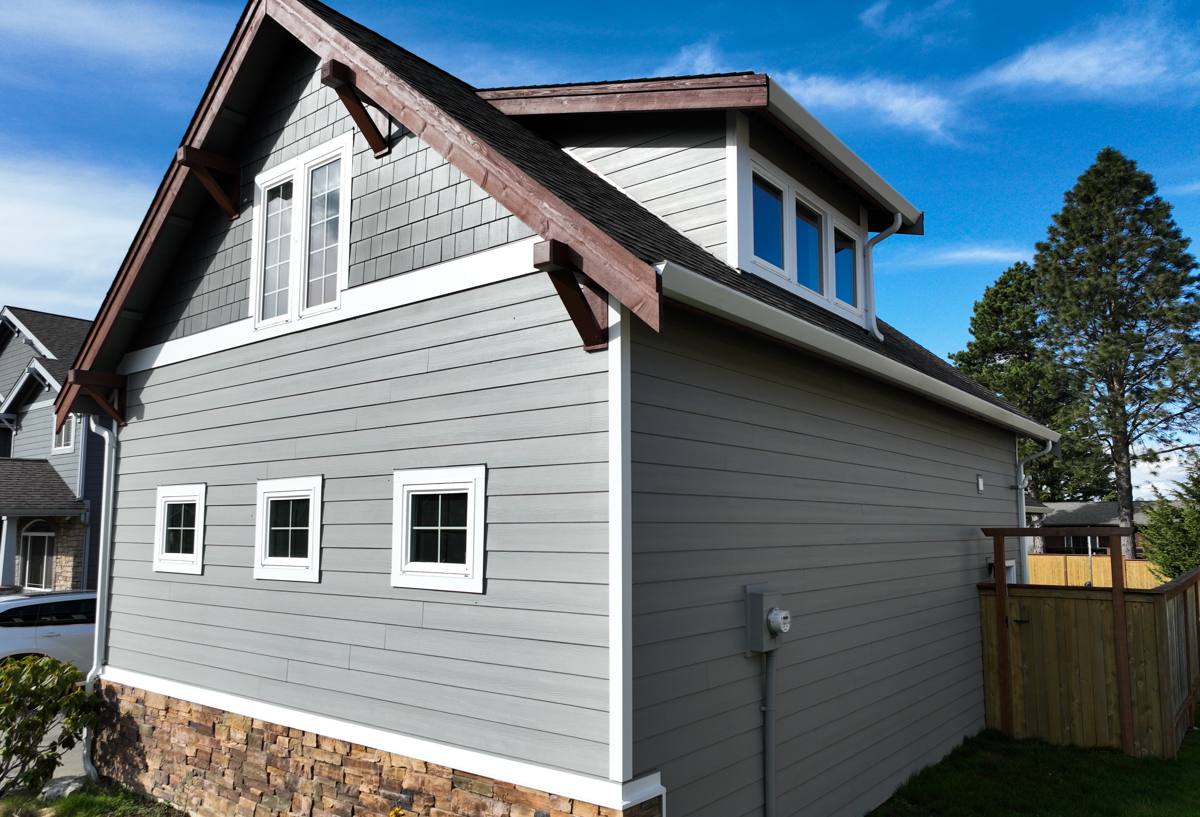
We made a deliberate decision as a company to install James Hardie fiber cement siding exclusively — we don't offer vinyl, LP SmartSide, Cemplank, Allura, primed spruce, or cedar. That's not a marketing angle; it's because we've seen how each of those alternatives performs under sustained coastal moisture exposure, and we'd rather stand behind one product system we trust completely than offer a menu of options with very different long-term outcomes.
Fiber cement is non-combustible and dimensionally stable — it doesn't expand and contract with moisture the way wood-based products do, which matters enormously in a climate where the siding is wet more often than it's dry. James Hardie's ColorPlus factory finish is baked on under controlled conditions and backed by its own finish warranty, so you're not relying on a field-applied paint job to hold up against years of salt air and rain.
How James Hardie Compares to the Alternatives
| Material | Moisture Behavior | Combustibility | Typical Long-Term Maintenance |
|---|---|---|---|
| James Hardie Fiber Cement | Dimensionally stable, engineered for wet climates | Non-combustible | Occasional wash; ColorPlus finish resists fading |
| Vinyl | Can warp or distort with heat/cold cycling | Combustible | Low, but limited color/repair options over time |
| LP SmartSide / Wood-Based | Absorbs moisture at cut edges and joints | Combustible | Repainting, edge sealing, moisture monitoring |
| Cedar | Natural material, prone to swelling and checking | Combustible | Regular refinishing, higher upkeep in wet climates |
| Primed Spruce | Softwood, needs prompt field painting to stay protected | Combustible | Ongoing paint maintenance |
We're not saying every one of those products fails — plenty of homes carry them without incident. What we're saying is that when we weighed moisture behavior, maintenance burden, and long-term appearance for a climate like this one, fiber cement was the clear winner, and we didn't want to keep installing products we had reservations about.
James Hardie Product Lines for This Climate
James Hardie makes climate-engineered HZ formulations, and the HZ5 line is the one specified for the Pacific Northwest's wetter, cooler conditions. It's formulated to perform in exactly the kind of freeze-thaw and moisture cycling that a Whatcom County winter delivers. For Semiahmoo specifically, we also pay close attention to:
- Lap siding profiles with proper reveal for clean water shedding
- HardiePanel vertical siding where a more modern or board-and-batten look is wanted
- HardieTrim for window, door, and corner detailing that resists the same moisture exposure as the field siding
- ColorPlus finish colors selected with UV and salt-air fading resistance in mind
Installation Details That Matter Most Here
Fiber cement siding is only as good as the installation behind it, and that's doubly true on a waterfront lot. A few things we treat as non-negotiable on every Semiahmoo project:
Flashing and Water Management
Every window, door, and penetration gets flashed to shed water outward, not just to look finished. Wind-driven rain will find any shortcut in the flashing sequence, and on a coastal lot that's not a hypothetical — it's a matter of when, not if.
Fastener and Hardware Selection
We use corrosion-resistant fasteners appropriate for coastal exposure. Standard fasteners that would be fine on an inland home can start showing rust streaks and weakening well ahead of schedule when they're exposed to regular salt air.
Proper Clearances
Hardie siding needs the manufacturer-specified clearance from grade, roof lines, and decks to avoid trapping moisture against the bottom edge of the boards. This is a common corner that gets cut on rushed jobs, and it's one of the first places problems show up.
Caulking and Joint Treatment
Butt joints and trim intersections are sealed with products rated for the movement and moisture conditions they'll actually see, not just whatever's on the truck.
Roofing, Windows, and Decks in the Same Environment
Siding doesn't work in isolation — the roof, windows, and any deck structures on a Semiahmoo property are dealing with the same salt air and moisture load. We handle all four (siding, roofing, windows, and decks), which lets us look at a property as one connected system rather than patching one component while ignoring how it interacts with the others. A new deck built without attention to ledger flashing, for example, can undermine even well-installed siding above it. Roof and gutter performance directly affects how much water runs down and across your walls. Window flashing has to tie into the siding's water management plan, not fight against it.
Why a Local Crew Matters
A crew that works Whatcom County regularly has already seen how homes in this specific microclimate age — which walls hold moss longest, where wind-driven rain tends to find its way in, and which details are worth the extra time on a coastal lot versus an inland one. That local pattern recognition is hard to replace with a generic install crew that hasn't worked this stretch of coastline before. It also means someone is realistically available if a warranty question or a minor issue comes up down the road, rather than a phone number that used to be local.
What a Typical Project Involves
A siding replacement in Semiahmoo generally follows the same sequence as elsewhere in the region, with extra care at the moisture-management steps given the exposure. Before we start, we walk the property, inspect for any existing moisture damage behind the current siding, and talk through product lines, colors, and trim details. Removal of old siding gives us a chance to check sheathing and framing for hidden water damage — not uncommon on older coastal homes — before anything new goes up. From there it's water-resistive barrier and flashing, then the Hardie siding and trim itself, finished with the caulking and detail work that keeps water on the outside where it belongs.
Simple Pre-Project Checklist for Homeowners
- Note any interior stains, musty smells, or soft spots on exterior walls before your estimate
- Point out areas with heavy moss or algae buildup — these often mark chronic moisture zones
- Mention any past water intrusion around windows, doors, or decks
- Ask what fastener and flashing materials will be used given the coastal exposure
- Confirm which James Hardie product line and color are being specified and why
If you're weighing a siding, roofing, window, or deck project on a Semiahmoo property, we're happy to take a look and walk you through what we'd recommend and why. Reach out for a free, no-pressure estimate using the form below.