 Ferndale
 Sumas sits at the far northern edge of Whatcom County, tucked against Sumas Mountain and the Nooksack River valley just south of the Canadian border. It's a quieter corner of our service area, but the exterior of a house here has to deal with the same weather everyone in this county deals with: long wet winters, a marine-influenced climate that pushes moisture inland off the Pacific, and stretches of the year where siding, trim, and roofing rarely get a chance to fully dry out. Add in the shade from surrounding tree cover and hillside terrain around parts of town, and you get a longer moss and mildew season than homeowners in drier parts of the state ever have to think about.
We're a Ferndale-based crew, and Sumas is part of our regular service area. That matters more than people expect. A contractor who works this county day in and day out knows what driving rain does to a poorly flashed window over a few winters, how moss creeps across a north-facing wall that never sees direct sun, and why a product that performs fine in Spokane or Sacramento can struggle here. We install one siding system — James Hardie fiber cement — because after years of tear-offs and re-sides across Whatcom County, it's the product we trust to hold up to this specific climate without turning into a maintenance project for the homeowner.
What Sumas Homes Are Up Against
Every house in this region is fighting the same slow battle with moisture. It's rarely a single storm that causes damage — it's the cumulative effect of siding staying damp for days at a time, sun-thaw-freeze cycles in the colder months, and organic growth that gets a foothold anywhere airflow and sunlight are limited.
Rain That Doesn't Let Up
Whatcom County doesn't get dramatic downpours as often as it gets steady, driving rain that can persist for days. That kind of weather finds every weak point in a home's exterior: a poorly lapped seam, a gap around a window flange, a butt joint that wasn't back-caulked. Wood and wood-composite sidings absorb some of that moisture at every exposed edge and cut end, and over years that adds up to swelling, softening, and eventually rot — especially at the bottom courses closest to grade and around anything protruding from the wall.
Moss, Mildew, and Shaded Walls
Between tree cover, cloud cover, and the county's overall humidity, a lot of homes in and around Sumas have at least one wall — usually north- or east-facing — that almost never dries out fully between rain events. That's exactly the environment moss and mildew need. On the wrong siding material, that growth isn't just cosmetic; it holds moisture directly against the surface and accelerates whatever degradation is already happening underneath.
Temperature Swings and Freeze Cycles
Sumas sits closer to the foothills than the coast, which means winter cold snaps can hit a little harder here than in Bellingham or Ferndale proper. Materials that have taken on moisture and then freeze are more prone to cracking, splitting, and paint failure. It's a slower process than storm damage, but it's just as real over the life of a house.
Why We Standardized on James Hardie
We used to install a wider range of siding products. Over time, watching how different materials actually performed on real Whatcom County homes — not in a brochure, but five, ten, twenty years after installation — we narrowed down to one system: James Hardie fiber cement.
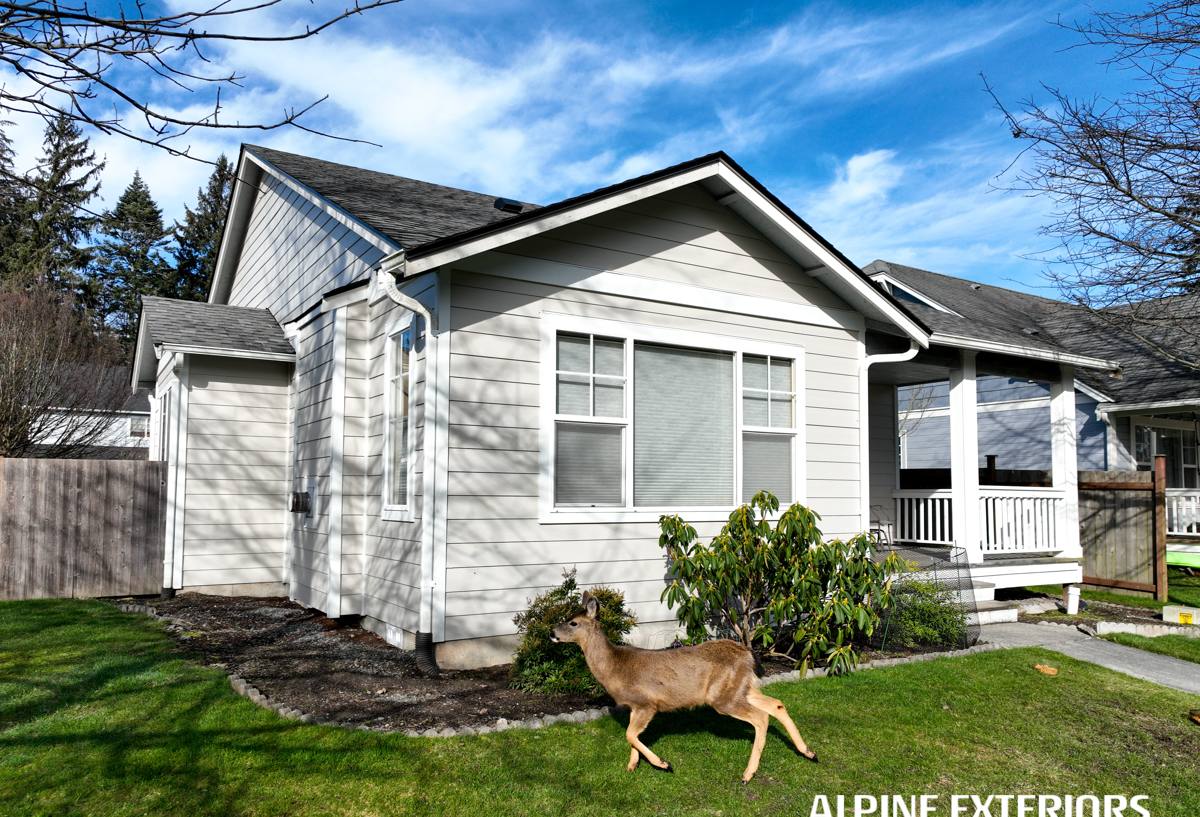
Hardie siding is engineered from cement, sand, and cellulose fiber. It doesn't absorb water the way wood or wood-composite products do, it won't support the kind of organic growth that thrives on cellulose-based siding, and it's non-combustible, which matters more every year given wildfire smoke and ember exposure across the Pacific Northwest. James Hardie also builds region-specific product lines — its HZ5 formulation is engineered for climates like ours, with freeze-thaw cycling and sustained moisture exposure factored into the product itself, not treated as an afterthought.
The factory-applied ColorPlus finish is another piece of this. Field-applied paint on any siding material is only as good as the prep, the weather during application, and the specific coat thickness a crew puts down that day. ColorPlus finish is baked on under controlled conditions before the boards ever reach a job site, which gives it a more consistent bond and a longer realistic repaint interval than most site-painted siding — a real advantage in a climate that doesn't offer many dry weeks for exterior painting anyway.
What We Don't Install, and Why
We get asked about vinyl, LP SmartSide, and other fiber cement brands fairly often, and we're upfront about why we don't offer them.
- Vinyl siding is inexpensive and low-maintenance in mild, dry climates, but it can become brittle in sustained cold, and it relies on the wall assembly behind it to manage moisture rather than resisting it directly. In a wet climate like ours, we'd rather install a material that's actively resistant to water damage.
- LP SmartSide and similar engineered wood products use resin-treated strand board as their base. They perform reasonably well when installed and maintained exactly to spec, but they're still wood-based, which means any breach in the factory coating — a scratch, an unsealed cut edge, a caulk joint that fails — gives moisture a path into a material that can swell and deteriorate.
- Other fiber cement brands (Cemplank, Allura) are chemically similar to Hardie, but we've standardized on one manufacturer so we can guarantee consistent product knowledge, factory-matched trim and accessories, and a warranty process we know inside and out rather than juggling specs across multiple product lines.
None of this means those products are unusable — it means we made a professional call about what we're willing to warranty our labor on, in this specific climate, and we've stuck with it.
Our Services Around Sumas
We handle the full exterior envelope, not just siding, because on most homes these systems interact with each other. A roof leak shows up as siding damage two years later. A poorly flashed window can rot the wall cavity behind good siding. Treating the exterior as one connected system is how you actually stop repeat problems.
Siding
Full siding replacement and repair using James Hardie lap siding, panel siding, and shingle-style siding, with proper water-resistive barrier, flashing, and rainscreen detailing behind the boards — the part of the job that determines whether siding lasts 10 years or 40.
Roofing
Roof replacement and repair, with close attention to flashing at valleys, chimneys, and wall intersections — the details that matter most in a climate where water finds every gap over time.
Windows
Window replacement with correct flashing and integration into the siding system, since a window installed without proper flashing is one of the most common sources of hidden wall damage we find when we tear off old siding.
Decks
Deck construction and repair built to handle year-round exposure, with material choices and detailing suited to a climate where a deck rarely gets a real dry season.
What Correct Hardie Installation Involves
Fiber cement siding is only as good as the installation behind it. A rushed or spec-deviating install can undercut everything the product is designed to do.
| Detail | Why It Matters |
|---|---|
| Proper clearance from grade, decks, and roof lines | Keeps siding out of standing water and splash-back zones |
| Correct fastener type, spacing, and penetration | Prevents fastener corrosion and panel movement over time |
| Rainscreen or drainage gap behind siding | Lets incidental moisture drain and the wall assembly dry out |
| Factory-cut edges sealed, field cuts primed | Cut edges are the most vulnerable point on any fiber cement board |
| Manufacturer-specified caulking at joints and penetrations | Failure here is the single most common cause of moisture intrusion |
We follow James Hardie's published installation requirements as a floor, not a suggestion — it's also what keeps the manufacturer's warranty intact if you ever need it.
Planning a Project in Sumas
A few things we walk through with homeowners early on, before any work starts:
- Current condition of the wall sheathing and water-resistive barrier once old siding is removed
- Whether existing trim, window flashing, and roof-to-wall transitions need attention as part of the project
- Realistic timeline given the wet-weather scheduling constraints common to this part of the county
- Which Hardie siding profile and ColorPlus color best fit the home's style and sun/shade exposure
- Whether roofing, window, or deck work should be bundled with the siding job to avoid redoing trim or flashing twice
Why a Local Crew Matters Here
Sumas is far enough from the bigger population centers in the county that it sometimes gets treated as an afterthought by contractors based elsewhere. We're headquartered in Ferndale and treat this area as core territory, not a detour. That means we're familiar with how weather moves through this part of the valley, we're not learning the region's quirks on your project, and we're reachable if a warranty question or follow-up comes up after the crew has moved on to the next job.
If you're weighing a siding, roofing, window, or deck project on a home in Sumas, we're happy to take a look and give you a straightforward, no-pressure estimate — no invented urgency, just an honest read on what your home actually needs.