 Ferndale
 Sumas Homes Face a Specific Set of Siding Problems
Sumas sits inland from Ferndale but still lives inside the same wet, marine-influenced weather pattern that defines Whatcom County. Homes here deal with long stretches of driving rain in the fall and winter, heavy dew and fog that keeps exterior walls damp for hours after sunrise, and a moss season that can run six months or longer on north-facing walls and anything shaded by trees or fences. Add in the salt-laden air that moves inland off the Strait of Georgia and Puget Sound on windy days, and you have a climate that is genuinely hard on exterior building materials — not in a dramatic, one-time-event way, but in a slow, cumulative way that shows up as soft trim, peeling paint, and swollen siding edges five or ten years down the road.
This is why the siding material and the installation details matter more here than they would in a drier climate. A product that performs fine in Eastern Washington or the Midwest can struggle in Sumas if it isn't dimensionally stable when wet, doesn't drain water away from the wall assembly, or relies on a field-applied paint job to keep moisture out. We install James Hardie fiber cement siding exclusively, and on a project like this, almost every decision — the product line, the fasteners, the flashing details — traces back to how well it holds up against rain, moss, and salt air over decades, not just years.
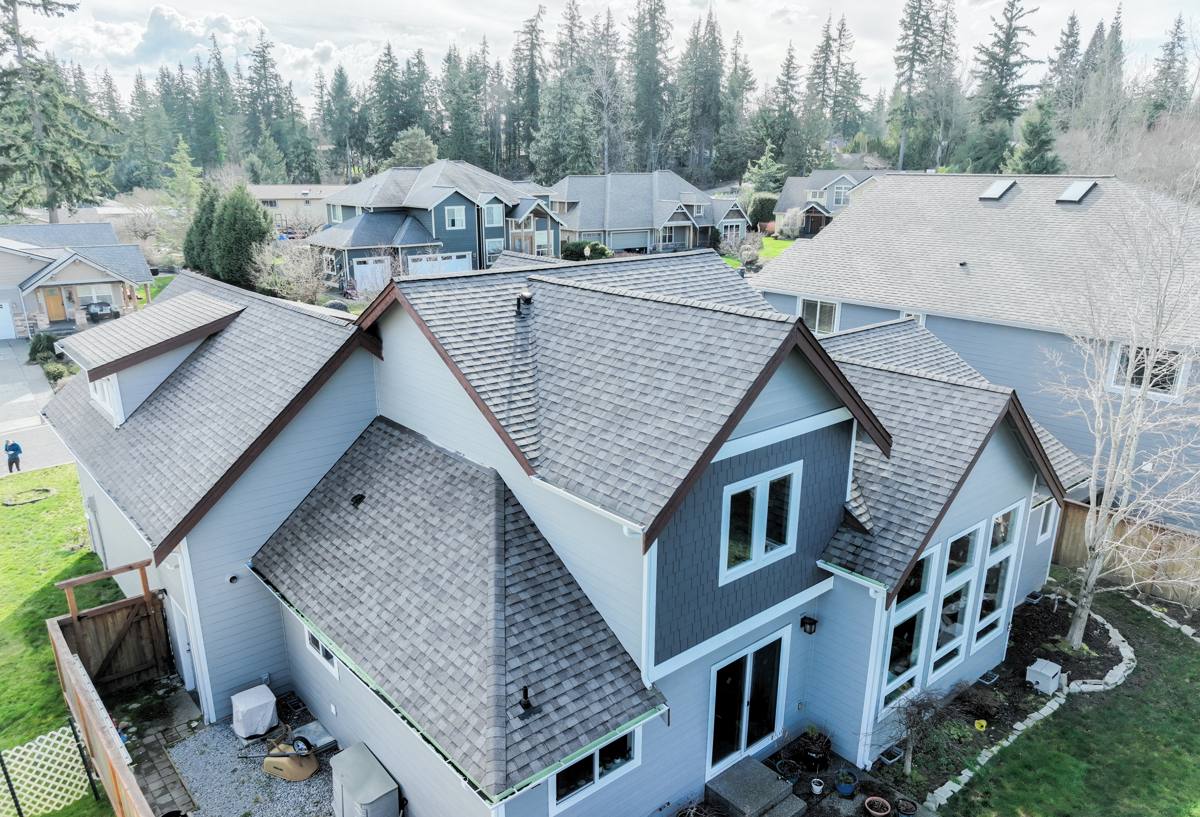
Why Fiber Cement Is the Right Call for This Area
Fiber cement is a mix of cement, sand, and cellulose fibers, engineered and pressed into planks or panels. Unlike vinyl, it doesn't expand and contract dramatically with temperature swings, so seams stay tighter over time. Unlike untreated wood products, it doesn't absorb water into its core, which means it resists the swelling and rot that drives so many siding failures in wet Pacific Northwest climates. And because it's non-combustible, it adds a layer of fire resistance that engineered wood siding simply can't match.
James Hardie backs this up with ColorPlus Technology — a factory-applied, baked-on finish that's far more consistent and durable than a field-applied paint job, and with HZ5 and HZ10 product engineering built specifically for climates like ours, where moisture exposure is the dominant stress on a building envelope. For a Sumas home, that combination — a stable substrate plus a factory finish designed for wet climates — is what actually holds up against the rain and moss cycle year after year.
What "Climate-Engineered" Actually Means
James Hardie's HZ5 products are engineered for regions with high moisture exposure and freeze-thaw cycling, which describes Whatcom County reasonably well — we don't get extreme cold, but we do get repeated wetting and drying, and occasional hard frosts. The board density, moisture resistance, and finish adhesion are all tuned for that pattern, rather than for a hot, dry climate where the main stress is UV and heat expansion.
What a Correct Fiber Cement Job Involves
Fiber cement siding is only as good as the installation behind it. Most of the siding failures we get called out to inspect in this region aren't material failures at all — they're installation shortcuts that let water get behind the siding and stay there. A correct job on a Sumas home includes several details that are easy to skip and expensive to fix later.
Drainage Plane and Rainscreen Gap
Fiber cement should never be installed tight against the weather-resistive barrier. A drainage plane — typically a furring strip system or a purpose-built rainscreen product — creates a gap that lets any water that does get behind the siding drain and dry out instead of sitting against the sheathing. In a climate with this much sustained rain, that gap is one of the single biggest factors in how long a siding job lasts.
Fastening and Joint Treatment
Fasteners need to be the corrosion-resistant type Hardie specifies, driven at the correct depth and location — over-driven or under-driven nails are a common source of premature failure. Butt joints and seams need to be treated with the right sealant and, ideally, minimized through smart panel layout, since every seam is a potential water entry point.
Flashing at Windows, Doors, and Penetrations
Every window, door, hose bib, light fixture, and vent penetrating the siding is a place water can get in if it's not flashed correctly. This is where generic installation crews cut the most corners, because it's slower work than just running boards across a flat wall. On a house exposed to Sumas's rain patterns, flashing quality is often the difference between siding that lasts thirty years and siding that needs repair in eight.
Factory Finish Integrity
Cut edges and job-site touch-ups need to be sealed with Hardie's approved touch-up products, not generic exterior paint. Every unsealed cut edge is a spot where the fiber cement can wick moisture, which undermines the whole point of using a factory-finished product in the first place.
How James Hardie Compares to Other Siding Options
We only install James Hardie, but homeowners deserve to understand why, especially when comparing quotes that include other materials. Here's an honest comparison based on how each material tends to perform in a wet, coastal-influenced climate like ours.
| Material | Moisture Behavior | Finish Durability | Fire Resistance |
|---|---|---|---|
| James Hardie fiber cement | Dimensionally stable, doesn't rot; performance depends on correct installation and flashing | Factory ColorPlus finish, long warranty on finish and product | Non-combustible |
| Vinyl siding | Doesn't rot, but can warp and gap; relies entirely on trapped moisture draining out from behind | Color is molded-in but can fade; can't be repainted easily without prep issues | Combustible, can melt or deform near heat sources |
| LP SmartSide / engineered wood | Wood-based core is more moisture-sensitive at cut edges and seams if maintenance lapses | Factory finish available, but wood substrate raises the stakes if water gets in | Combustible |
| Cedar / primed wood | Absorbs moisture readily; needs consistent repainting and sealing to avoid rot | Field-applied finish, shortest repaint cycle of the group | Combustible |
None of these are "bad" products in every scenario — vinyl has its place on a budget, and cedar has real aesthetic appeal for the right buyer. But for a house that's going to sit through decades of Whatcom County rain and moss seasons, fiber cement's combination of dimensional stability and factory-applied finish is why we standardized on it and stopped installing the alternatives.
Our Process for a Sumas Siding Project
- On-site inspection: We look at the existing siding, sheathing condition, moisture staining, and any rot or moss buildup before quoting anything.
- Product and color selection: We walk through Hardie's plank, panel, and shingle lines and ColorPlus color options based on the home's style and exposure.
- Tear-off and sheathing check: Old siding comes off and we inspect the sheathing underneath — this is often where hidden moisture damage from a prior installation shows up.
- Weather-resistive barrier and drainage plane: We install (or verify and repair) the water-resistive barrier and set up the rainscreen gap before any siding goes up.
- Installation to manufacturer spec: Fastening, joint spacing, and panel layout follow Hardie's published installation requirements, not shortcuts.
- Flashing and trim detail: Windows, doors, and penetrations get flashed and sealed before siding closes around them.
- Final walkthrough: We check touch-up work, caulking lines, and overall fit before calling the job done.
Signs Your Current Siding Needs Attention
- Soft or spongy spots when you press on siding, especially near the bottom courses
- Persistent moss or algae staining that comes back within a season of cleaning
- Visible gaps or buckling at seams and corners
- Peeling or bubbling paint, particularly on north- and west-facing walls
- Water stains or discoloration on interior walls near exterior corners
- Warping panels or boards that no longer sit flat against the wall
- Rising energy bills that suggest air and moisture are moving through gaps in the envelope
Any one of these on its own might be minor. Several together, especially on a home that's had the same siding for fifteen-plus years, usually means it's worth having someone take a real look rather than just cleaning the surface again.
What Affects the Cost of a Sumas Siding Project
| Factor | Why It Matters |
|---|---|
| Home size and wall complexity | More corners, gables, and dormers mean more cutting, flashing, and labor time |
| Current siding removal | Tear-off of old cedar, vinyl, or damaged material adds labor and disposal cost |
| Sheathing repair | Rot found during tear-off needs to be addressed before new siding goes on — this is not optional |
| Hardie product line chosen | Plank, shingle, and panel products, plus trim and accessory choices, vary in material cost |
| Color and finish selection | Standard ColorPlus colors versus custom or premium finishes affect price |
| Access and site conditions | Slopes, landscaping, and multi-story sections affect scaffolding and labor time |
We give honest, project-specific estimates after seeing the house — broad ballpark ranges without an inspection tend to be more misleading than helpful, especially once tear-off condition is factored in.
Maintenance Expectations After Installation
One of the real advantages of fiber cement in this climate is how little ongoing maintenance it needs compared to wood siding. There's no repainting cycle every few years — ColorPlus finishes are engineered to hold color far longer than field-applied paint. That said, "low maintenance" isn't "no maintenance." In a climate with a long moss season, we recommend an annual rinse-down of north-facing and shaded walls to keep organic growth from taking hold, and a periodic check of caulking at trim and penetrations, since sealant is the one component that does wear out over time regardless of the siding material behind it.
Why Hiring a Crew That Works This Area Matters
Installation quality is the single biggest variable in how long siding lasts, and installation quality depends heavily on whether the crew understands the specific weather pattern they're building against. A crew that mostly works drier climates may not think twice about drainage gaps or flashing sequencing, because in their normal conditions, minor gaps don't get tested by weeks of steady rain. In Sumas and the rest of Whatcom County, those same shortcuts get found out fast — usually a wet winter or two later, and usually behind the wall where it's expensive to fix.
We install James Hardie siding on homes throughout this region because we've seen firsthand what holds up and what doesn't against this specific combination of rain, moss, and salt air. That local pattern recognition — knowing which details actually matter here versus which ones are just checklist items elsewhere — is a big part of what separates a siding job that lasts thirty-plus years from one that needs attention again in under ten.
If you're weighing a siding replacement or repair in Sumas, we're happy to come take a look and give you a straightforward, no-pressure estimate — just fill out the form below to get started.