 Ferndale
 One Product, One Standard
Most siding contractors will install whatever a homeowner picks off a brochure. We don't. We install James Hardie fiber cement siding, and that's it. No vinyl, no LP SmartSide, no Cemplank or Allura fiber cement, no primed spruce, no cedar. That's a narrower menu than almost anyone else in Whatcom County offers, and we think that's worth explaining rather than just stating.
This isn't a marketing gimmick or a manufacturer kickback arrangement. It's the result of years of tear-offs, warranty claims, and callbacks on other products in a climate that does not forgive corner-cutting. Ferndale sits close enough to the Strait of Georgia and Bellingham Bay that salt-laden air is a real factor on exterior materials, and the Whatcom County weather pattern of driving rain followed by long damp, mossy stretches puts a specific kind of stress on siding that a lot of products simply aren't built to handle long-term.
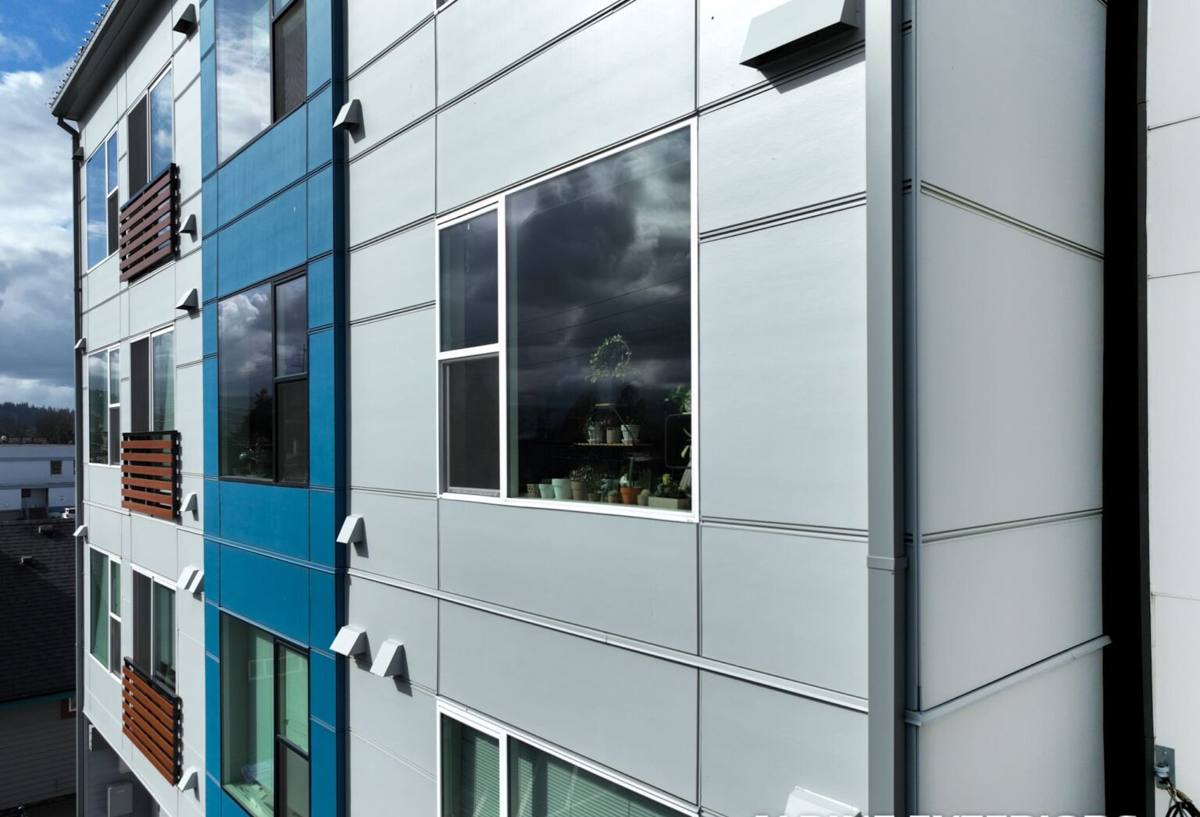
What the Salt Air and Moss Season Actually Do
Coastal exposure isn't just a "the paint fades faster" problem. Salt air accelerates corrosion on fasteners and trim metal, and it interacts with organic growth to hold moisture against a wall longer than inland homes ever deal with. Combine that with our wet season, which can run six or seven months of intermittent rain, fog, and shade-driven moss growth on north and west-facing walls, and you get siding that's rarely allowed to fully dry out between soakings.
Materials that rely on a factory or field-applied paint film to keep water out are working against that cycle from day one. Every hairline crack, every fastener hole, every place where caulking eventually shrinks becomes a spot where moisture gets a foothold. Wood-based products swell and check. Vinyl doesn't rot, but it doesn't stop moss and mildew from taking hold on its surface either, and it moves enough with temperature swings that seams open up over time. We got tired of watching this play out on siding we didn't install, and eventually tired of watching it happen on jobs where we'd installed something other than fiber cement because a customer requested it.
Why We Ruled Out the Alternatives
Vinyl Siding
Vinyl is inexpensive and low-maintenance in mild climates, and we're not going to pretend otherwise. The trade-offs that matter here: it's a petroleum-based product that becomes brittle in cold snaps and can warp or buckle near heat sources, its seams and J-channels give moisture a path behind the wall if not detailed perfectly, and it does nothing to resist wind-driven rain the way a rigid, properly flashed fiber cement assembly does. It also can't be painted a dark color without risking heat warping, which limits design options homeowners often want.
LP SmartSide
LP SmartSide is an engineered wood product with real strengths — it's lighter than fiber cement and easier to cut. But it's still wood at its core, treated with a zinc borate process to resist rot and insects. In a climate with our humidity and moss pressure, any breach in that treated layer or factory finish — a saw cut, a fastener, a scratch during install — creates a point where wood can start absorbing moisture. We've torn off SmartSide with swollen, delaminating edges at butt joints and corners in exactly the wall orientations that catch the most weather here.
Cemplank and Allura (Other Fiber Cement Brands)
These are legitimate fiber cement competitors to James Hardie, and the raw material science is similar. Where we see the gap is in the factory finish system, the regional engineering of the product lines, and the depth of installer training and warranty backing available through Hardie's network. We'd rather standardize on one system we know inside and out, with one warranty structure and one set of installation specs our crews have executed hundreds of times, than juggle multiple fiber cement lines with different install quirks.
Primed Spruce and Cedar
Real wood siding has genuine appeal — it's a classic look, and cedar in particular has natural rot resistance that outperforms other softwoods. But both require an ongoing maintenance commitment (repainting or restaining on a cycle, caulk inspection, moisture monitoring) that most homeowners underestimate when they sign the contract. In a climate where a wall can stay damp for days at a stretch during our wet months, that maintenance window shrinks and the cost of falling behind on it goes up. We stopped installing wood siding because too many customers didn't have the appetite for the upkeep it actually demands.
Why James Hardie Specifically
James Hardie fiber cement is a mix of cement, sand, and cellulose fiber, pressed and cured into a rigid board that is non-combustible and dimensionally stable — it doesn't expand and contract with moisture the way wood does, and it doesn't get brittle in cold or soft in heat the way vinyl can. That stability alone solves a lot of the failure points we see in other products.
On top of that, Hardie's ColorPlus factory finish is baked on under controlled conditions rather than field-applied, which gives it more consistent coverage and adhesion than a job-site paint job, and it comes with its own finish warranty separate from the product warranty. For a region where a fresh coat of field paint might not fully cure before the next rain rolls in, a factory finish is a meaningful advantage.
Hardie also engineers specific product lines for different climate zones — its HZ5 line is built for regions with freeze-thaw cycling and sustained moisture exposure, which fits the Pacific Northwest better than a generic national product. That's not a marketing category; it changes the moisture-resistance formulation of the board itself.
Comparing the Options We Considered
| Material | Moisture Behavior in Our Climate | Maintenance Burden | Why We Don't Install It |
|---|---|---|---|
| Vinyl | Seams and channels can let moisture behind the wall; doesn't resist wind-driven rain well | Low, but cleaning moss/mildew off the surface is ongoing | Brittle in cold, limited dark-color options, seam vulnerability |
| LP SmartSide | Engineered wood core can absorb moisture at cuts, fasteners, and joints | Moderate — finish inspection and caulk maintenance | Wood core still vulnerable once the treated layer is breached |
| Cemplank / Allura | Similar fiber cement performance to Hardie | Low to moderate | We standardize on one system, one warranty, one install spec |
| Primed Spruce / Cedar | Absorbs moisture readily; needs to dry out between rain events | High — repainting/restaining cycle required | Maintenance demand doesn't match our wet-season reality |
| James Hardie Fiber Cement | Non-combustible, dimensionally stable, engineered for regional moisture exposure | Low — factory finish, occasional wash-down | What we install |
What Correct Installation Actually Involves
Fiber cement's reputation depends heavily on how it's installed, and this is where a lot of the horror stories about "bad siding" actually come from — bad installation, not a bad product. Hardie publishes detailed installation specs, and deviating from them is what causes premature failures.
- Proper clearance from grade, decks, patios, and roof lines so the board never sits in standing water or snow
- A correctly detailed weather-resistive barrier and rain screen gap behind the siding, especially important given how much rain this area sees
- Fastener placement and type matched to Hardie's spec, not generic nails or screws
- Properly caulked and sealed butt joints, corners, and penetrations (vents, hose bibs, light fixtures)
- Correct overlap and flashing at window and door trim to shed water outward, not behind the wall
- Factory-cut edges primed or sealed wherever field cuts expose raw material
When these details are followed, Hardie siding performs for decades in exactly the conditions Ferndale sees every winter. When they're skipped to save labor time, the product gets blamed for problems that installation caused.
The Honest Cost Conversation
James Hardie costs more upfront than vinyl and often more than engineered wood. We won't pretend otherwise, and any contractor who tells you it's the cheapest option is not being straight with you. The honest case for it is a lifecycle one: fewer repaint cycles, a factory finish warranty, resistance to the moisture and moss pressure that shortens the life of other products here, and a transferable warranty that matters if you sell the home. For a lot of homeowners, that math works out in Hardie's favor over a 20 to 30 year window, even with the higher install cost. For a homeowner planning to sell in a year or two, the calculation is different, and we'll say so plainly if asked.
Where This Leaves You as a Homeowner
You don't have to agree with our standard, and plenty of good contractors in Whatcom County install other products competently. What we'd ask is that you go in with clear eyes about what each material actually asks of you — the maintenance, the moisture tolerance, the realistic lifespan in a coastal, rainy climate — rather than just comparing sticker prices. If James Hardie is the direction you're leaning, we can walk you through the specific product line, color options, and what installation would look like on your home.
If you'd like a straightforward, no-pressure estimate on a James Hardie siding project in Ferndale or anywhere in Whatcom County, the form below gets you a real conversation, not a sales pitch.