 Ferndale
 Why Blaine Homes Need Siding Built for This Exact Climate
Blaine sits about as close to the water and the weather as a Whatcom County town gets. Homes here take on salt-laden air off the strait, wind-driven rain that hits walls at an angle instead of just falling straight down, and a shaded, damp season that runs long enough to grow moss on siding that never fully dries out between storms. None of those conditions are unusual on their own, but stacked together year after year, they're hard on a wall assembly that wasn't built with them in mind.
That's the reason this page exists as its own topic rather than folding into a general siding page. Fiber cement siding services in Blaine aren't just "siding installation, but near the water" — the material choice, the fastening hardware, the flashing detailing, and the maintenance expectations all shift once you're working this close to the Salish Sea.
Salt Air and Corrosion
Airborne salt accelerates corrosion on anything metal — nail heads, flashing, trim fasteners, hose bib penetrations. On a home a few blocks from the water, uncoated or poorly matched hardware can start showing rust bleed through paint or caulk well before the siding itself shows any wear. It's a slow problem, which is exactly why it gets missed: nobody notices a fastener corroding under a bead of caulk until the stain shows up on the face of the wall.
Wind-Driven Rain Off the Strait
Rain that comes in sideways behaves differently than rain that falls straight down. It gets pushed under laps, into seams, and behind trim that would stay dry in a calmer climate. Siding systems and flashing details that are adequate in a sheltered inland yard can be marginal on an exposed Blaine lot, particularly on gable ends and upper stories that catch the brunt of it.
A Long, Shaded Moss Season
North-facing walls, sections shaded by mature trees or neighboring structures, and anywhere airflow is blocked stay damp longer here than they would in a drier part of the state. Moss and mildew don't just look bad — sustained moisture against a wall surface is exactly the condition that finds any weak point in the water-resistive barrier or flashing underneath it.
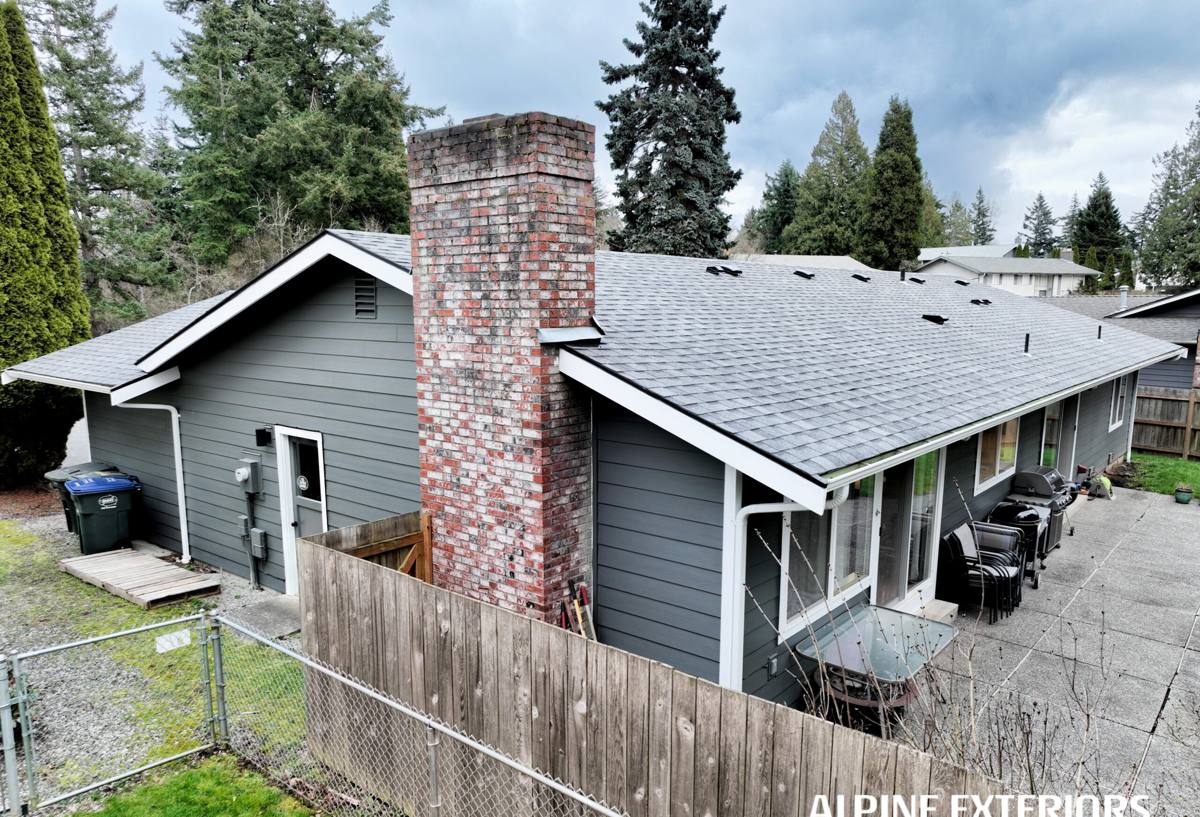
Why Fiber Cement Is the Material We Put on Blaine Homes
Fiber cement is a mix of cement, sand, and cellulose fibers, pressed and cured into a dense, dimensionally stable board. It doesn't expand and contract with moisture the way wood-based products do, it's non-combustible, and it holds paint and factory finishes far longer than wood-fiber siding does. James Hardie, the manufacturer we install exclusively, also builds engineered product lines for specific climate zones — including formulations aimed at wetter, more humid regions like ours — rather than shipping one generic board everywhere in the country.
We don't install LP SmartSide, vinyl, or other fiber cement brands, and that's a deliberate standard, not an oversight. Wood-fiber composite products depend on an intact factory coating to keep moisture out of a wood-based core; once that coating is compromised at a cut edge or a fastener hole, the core is vulnerable in exactly the wet conditions Blaine sees for months at a stretch. Vinyl is lightweight and affordable but distorts with temperature swings and offers little rigidity against wind-driven rain and gusts off the water. Fiber cement's cement-based core doesn't have that vulnerability, and one product line, installed correctly and consistently, is something our crews know inside and out.
Factory-Applied ColorPlus Finish vs Field-Painted Siding
James Hardie's ColorPlus finish is baked on at the factory under controlled conditions, which gives it more consistent coverage and better fade and moisture resistance than a coat of paint applied on-site after installation. It also comes backed by its own warranty, separate from the substrate warranty. Field-painted siding depends entirely on weather conditions at the time of painting and the quality of that specific application — a bigger variable in a region where dry painting windows aren't guaranteed.
What a Correct Fiber Cement Install Looks Like on a Blaine Home
Fiber cement is only as good as the assembly it's installed into. The board itself resists moisture well, but a wall system fails at its weak points — laps, penetrations, and fastener locations — not usually across a flat, uninterrupted panel face. In a climate like this one, those details aren't optional refinements; they're the difference between siding that lasts decades and siding that develops hidden problems in five to ten years.
Drainage Gap and the Water-Resistive Barrier
Correct installation starts with a continuous water-resistive barrier over the sheathing, lapped and taped so water sheds outward and down rather than working its way behind the barrier. Behind the siding itself, a drainage gap gives any moisture that does get past the face material a path to drain and evaporate instead of sitting against the sheathing. On a home exposed to steady wind-driven rain, skipping or shortcutting this layer is one of the most common causes of hidden rot that doesn't surface until years later.
Fasteners, Clearances, and Flashing Sequencing
We use fastener hardware appropriate for coastal exposure rather than whatever's cheapest, and we follow manufacturer-specified nailing patterns and clearances — proper gaps at grade, roof lines, and decks so siding isn't sitting in standing water or trapped moisture. Flashing at windows, doors, and any wall penetration has to be sequenced correctly — installed in the right layering order relative to the water-resistive barrier — so water is always directed out and down, never trapped behind trim or funneled into a seam.
Cutting, Sealing, and Field Painting Where Needed
Cut edges and any field-applied touch-up need to be sealed per manufacturer specification, since a raw cut edge is the one place ColorPlus's factory protection isn't already present. Joints and butt seams get treated with the correct sealant, not a generic caulk, and expansion gaps are respected rather than caulked shut, which can trap moisture instead of letting the assembly move and drain as designed.
Our Process for a Blaine Fiber Cement Siding Project
The steps below are consistent regardless of home size, but the specifics — how much tear-off, how many penetrations need re-flashing, whether hidden sheathing repair is needed — only become clear once we're on-site.
| Step | What Happens |
|---|---|
| Walkthrough & assessment | In-person look at the home's size, existing siding condition, shaded or moss-prone walls, and any visible moisture damage |
| Written scope | Clear breakdown of tear-off vs. overlay, material and product line, trim details, and a contingency plan if hidden damage is found |
| Tear-off & inspection | Old siding removed, sheathing and framing inspected and repaired where needed before anything new goes on |
| Water-resistive barrier & drainage gap | New barrier installed and taped, drainage gap set per manufacturer spec |
| Fiber cement installation | Panels or lap siding installed with correct fastener hardware, clearances, and flashing sequencing at every penetration |
| Trim, caulk & touch-up | Cut edges sealed, joints treated correctly, trim finished |
| Final walkthrough & warranty registration | Walk the finished job together, register the manufacturer warranty in your name |
James Hardie Product Lines That Fit Blaine's Coastal Conditions
James Hardie makes several product lines, and which one fits a given home depends on the architectural style, exposure, and the look the homeowner wants. We'll walk through the options during the estimate rather than defaulting to one product for every home.
| Product Line | Typical Use | Why It Fits Here |
|---|---|---|
| HardiePlank lap siding | Traditional horizontal lap look, most common residential choice | Wide range of profiles and ColorPlus finishes; engineered HZ formulations suited to wetter climates |
| HardiePanel vertical siding | Board-and-batten and modern vertical styling | Clean lines with fewer horizontal laps for water to catch on |
| HardieShingle siding | Cottage or shingle-style accents and gable detailing | Non-combustible alternative to cedar shingle look without the ongoing maintenance |
| HardieTrim boards | Window, door, corner, and fascia trim | Matches the siding's durability so trim doesn't become the weak point in the system |
Signs Existing Siding in Blaine Is Already Struggling
If you're not sure whether your current siding needs attention, a few warning signs are worth checking for before they turn into a larger repair:
- Soft or spongy spots when you press on the siding, especially near the bottom courses or below windows
- Visible moss, algae, or dark staining that keeps coming back after cleaning
- Panels or boards that look warped, buckled, or separated from the wall
- Cracked, shrunken, or missing caulk at joints, corners, and window trim
- Peeling or bubbling paint, particularly on wood or engineered wood siding
- Rust streaks running down from fastener heads or metal trim
- Gaps opening up at trim boards or corner boards that weren't there a year or two ago
Any one of these on its own might just mean routine maintenance. Several of them together, especially on a shaded or water-facing wall, usually means moisture has been finding its way in for a while.
Maintaining Fiber Cement Siding in a Marine Climate
Fiber cement asks for less upkeep than wood or engineered wood siding, but "low maintenance" doesn't mean "no maintenance," especially in a climate that grows moss as readily as this one does. A yearly rinse-down to clear pollen, salt residue, and early moss growth keeps the ColorPlus finish looking right and prevents organic growth from getting a foothold. Keeping gutters clear and downspouts directing water away from the foundation matters just as much as the siding itself — a lot of what looks like a siding problem actually starts with water management around the home. It's also worth doing a quick visual check of caulk lines and trim joints once a year, since those are the spots most likely to need attention long before the siding panels do.
Why It Matters to Hire a Crew That Already Works Blaine
A crew that mainly works drier, inland projects doesn't build the same instincts as one that installs siding on exposed, water-facing homes on a regular basis. Knowing which walls in this town tend to hold moisture longer, which fastener hardware actually holds up against salt air over time, and how aggressively to detail flashing on a gable that catches wind off the strait isn't something you learn from a manufacturer's install manual alone — it comes from doing this specific kind of job, in this specific place, repeatedly. That's the practical argument for hiring locally familiar installers rather than the cheapest bid from a crew that mostly works somewhere drier and calmer.
If you're weighing a siding project in Blaine and want a straight answer about what your home actually needs, we're glad to walk the property with you, point out anything we see, and explain the reasoning behind our recommendation. Reach out below for a free, no-pressure estimate.