 Ferndale
 Cordata's Climate Puts Real Stress on a Deck
Homes in and around Cordata deal with a specific combination of weather that's harder on outdoor structures than most people realize. You've got long stretches of driving rain in fall and winter, salt-laden air drifting in off the Sound, and a moss and algae season that can run eight months or more out of the year. None of that is dramatic on its own, but stacked together year after year, it's exactly the kind of slow, steady exposure that finds every weak point in a deck — the fastener that wasn't quite right, the board that wasn't ventilated underneath, the ledger connection that trapped water instead of shedding it.
Composite decking exists specifically to handle this kind of environment better than wood does, but "composite" isn't a single product with one set of properties. Board quality, core construction, and how a deck is actually built underneath it all vary a lot — and in this climate, those differences show up faster than they would somewhere dry. A deck built for a Whatcom County winter needs to be evaluated differently than one built for a mild, dry climate spec sheet.
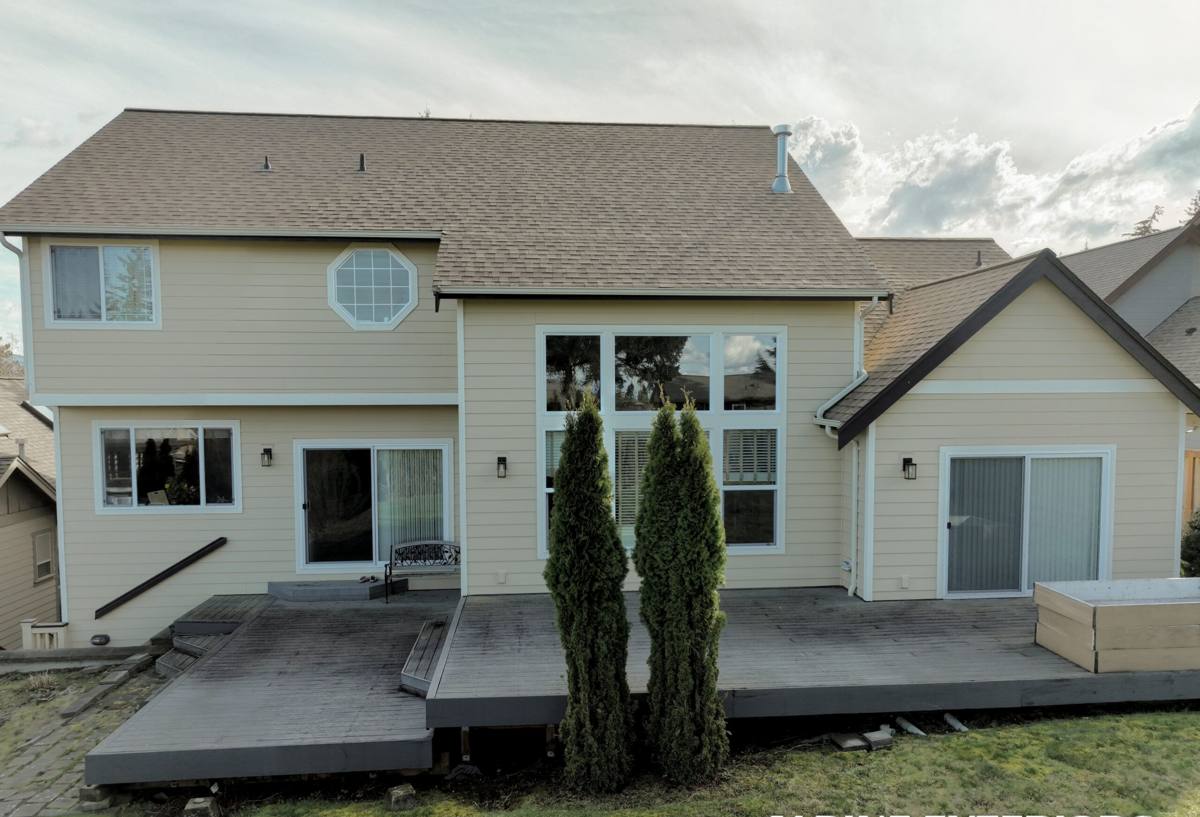
What "Correct" Composite Decking Looks Like Here
A correctly installed composite deck in this area isn't just about which board you pick. It's a system — board, fasteners, substructure, and drainage all working together to move water off and away from the structure quickly, and to keep salt-laden moisture from sitting against any single point long enough to cause a problem.
A few things matter more here than they would in a drier climate:
- Board spacing that accounts for wet-season swelling, not just dry-day fit
- Hidden fastener systems rated for coastal or high-moisture use, not generic interior-grade hardware
- Joist tape or another moisture barrier on every framing member, not just the ones that look exposed
- Airflow underneath the deck so moss and algae don't get a permanently damp surface to colonize
- Flashing at the house connection that actually sheds water away from the ledger board, every time, not just when it's raining lightly
Skip any one of those and the deck will probably still look fine for a year or two. The problems that show up in this climate are almost always slow ones — moisture getting trapped somewhere it shouldn't be, not a single dramatic failure.
Why Moss Season Matters More Than People Expect
Moss and algae growth on decking isn't just a cosmetic nuisance. A deck surface that stays damp and shaded for long stretches becomes a growth surface, and that growth holds moisture against the board and makes the surface genuinely slick underfoot — a real slip hazard on stairs and transitions, not just an eyesore. Board texture, color, and how much direct sun a deck gets all affect how bad this is in practice, which is part of why board selection should be a conversation about your specific site, not a one-size answer.
Composite Board Options for This Climate
There isn't one "best" composite board — there are trade-offs, and the right call depends on your budget, how much direct weather exposure the deck gets, and how much upkeep you want to do. Here's how the main categories generally compare for a wet, salt-air, moss-prone environment like Cordata's:
| Board Type | Moisture Behavior | Maintenance | Typical Trade-off |
|---|---|---|---|
| Capped composite (full wrap) | Best resistance to moisture absorption and staining | Occasional wash-down | Higher upfront cost |
| Capped composite (top-only) | Good on the walking surface, more exposure risk at cut edges | Low, but edge sealing matters | Mid-range cost, needs careful edge detailing at cuts |
| Uncapped composite | More prone to moisture absorption and mold in a wet climate | Higher — more frequent cleaning | Lower cost, shorter realistic service life here |
| PVC decking | Doesn't absorb moisture; very stable in wet conditions | Low | Different look/feel than wood-composite blends; higher cost |
For a project in this specific climate, we generally steer homeowners toward fully capped boards for anything with real weather exposure, and we're upfront when a lower-tier product isn't going to hold up the way a homeowner expects it to over a Whatcom County decade. That's a standard we hold to on our own installs, not a judgment on any single manufacturer's whole product line — most composite brands make a range of tiers, and the tier matters as much as the brand name on the box.
The Substructure Is What Actually Determines Lifespan
Homeowners tend to focus on the decking boards because that's what they see and touch. But in this climate, the framing underneath is what actually determines how long the deck lasts and how it holds up structurally. Composite boards are largely immune to rot — the wood or wood-alternative framing underneath them is not, unless it's protected correctly.
That means:
- Pressure-treated or composite substructure material rated for ground contact where it's close to grade
- Proper joist spacing for the specific board being installed — composite boards have span ratings that vary by brand and profile, and undersized spacing leads to flex and premature wear
- Post bases and hardware that don't trap water against the wood, especially at ground level where splash-back and standing moisture are worst
- A ledger connection to the house that's flashed correctly — this is one of the single most common failure points we find on older decks in this region, composite or wood
We've seen decks where the visible composite surface still looks nearly new while the framing underneath has been quietly deteriorating for years because it was never protected properly during the original build. Getting the substructure right the first time is the difference between a deck that needs board replacement in twenty years versus one that needs to be rebuilt from the ground up.
How We Approach a Cordata Composite Decking Project
Every property is a little different, but the general sequence looks like this:
- On-site assessment — we look at sun exposure, drainage patterns, grade, and how the deck will tie into the house, since all of that affects both board choice and framing decisions.
- Board and layout selection — we walk through the trade-offs above in plain terms, based on your budget and how much sun or shade the deck will actually get.
- Substructure build or repair — framing, flashing, and moisture barriers go in before a single composite board is placed. This is the stage that determines long-term performance and it's not one we shortcut.
- Deck installation — hidden or approved fastener systems, correct spacing for wet-season expansion, and attention to every cut edge and transition.
- Final walkthrough — we go over basic care with you before we consider the job done, so you know what routine maintenance actually looks like for the specific product installed.
We don't treat the framing stage as a formality on the way to the "real" job of laying boards. In this climate, it's arguably the more important half of the work.
Keeping a Composite Deck Looking Good Through Whatcom County Winters
Composite decking is lower-maintenance than wood, but "low-maintenance" doesn't mean "no maintenance," especially with the moss and moisture pressure this area sees. A short seasonal routine keeps a well-built deck performing the way it should:
- Sweep off standing leaves and debris regularly through fall — trapped organic matter is what feeds moss and algae growth
- Do a soft-wash cleaning at least once or twice a year, more often on shaded sections that don't get much direct sun
- Check that gaps between boards stay clear so water can drain through rather than pooling on the surface
- Look underneath the deck once a year for any signs of standing water, debris buildup, or damage to flashing at the house connection
- Avoid pressure-washing at close range or high PSI on composite boards — it can damage the surface cap on some products
None of this is heavy work, but skipping it entirely in a climate like this is how a deck that should look good for decades starts looking tired after five or six years.
Cost Factors to Expect
Composite decking costs vary a lot based on board tier, deck size, structural complexity, and site conditions, so we won't quote a number without seeing the actual project. But the factors that move the price are consistent:
| Factor | Why It Affects Cost |
|---|---|
| Board tier (uncapped vs. capped vs. PVC) | Material cost per square foot varies significantly by product line |
| Deck height and railing requirements | Taller decks need more substructure and code-required railing work |
| Existing structure condition | Rebuilding a failed substructure costs more than building fresh on solid footings |
| Site access and grade | Sloped or hard-to-access lots take more labor to frame and level correctly |
| Layout complexity | Multiple levels, angles, or built-in features add both material and labor time |
We'd rather walk your specific property and give you a real number than throw out a broad range that doesn't mean much once you're standing on the actual site.
Why Local Experience in Cordata Matters
A composite deck built to a generic spec sheet and one built for this specific climate can look identical on installation day and perform very differently five years later. A crew that already works in and around Ferndale and greater Whatcom County has seen how the salt air, the rain patterns, and the moss season actually play out on real decks over time — which board tiers hold up, which fastener systems corrode faster near the water, and where flashing tends to fail on this region's typical home construction.
That experience shows up in the decisions that don't make it onto a sales brochure: how joists get spaced for this specific climate's board expansion, where extra flashing gets added even when it's not strictly required, and which corners never get cut because we've seen what happens when they are. It's the difference between a deck that's built to pass inspection and one that's built to actually last here.
If you're planning a new composite deck in Cordata or looking to replace an aging one, we're happy to come take a look and walk you through what we'd actually recommend for your property — no pressure, no obligation. Use the form below to request a free estimate.