 Ferndale
 Windows in Custer Take a Different Kind of Beating
Custer sits in the part of Whatcom County where salt-tinged air off the Strait of Georgia and Puget Sound mixes with long, wet winters and a moss season that can stretch from fall through spring. That combination is hard on a lot of building materials, but windows feel it first because they're full of seams, seals, and moving parts. Salt air accelerates corrosion on hardware and fasteners. Driving rain finds any weak point in flashing or sealant and pushes water sideways, not just down. And the same damp, shaded conditions that grow moss on a roof also keep window sills and lower sashes wet longer than they should be, which is exactly what wood rot and failed seals need to take hold.
None of this means Custer homes need exotic windows. It means the installation has to be done correctly, with the right materials in the right places, by someone who has actually dealt with these conditions before rather than someone applying a one-size-fits-all approach from a drier part of the state.
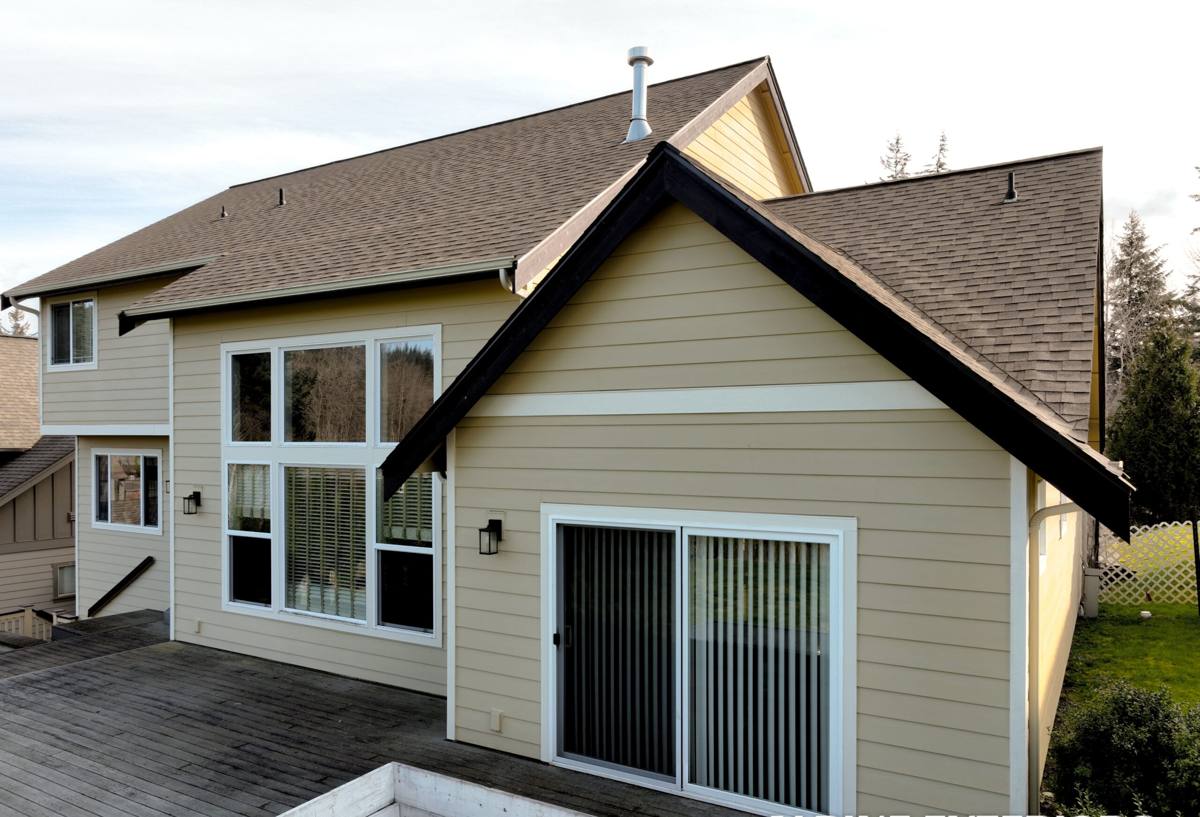
Signs a Custer Home's Windows Are Due
Most homeowners don't wake up one day and decide to replace windows — they notice small problems that add up. In this climate, watch for:
- Fogging or a permanent haze between panes (the seal on the insulated glass unit has failed)
- Soft or spongy wood at the sill or lower corners of the frame
- Windows that are hard to open, close, or lock — often a sign the frame has shifted or swollen
- Visible gaps between the frame and siding, or caulk that's cracked and pulling away
- A cold draft near the window even when it's fully latched
- Condensation forming on the inside of the glass regularly through the wetter months
- Musty smell near a window that doesn't go away with cleaning
Any one of these on its own might just need a repair. Several together, especially on the weather-facing side of the house, usually mean the windows are past the point where patching makes sense.
What a Correct Window Replacement Job Actually Involves
Swapping the glass unit itself is the easy part. The work that determines whether a window lasts 20 years or leaks in 3 happens around it.
Removing the Old Window Without Making Things Worse
Old caulk and flashing get stripped back, not just covered over. If there's hidden rot in the framing, it needs to be found and addressed before a new window goes in — installing a new unit against a compromised opening just hides the problem for a while.
Flashing and Water Management
This is the step that matters most in a driving-rain climate. Proper flashing directs any water that gets behind the siding back out, rather than letting it pool at the sill or work its way into the wall cavity. A window can be top-quality and still fail early if the flashing detail underneath it is wrong.
Sealing and Insulation
Gaps around the frame get filled with the right materials — not just a bead of caulk on the exterior face, but backer rod and low-expansion foam in the cavity where appropriate, plus a proper exterior sealant designed to move with temperature and humidity swings instead of cracking.
Fastening and Squaring
A window that isn't shimmed level and square will bind, won't lock properly, and puts uneven stress on the seals over time. This is a slow, careful step that's easy to rush and easy to notice later when it's done wrong.
Window Materials That Hold Up in This Climate
There's no single "correct" material for every home — it depends on the house, the budget, and how exposed the window is to weather. Here's how the common options generally compare for a Custer-area property:
| Material | How it handles salt air & moisture | Maintenance | Typical trade-offs |
|---|---|---|---|
| Vinyl | Won't rust or rot; performs consistently in damp, salty air | Low — occasional cleaning | Frame color/size options more limited than wood or fiberglass |
| Fiberglass | Very stable in temperature and moisture swings; strong resistance to warping | Low | Higher upfront cost than vinyl |
| Wood (clad exterior) | Good if the exterior cladding and flashing details are done right; interior wood gives a different look | Higher — exterior clad reduces but doesn't eliminate upkeep | More installation-sensitive; a weak seal or flashing detail shows up faster |
| Aluminum | Prone to corrosion in salt-air environments over time unless well-finished | Moderate to high | Better thermal breaks needed for this climate; conducts cold |
For most homes in this area we lean toward vinyl or fiberglass for the exterior-exposed elevations because they hold up with the least fuss in salt air and constant damp. Where a homeowner wants a wood-look interior, a clad option can still work well — it just puts more weight on getting the exterior detailing right the first time, since that's where moisture problems start.
Glass Packages Worth Discussing
Beyond the frame material, the glass package affects comfort and condensation control through a wet Whatcom County winter. Double-pane with a Low-E coating and argon fill is the common baseline; triple-pane adds further insulation value and can help reduce interior condensation on the coldest, dampest days, at added cost. Which makes sense depends on the specific room, orientation, and budget — worth a real conversation rather than a default upgrade.
Our Process, Start to Finish
- On-site assessment — we look at the actual condition of the existing windows, framing, and surrounding siding, not just the glass.
- Straightforward estimate — options and pricing explained in plain terms, including why we'd recommend one material or glass package over another for that specific window.
- Scheduling around weather — we plan installs to minimize how long an opening sits exposed, which matters more here than in drier regions.
- Removal and inspection — old units come out carefully so we can check the framing underneath before anything new goes in.
- Correct flashing, sealing, and setting — the steps described above, done in order, not shortcut.
- Interior and exterior finish work — trim, caulking lines, and cleanup so the finished job looks right from both sides.
- Final walkthrough — every window opens, closes, and locks the way it should before we call it done.
Why a Crew That Already Works Custer Matters
A lot of window problems in this part of Whatcom County trace back to installation choices that would be perfectly fine somewhere drier — a flashing detail skipped, a sealant not rated for constant damp exposure, a wood window installed without enough attention to the exterior weather barrier. A crew that regularly works Custer and the surrounding Ferndale area has already seen which shortcuts cause callbacks here and builds around them from the start.
There's also a practical side: local scheduling means a shorter wait for an estimate, faster response if something needs a follow-up look, and a contractor who's realistic about how the region's rain patterns affect install timing — rather than promising a schedule that doesn't account for a soggy stretch of weather.
What Window Replacement Typically Costs
Pricing depends on window size, material, glass package, and how much (if any) hidden repair the opening needs once the old window comes out. As a general guide:
| Cost factor | Why it moves the price |
|---|---|
| Frame material | Vinyl is generally the most budget-friendly; fiberglass and clad-wood cost more |
| Glass package | Triple-pane and specialty coatings add cost over standard double-pane Low-E |
| Window size and type | Larger units, custom shapes, or sliders/casements versus standard double-hung all affect price |
| Hidden repair needs | Rot or damage found in the framing once the old window is out adds labor and material |
| Number of windows | Doing a whole elevation or the whole house at once is typically more cost-efficient per window than one-off replacements |
We don't quote a number without seeing the actual windows and framing — anyone who does is guessing, and in a climate where hidden rot is common, that guess can be wrong in either direction.
Questions Worth Asking Before You Hire Anyone
- Do you carry current liability insurance and, if required, bonding — and can you show proof?
- Will you inspect the framing after removal before installing the new window, or is that assumed to be fine?
- What specific flashing and sealing method do you use, and why?
- Do you work in this area regularly, or is this a one-off job for you?
- What's covered under warranty — labor, materials, or both — and for how long?
- How do you handle scheduling around wet weather?
A contractor who answers these clearly and specifically, without hedging, is generally one who's done the work enough times to know exactly how they do it.
Ready for a Straight Answer on Your Windows?
If your Custer-area home has windows that are fogging, sticking, drafting, or showing soft spots at the sill, it's worth having someone look before those problems spread into the surrounding wall. We offer free, no-pressure estimates — use the form below to get a real assessment of what your windows need and what it would take to fix it right.