 Ferndale
 Building a Deck That Can Actually Handle Sandy Point
Sandy Point sits close enough to the water that every deck built there is really being built for two things at once: the people who'll use it, and the weather that's going to try to take it apart. Salt-laden air, wind-driven rain coming off the Strait, and a moss season that can stretch from October well into spring all put more stress on an outdoor structure here than a deck would see even a few miles inland in Ferndale. None of that means a deck can't last for decades in Sandy Point. It means the material choices, fastener choices, and drainage details have to be right the first time, because the ocean air doesn't give a poorly built deck much grace period.
We build and repair decks throughout Whatcom County, but Sandy Point homes get treated as their own category. A deck spec that's perfectly fine in Bellingham's Fairhaven neighborhood or out past the Guide Meridian can fail early on a waterfront lot here if it's not adjusted for the exposure.
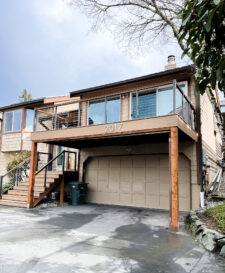
What Salt Air and Coastal Exposure Actually Do to a Deck
Salt air isn't just "extra moisture." Airborne salt accelerates corrosion on anything metal, and it does it faster than plain rain does. On a deck, that shows up first in the small stuff — nail heads bleeding rust streaks down decking boards, screw heads seizing or snapping when you try to remove them years later, joist hangers pitting and weakening from the inside where you can't see it.
Fasteners and Hardware
This is the single biggest place we see corners cut on older Sandy Point decks. Standard galvanized fasteners are rated for general outdoor use, not for sustained salt exposure, and they visibly degrade faster on waterfront lots than the same fastener would inland. We spec stainless steel or heavy-duty coated fasteners rated for coastal and treated-lumber use on every Sandy Point deck, along with corrosion-resistant joist hangers and post bases. It costs more up front. It's a fraction of the cost of replacing a deck's structural connections in twelve years instead of thirty.
Wood Movement and Salt Cycling
Wood decking on a salt-exposed site goes through more aggressive wet-dry cycling than it would elsewhere — salt in the air draws moisture into the wood fibers, then the wood dries out between rain events, and that repeated swelling and shrinking is what drives cupping, checking, and early fastener pull-through. It's not that wood can't be used near the water; it's that the finish schedule and fastening method both need to account for that cycling from day one.
Framing and Structure: Getting the Bones Right
The part of a deck nobody sees is the part that determines whether it's still safe in year twenty. On a coastal build we pay particular attention to:
- Ledger board flashing — where the deck attaches to the house is the single most common source of hidden rot on decks in wet climates, coastal or not
- Footing depth and drainage — Whatcom County's frost depth and this area's saturated soils both factor into footing design
- Joist protection — joist tape or an equivalent barrier on top of every joist, so fastener penetrations don't become entry points for moisture
- Post-to-beam and beam-to-footing connections using corrosion-resistant hardware, not just at the visible railing posts
A deck can look finished and beautiful while having a ledger connection that's already rotting behind the siding. That's why we treat the framing inspection as seriously as the decking material choice — arguably more so, since decking is replaceable and a compromised structure isn't something you want to find out about the hard way.
Choosing a Decking Material for a Sandy Point Home
There's no single right answer here — it depends on how much upkeep you want to do, your budget, and how close your lot actually sits to open water and wind exposure. Here's how the common options actually compare under this area's conditions:
| Material | Salt Air Behavior | Moss/Algae Resistance | Maintenance | Typical Lifespan Here |
|---|---|---|---|---|
| Pressure-treated wood | Handles it fine if fastened correctly; hardware is the weak point | Needs regular cleaning and periodic sealing | Annual cleaning, re-sealing every 2-3 years | 15-25 years with upkeep |
| Cedar | Naturally decay-resistant, but surface grays and weathers faster near salt air | Still needs cleaning; grain can hold moss spores if shaded | Sealing/staining every 1-3 years to hold color and protect fibers | 15-20 years |
| Composite decking | Doesn't absorb moisture the way wood does; hardware still needs to be corrosion-rated | Resists moss better than wood, but still needs washing in shaded, damp spots | Periodic washing; no staining or sealing | 25-30+ years |
| PVC/capped decking | Best moisture resistance of the common options | Best moss resistance; smooth cap sheds spores more easily | Washing only | 25-30+ years |
We're not going to tell you composite or PVC is "better" in some absolute sense — plenty of Sandy Point homeowners want real wood underfoot and are willing to do the maintenance for it. What we will say honestly: if you want the lowest-maintenance option for a salt-exposed, moss-prone site, capped composite or PVC decking with corrosion-rated hardware is the combination that asks the least of you year over year.
Designing Around Moss and a Long Wet Season
Moss doesn't grow on a deck because the material is "bad" — it grows wherever moisture sits and doesn't get enough light or airflow to dry out. In Sandy Point's wet season, that's often the shaded side of the deck, the area under furniture that never moves, and any spot where boards were installed tight with no drainage gap.
Board Spacing and Airflow
Proper gapping between boards, and between the decking and any adjacent wall or planter, lets water actually drain through instead of pooling on the surface. On multi-level or covered decks, we also look at how air moves underneath — a deck that's fully skirted with no ventilation traps moisture against the framing and speeds up both rot and moss growth.
Substructure Drainage
Where grading allows, we slope the ground beneath a low deck away from the house and framing, and avoid designs that create a bathtub effect where water collects under the structure with nowhere to go. This matters more here than in drier parts of the state simply because of how many wet months the substructure has to deal with each year.
Railings and Hardware Details That Get Overlooked
Railing posts and their connections take a beating on coastal decks because they're often the tallest, most wind-exposed part of the structure. We use stainless or coated structural screws and post connectors rated for the same exposure as the rest of the frame, and we pay attention to how railing posts are through-bolted rather than just screwed to the rim joist — a detail that affects both long-term safety and how well the railing holds up to salt-driven corrosion at the connection points.
Permits and Local Requirements
Deck permitting in unincorporated Whatcom County (which is where Sandy Point falls) and within Ferndale city limits follow different review paths, and waterfront or near-shoreline properties can carry additional setback or shoreline management considerations depending on the parcel. We handle the permit application and any required inspections as part of the project, and we'll tell you upfront if your specific lot needs anything beyond a standard building permit — we'd rather flag that early than have it surface as a surprise partway through the build.
Our Process for a Sandy Point Deck Project
Every deck we build follows the same sequence, adjusted for the site conditions we find:
- On-site visit to assess exposure, existing structure (for replacements), drainage, and access
- Design and material recommendation based on your budget, maintenance preference, and the lot's wind/salt exposure
- Permit application and, where applicable, coordination on shoreline or setback requirements
- Demolition of the old deck (if replacing) with an inspection of the ledger and framing before we build anything new
- Framing with corrosion-resistant hardware and proper flashing, inspected before decking goes down
- Decking, railing, and finish work
- Final walkthrough and care instructions specific to the material you chose
Maintenance Checklist for a Coastal Deck
Whatever material you choose, a few habits go a long way toward getting the full lifespan out of a Sandy Point deck:
- Rinse salt residue and debris off the surface a few times a year, more often on the side facing open water or prevailing wind
- Sweep standing leaves and debris out of corners and against the house before the wet season sets in
- Check and re-seal or re-stain wood decking on schedule — don't wait until it visibly grays and cracks
- Inspect fastener heads and hardware annually for early rust or corrosion, especially at railing posts and stairs
- Keep furniture and planters moved periodically so moisture and moss don't get a permanent foothold underneath
- Confirm gaps between boards stay clear so water keeps draining through rather than sitting on the surface
Why Hiring a Sandy Point Crew Matters
A contractor who mostly builds decks in drier, inland parts of Whatcom County can still build a structurally sound deck — but they may not default to the fastener grade, flashing details, or drainage design that a salt-exposed, moss-heavy site actually needs unless they're specifically thinking about it. We build in Sandy Point regularly enough that those adjustments are standard practice for us, not an afterthought we bolt on after something fails. That familiarity with how this specific stretch of coastline treats decks is what separates a deck that looks good for five years from one that's still solid at twenty-five.
If you're planning a new deck or need an honest look at whether an existing one is holding up the way it should, we're happy to come out, walk the site, and give you a straightforward estimate — no pressure, no obligation.