 Ferndale
 Siding Replacement Built for Everson's Climate
Everson sits along the Nooksack River in the farmland east of Bellingham, and while it's inland from the water, it still lives inside Whatcom County's marine-influenced weather pattern. Moist Pacific air moves in off Bellingham Bay and the Strait of Georgia, driving rain sideways during fall and winter storms, and settling into a damp, low-light stretch each year that's ideal for moss and algae growth on anything with a north or shaded exposure. Add in the salt-tinged air that reaches this far inland on strong westerly weather systems, and you have a combination that's genuinely hard on exterior building materials — especially siding that wasn't engineered with this climate in mind.
This is the environment we design every Everson siding replacement around. It's not about picking a product off a shelf and nailing it up — it's about understanding how water, wind, and organic growth actually behave on a house in this specific part of Whatcom County, and building an assembly that holds up to it for decades instead of years.
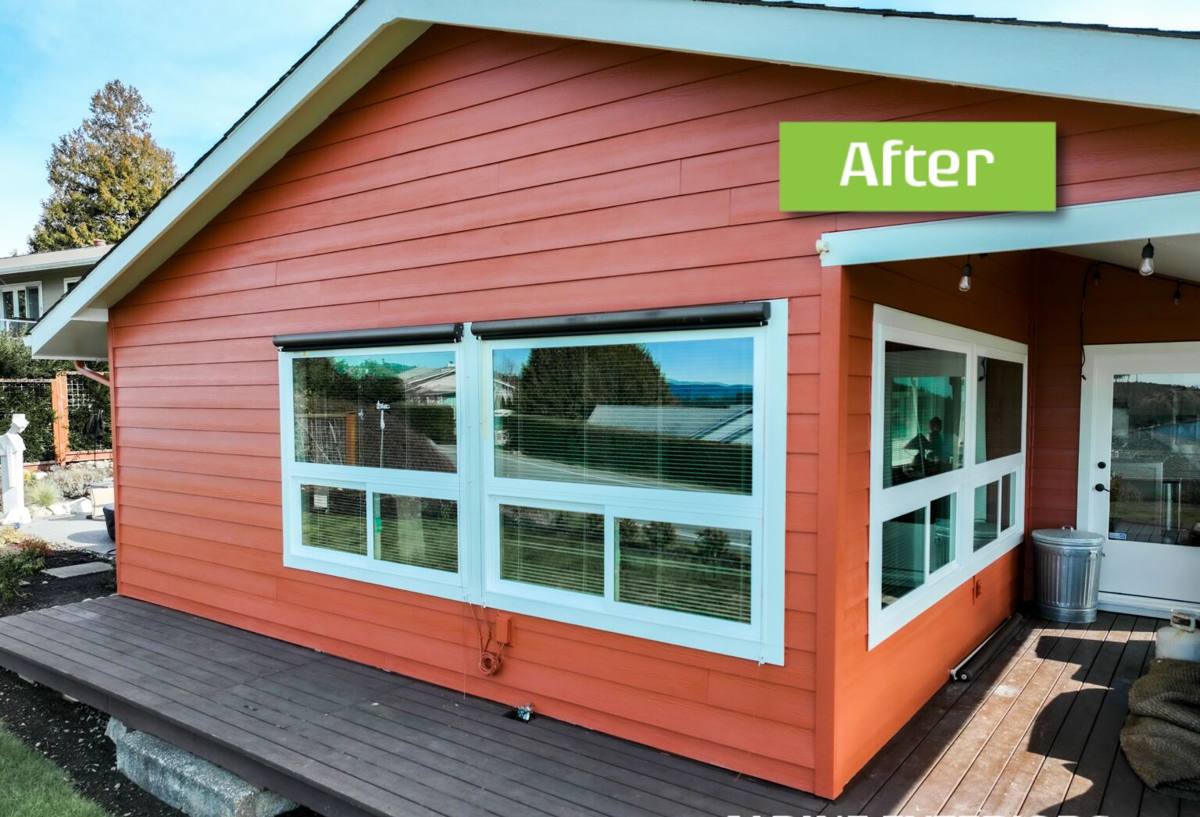
Why Everson Homes Wear Out Siding Faster Than You'd Expect
A lot of homeowners assume siding failure is just age. In our experience working this area, it's almost always a combination of moisture exposure and a weak point in the original installation. Common patterns we see on Everson homes include:
- Moss and algae staining that starts on shaded north walls and under eaves, then spreads across whole elevations if never treated
- Swelling, delamination, or soft spots on wood-based siding products where moisture got behind the surface coating
- Cracked or warped panels near ground level, where splash-back and standing moisture do the most damage
- Caulked seams and butt joints that failed years ago, quietly letting water behind the siding long before anything looked wrong on the surface
- Paint that needs recoating every 5-8 years just to keep ahead of moisture and UV breakdown
None of these are unusual for the Pacific Northwest. They're predictable outcomes of long wet seasons meeting siding materials that either absorb moisture, rely on a factory or field-applied coating to keep water out, or depend on installation details being perfect and staying that way for 20+ years. When any one of those fails, the clock starts running on a much bigger repair.
Signs It's Time to Replace, Not Repair
- Soft or spongy siding when you press on it, especially near the bottom courses
- Visible gaps, warping, or buckling panels
- Persistent moss or algae that returns within a season of cleaning
- Peeling or bubbling paint across multiple wall sections
- Rising energy bills that suggest moisture or air infiltration behind the siding
- Visible rot at trim boards, corners, or window and door casings
What a Correct Siding Replacement Actually Involves
Siding replacement is not just swapping old panels for new ones. The siding itself is the least complicated part of the job — the assembly behind it is what determines whether the house stays dry for the next 30-50 years. On every full replacement we do, that means:
1. Full Tear-Off and Inspection
We remove the old siding down to the sheathing and inspect for hidden rot, soft spots, or prior water damage. This is often the first time anyone has seen the actual condition of the wall assembly in decades, and it's where we catch problems that repairs alone would have missed.
2. Sheathing Repair
Any damaged or rotted sheathing gets cut out and replaced before anything else happens. Installing new siding over compromised sheathing just hides a problem that will resurface — usually in a worse spot.
3. Weather-Resistive Barrier
A new, correctly lapped weather-resistive barrier goes over the sheathing. This layer is what actually stops bulk water from reaching the wall structure if any moisture does get past the siding — it matters more than most homeowners realize.
4. Flashing at Every Penetration
Windows, doors, hose bibs, light fixtures, and any other wall penetration get properly flashed and integrated with the weather barrier. This is where the majority of long-term leaks originate on homes we've re-sided in this region — not the siding field itself.
5. Correct Fastening and Clearances
James Hardie siding has specific fastening patterns, gaps, and ground clearance requirements that are part of keeping the manufacturer's warranty valid — and more importantly, part of what actually keeps water from wicking into the bottom edge of the material. We follow Hardie's installation specifications exactly, not a shortcut version of them.
6. Trim, Caulking, and Paint Detail
Finish work — trim, corner details, and any field-applied caulking or touch-up — gets done to the same standard as the rest of the job. This is often where corners get cut on lower-cost re-sides, and it's usually the first place problems show up again.
Why We Only Install James Hardie Fiber Cement
We get asked regularly why we don't offer vinyl, LP SmartSide, cedar, or other fiber cement brands. The honest answer is that after years of doing repair and replacement work across Whatcom County, we standardized on James Hardie because it holds up to this specific climate better than the alternatives, and we'd rather install one product correctly than several products with compromises we'd have to explain to homeowners later.
Vinyl siding is affordable and low-maintenance, but it expands and contracts with temperature swings, can crack in cold snaps, and doesn't hold paint if you ever want to change the color. Wood-based products like LP SmartSide and cedar look great and perform reasonably well when maintained, but they're organic materials — they can swell, rot, or feed moss and mildew growth if moisture gets behind the surface coating, which is exactly the failure pattern we see most often in this climate. Cement-based alternatives to Hardie exist too, but Hardie's engineering-to-climate approach (their HZ5 product line is formulated specifically for the wetter, more humid parts of the country, including western Washington) and their factory-applied ColorPlus finish are what we've found perform most consistently over a 30-50 year window.
James Hardie fiber cement is non-combustible, doesn't absorb moisture the way wood-based products can, resists moss and pest damage far better than wood, and comes with a factory-baked ColorPlus finish that's engineered to resist fading and doesn't require repainting on the same 5-8 year cycle as painted wood siding. It also carries a strong, transferable limited warranty — a real advantage if you ever sell the home.
How the Common Siding Options Compare
| Material | Moisture Behavior in Wet Climates | Maintenance | Typical Lifespan |
|---|---|---|---|
| James Hardie fiber cement | Engineered for wet, humid regions; resists moisture absorption | Occasional wash; ColorPlus finish resists fading | 30-50+ years with proper install |
| Vinyl | Doesn't absorb water, but seams and gaps can let moisture behind it | Low, but can't be repainted; cracks in cold | 20-30 years |
| LP SmartSide / engineered wood | Vulnerable to swelling and edge damage if coating fails | Repainting and edge sealing over time | 20-30 years, shorter if maintenance lapses |
| Cedar / primed spruce | Absorbs moisture readily; prone to rot and moss without upkeep | High — regular painting/staining and moisture checks | 15-25 years without consistent maintenance |
Our Process for an Everson Siding Replacement
We keep the process straightforward and communicate clearly at each step, since a full re-side is a significant project on your home.
- On-site assessment — we walk the exterior, check for hidden moisture or rot, and talk through what your home actually needs
- Written estimate — a clear scope and price, no vague allowances or surprise add-ons buried in fine print
- Material selection — choosing the right Hardie plank, panel, or shingle profile and ColorPlus color for your home
- Tear-off and sheathing repair — removing old siding and fixing anything the tear-off reveals
- Weather barrier and flashing — the layer that does the real waterproofing work
- Hardie installation to spec — correct fastening, clearances, and joint treatment
- Final trim, caulk, and walkthrough — finishing details and a final walk with the homeowner before we call it done
What Drives the Cost of a Siding Replacement
Every home is different, but the same handful of factors move the price up or down on most Everson projects:
| Cost Factor | Why It Matters |
|---|---|
| Home size and wall complexity | More square footage and more corners, gables, and dormers mean more material and labor |
| Sheathing/rot repair needed | Hidden damage found at tear-off can add scope — this varies home to home |
| Siding profile and accessories | Lap width, shingle-style siding, and trim details affect material cost |
| Number of stories and access | Two-story walls and tight lot access add labor time |
| Window and door count | Each opening needs flashing and trim work, which adds labor |
We'll walk through these specifics for your home during the estimate — we don't like giving ballpark numbers over the phone without seeing the house, because the range between a simple single-story re-side and a complex multi-gable home is wide.
Why Hiring a Crew That Already Works in Everson Matters
A siding crew that regularly works Whatcom County homes already knows how this climate behaves on a wall assembly — where moss actually builds up, which exposures take the worst driving rain, and how much clearance and flashing detail actually holds up here versus what a generic installation manual assumes for a drier region. That local pattern recognition shows up in the small decisions during a job: where to add extra flashing attention, how tight to run clearances at grade, which details are worth doing right the first time because a callback in this weather is a bigger deal than it would be somewhere drier.
It also matters for scheduling and weather planning. A re-side involves stretches where your walls are open to the elements, and a crew that knows this region's rain patterns plans the job to minimize that exposure window rather than getting caught mid-tear-off by a system rolling in off the Strait.
Protecting Your Investment After Installation
James Hardie siding is low-maintenance, but "low-maintenance" doesn't mean "no maintenance." A periodic rinse-down to keep moss and organic buildup from taking hold, especially on shaded north-facing walls, goes a long way in this climate. Keep an eye on caulked joints and trim over the years, and address any physical damage — a ladder scrape, a stray baseball, storm debris — promptly rather than letting exposed edges sit. Done right the first time, a Hardie re-side in Everson should be one of the lowest-maintenance exterior decisions you make for the life of the home.
If your siding is showing moss buildup that keeps coming back, soft spots, failing paint, or you're just planning ahead for a home you know needs attention, we're happy to take a look. We offer free, no-pressure estimates for Everson homeowners — walk the property with us, get a clear answer on what your home actually needs, and decide from there.