 Ferndale
 Point Roberts Sits in a Harder Weather Pocket Than Most of Whatcom County
Point Roberts is surrounded by saltwater on three sides — Boundary Bay to the east and the Strait of Georgia to the west and north. That geography means homes here take on salt-laden air almost daily, along with wind-driven rain that comes off the water with real force during fall and winter storms. Add the shade and moisture that collect under mature tree cover on many lots, and you get a long moss season that can run from early fall well into spring. Siding on a Point Roberts home isn't dealing with one or two tough conditions — it's dealing with all of them, more or less continuously.
None of that is unique to Point Roberts in isolation. Plenty of homes along the Whatcom County coastline see salt air, and plenty of homes under tree canopy see moss. What's different here is how much overlap there is between the two, on a peninsula with limited shelter from prevailing weather. Siding that would hold up fine a few miles inland can start showing problems years earlier out here.
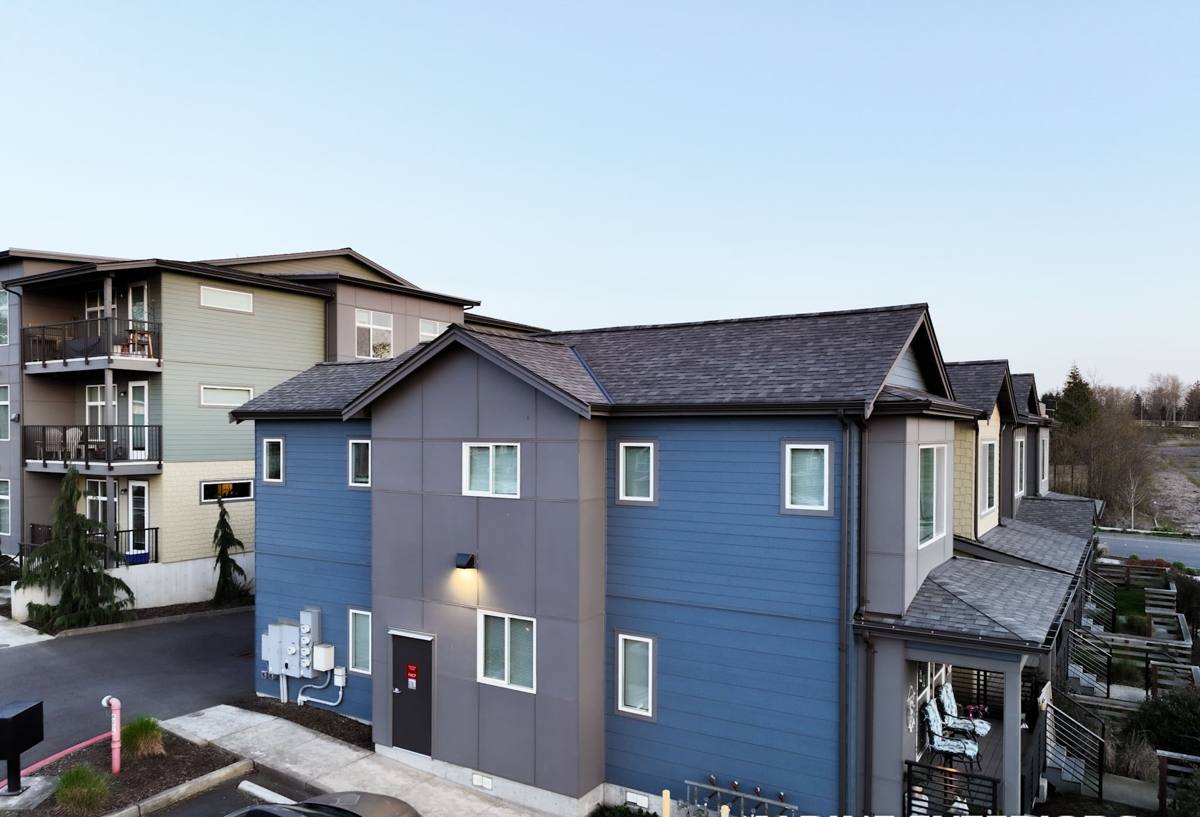
What Actually Fails on Siding in This Kind of Exposure
When we get called out to look at failing siding in this area, the damage usually traces back to one of a handful of causes:
- Moisture trapped behind the siding — from failed caulking, gaps at trim, or a weather-resistive barrier that was never properly lapped and taped
- Moss and algae holding dampness against the wall — especially on north- and west-facing walls that don't get much direct sun to dry out between rain events
- Finish breakdown from salt air — paint and factory finishes both degrade faster under repeated salt exposure, especially where fasteners or cut edges weren't sealed
- Fastener and trim failure — corrosion-prone fasteners and unsealed cut ends give moisture a place to start working into the material
Most of these are installation and maintenance issues, not inherent flaws in every siding product — but some materials handle this combination of salt, rain, and shade-driven moss far better than others, which is a big part of why we've standardized on one product line rather than offering several.
What a Correct Siding Replacement Actually Involves
It's Not Just Removing Old Boards and Nailing Up New Ones
A siding replacement done right is really a whole-wall moisture management job, not a cosmetic swap. That means:
- Full tear-off to inspect the sheathing underneath — not siding installed over existing layers, which traps whatever moisture problems are already there
- Repair or replacement of any sheathing that's gone soft or delaminated from past moisture intrusion
- A properly lapped and sealed weather-resistive barrier (WRB) behind the new siding
- Correct flashing at every window, door, and roof-to-wall intersection — the details that let water get behind siding in the first place
- A drainage gap or rainscreen approach where the wall assembly calls for it, so incidental moisture can drain and dry instead of sitting against the siding back
- Fastener schedule and trim sealing done to the manufacturer's actual installation spec, not just "close enough"
Why This Matters More on Point Roberts
Skip any one of those steps inland and a house might go a decade before it shows. Skip it here, with near-constant salt air and moss-holding moisture, and the same shortcut can show up in a fraction of the time. The visible siding is the last line of defense — the flashing, wrap, and drainage details behind it are what actually decide whether a wall stays dry.
Why We Install Only James Hardie Fiber Cement in This Kind of Exposure
We don't carry vinyl, LP SmartSide, cedar, primed spruce, or other fiber cement brands. That's a deliberate standard, not an oversight — and it matters more in a place like Point Roberts than almost anywhere else we work.
James Hardie fiber cement is non-combustible, which matters for wildfire-adjacent risk and insurance considerations regardless of location. But the bigger factor for this specific climate is moisture behavior. Hardie's HZ5 product line is engineered for the wetter, harsher weather zones on the West Coast, and the ColorPlus factory finish is baked on under controlled conditions rather than field-applied — which means better, more even adhesion and better resistance to fading and finish breakdown from constant salt air and UV, compared to a paint job applied on site. Fiber cement also doesn't feed moss and algae growth the way wood-based products can, and it doesn't have the moisture-swelling behavior that engineered wood products have to be specifically detailed and maintained against.
None of this means other products are junk — cedar has real appeal, and engineered wood siding has genuine advantages in the right setting. But for a peninsula getting salt air from two directions and a moss season that runs half the year, we've seen enough to know which product gives homeowners the least maintenance burden and the longest real service life. That's why it's the only thing we put on a house.
| Factor | James Hardie Fiber Cement | Vinyl / Wood-Based Siding |
|---|---|---|
| Moss and algae resistance | Doesn't feed organic growth; surface cleans without damaging the material | Wood substrates can hold moisture that feeds growth; vinyl surfaces can still stain and require care |
| Salt air / finish durability | Factory-baked ColorPlus finish holds color and adhesion longer under constant salt exposure | Field-applied paint or factory vinyl color can fade or chalk faster in heavy salt air |
| Moisture response | Dimensionally stable; doesn't swell, cup, or rot from repeated wetting | Wood-based products can swell or degrade at cut edges and fasteners if not sealed and maintained |
| Fire rating | Non-combustible material | Combustible (wood-based); vinyl can deform under heat |
Why a Crew That Already Works Point Roberts Matters Here
Point Roberts is a U.S. exclave — the only way in by land is through a Canadian border crossing, and that adds a layer of logistics that most siding jobs elsewhere never have to think about. Material deliveries, equipment, and crew scheduling all have to account for crossing wait times and paperwork, and disposal/hauling of old siding has its own logistics loop back out. A contractor who only occasionally takes a Point Roberts job is relearning that logistics puzzle every time, which shows up as delays, rescheduled start dates, or corners cut to avoid a second border crossing mid-job.
Permitting also runs through Whatcom County the same as it does for the rest of the peninsula, and a crew that's pulled those permits before knows what the county will ask for before it becomes a delay. None of this changes what correct installation looks like — the flashing, the WRB, the fastening schedule are the same regardless of what it took to get the crew and materials there. But it changes whether your project actually starts and finishes on the schedule you were given, which is worth asking any contractor about directly before you hire them.
Our Process for a Point Roberts Siding Replacement
- On-site assessment. We look at the existing siding, sheathing condition where accessible, and the specific exposure of each wall — a shaded, moss-prone north wall gets evaluated differently than a wall taking direct wind off the water.
- Logistics and scheduling. Material staging and crew scheduling get planned around the border crossing up front, so the job isn't stalled mid-way waiting on a second delivery trip.
- Full tear-off. Old siding comes off completely so we can see and address whatever's underneath, rather than covering up unknowns.
- Sheathing repair. Any soft, delaminated, or moisture-damaged sheathing gets repaired or replaced before anything new goes up.
- WRB, flashing, and drainage detailing. This is the step that determines whether the wall stays dry for the next 20-plus years — done to spec, not shortcut.
- Hardie installation. Fastened, trimmed, and sealed to manufacturer specification for the HZ5 climate zone.
- Final walkthrough. We go over the finished job with you before calling it done.
What Drives the Cost of a Job Like This
| Cost Factor | Why It Matters |
|---|---|
| Home size and wall complexity | More corners, dormers, and trim detail mean more labor and material cutting |
| Condition of existing sheathing | Hidden moisture damage found during tear-off adds repair scope before new siding can go up |
| Current siding type and removal difficulty | Some materials come off cleanly; others (especially old, brittle, or multi-layered siding) take longer to strip |
| Site and logistics access | Staging materials and equipment around border-crossing scheduling is a real planning factor unique to this area |
| Exposure-driven detailing | Walls facing prevailing wind and rain may need more attention to flashing and drainage detail than sheltered walls |
We give a written, itemized estimate after the on-site assessment rather than a phone-quote guess — there's too much variation from house to house to price it any other way responsibly.
Signs Your Siding Needs Replacing, Not Just Patching
- Soft or spongy spots when you press on the siding, especially near the bottom courses or below windows
- Persistent moss or dark staining that comes back quickly after cleaning
- Paint or finish that's peeling, bubbling, or chalking heavily rather than just fading evenly
- Visible gaps, warping, or cupping in boards, particularly on walls facing prevailing wind and rain
- Interior signs — soft drywall, musty smell, or staining near exterior walls — that point to moisture getting through
- Siding that's original to a home built more than 25-30 years ago, especially wood-based products nearing the end of realistic service life
Caring for Hardie Siding Once It's Installed
Fiber cement is low-maintenance, not no-maintenance. A rinse-down once or twice a year cuts down on moss and salt residue buildup, especially on shaded or water-facing walls. Keep an eye on caulking at trim and penetrations over time, and trim back vegetation that keeps a wall shaded and damp longer than it needs to be. Beyond that, correctly installed Hardie siding is built to go a long time between any real attention.
If your Point Roberts home is due for new siding, or you're not sure whether what you have needs replacing or just some repair, we're happy to come take a look. The estimate is free, there's no pressure, and you'll get a straight answer either way — just fill out the form below to get started.