 Ferndale
 Sudden Valley sits close enough to Bellingham Bay and the surrounding hills that its roofs take a specific kind of beating: salt-laden air off the water, long stretches of driving rain in the fall and winter, and a moss season that can run nearly eight months out of the year. When wind or a falling branch damages a roof out here, the repair has to account for all three of those factors at once — not just patch the hole and move on. A repair that ignores the local climate tends to fail again within a season or two.
This page covers what storm damage roof repair actually involves for homes in and around Sudden Valley, what correct work looks like, and why it matters to hire a crew that already understands how Whatcom County weather treats a roof.
What Storms Actually Do to a Sudden Valley Roof
Storm damage isn't always a dramatic hole in the roof deck. Most of what we find after a wind event or heavy rain is quieter and easier to miss from the ground:
- Lifted or creased shingles along ridge lines and roof edges, where wind gets underneath and breaks the seal without tearing the shingle off entirely.
- Displaced or cracked ridge caps from sustained gusts, which then let wind-driven rain work its way under the cap.
- Granule loss from hail or debris impact, which doesn't leak right away but shortens the life of the shingle underneath.
- Flashing pulled loose around chimneys, skylights, and roof-to-wall transitions — often the actual source of a leak that shows up as a stain on an interior ceiling.
- Branch or debris strikes that punch through the shingle layer and sometimes the underlayment, especially where trees overhang the roofline.
- Gutter and downspout damage that redirects water somewhere it was never meant to go, including behind fascia boards and into soffits.
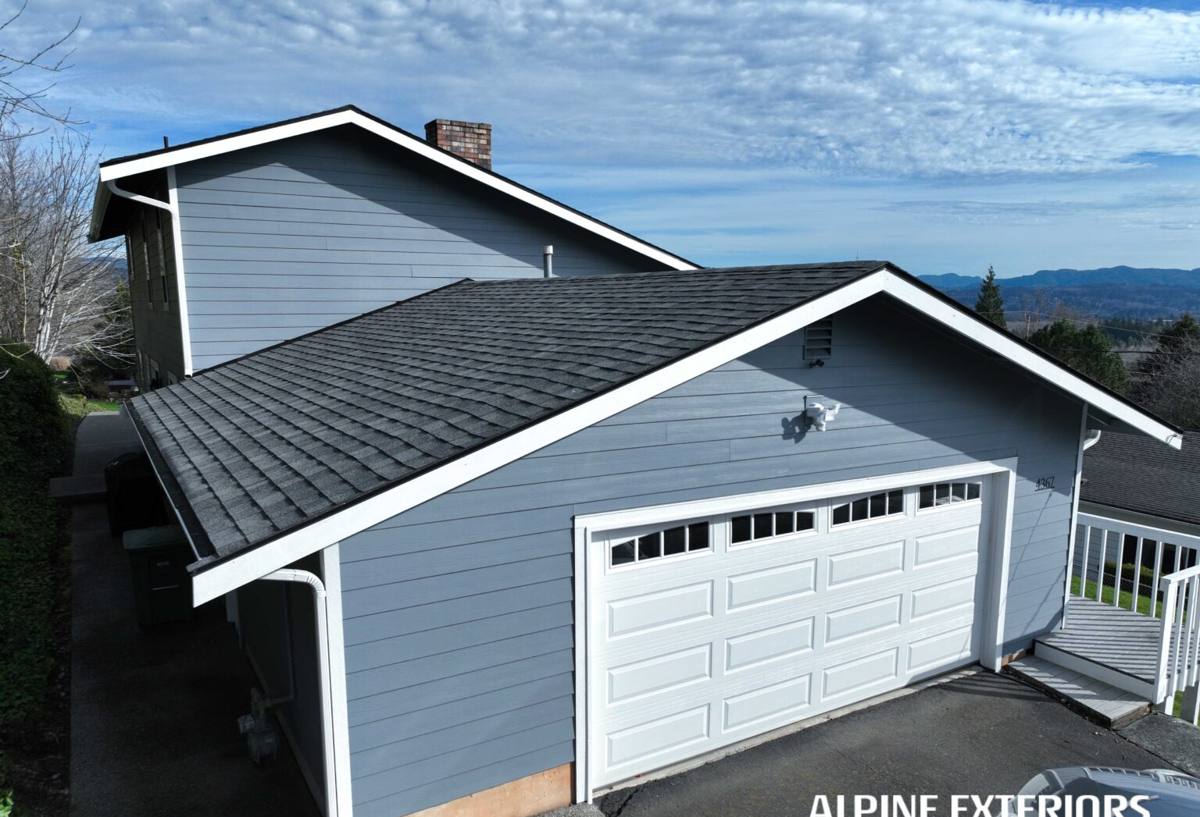
Why Moss and Salt Air Change the Repair
Moss Season
Whatcom County's damp, shaded conditions mean moss growth is close to a year-round concern on north-facing slopes and anywhere tree cover keeps a roof from drying out between storms. Moss isn't just cosmetic — it holds moisture against the shingle surface, works its way under tabs, and can lift shingles enough that wind finds an easy entry point during the next storm. If we're repairing storm damage on a roof that already has moss growth nearby, we treat that as part of the job, not a separate issue to ignore. Repairing a damaged section next to an untreated moss mat just means the same area fails again.
Salt Air
Proximity to the bay means metal components — nails, flashing, gutter hardware, vent caps — corrode faster here than they would further inland. A storm repair that reuses corroded fasteners or unsealed metal flashing is a repair that's already counting down to its next failure. We match fastener and flashing material to what actually holds up in a marine-influenced climate, not whatever is fastest to grab off the truck.
Driving Rain
Wind here rarely comes straight down. Storms tend to push rain sideways, which means water finds gaps that would never leak in a calmer climate — under a lifted shingle tab, along a poorly lapped flashing edge, through a nail hole that isn't sealed. Any storm repair on a Sudden Valley roof has to be built assuming the next storm will hit at an angle.
What a Correct Storm Damage Repair Involves
A proper repair follows a sequence — skipping steps is how "repairs" turn into repeat service calls.
- Full roof assessment, not just the reported spot. Wind damage is rarely isolated to one location. We check the whole roof plane, not just where the homeowner noticed a leak or missing shingle.
- Interior check for water intrusion. Stains, soft spots, or musty smells in the attic or top-floor ceilings tell us how far water has already traveled, which changes the scope of the repair.
- Deck inspection where shingles are removed. If water got under the shingle layer, the roof deck underneath may be soft or delaminating. Patching over a compromised deck doesn't hold.
- Underlayment and flashing repair or replacement. This is the layer that actually stops water once the shingle surface is breached — it gets the same attention as the visible shingles.
- Matching materials, not just matching color. Shingle repairs should match the existing product's weight and profile so the patched section performs the same as the rest of the roof, not just looks similar from the driveway.
- Moss and debris clearing on the surrounding roof plane. Since it's already up there, this is the efficient time to address growth that would otherwise undermine the repair.
- Documentation for insurance. Photos and a written scope of damage, useful whether or not a claim is filed.
Insurance and Storm Damage Claims
Most homeowners insurance policies cover sudden storm damage — wind, hail, falling limbs — though coverage details and deductibles vary by policy. A few things are worth knowing going in:
- Document damage with photos before any repair work begins, if it's safe to do so.
- An adjuster's inspection benefits from a contractor's written assessment alongside it — two sets of eyes catch more than one.
- Damage from long-term neglect (moss buildup, deferred maintenance) is typically treated differently than sudden storm damage, which is another reason not to let moss and minor wear sit unaddressed between storms.
- We provide honest, written scopes of damage — we don't inflate a claim, and we don't downplay real damage to make a sale.
Repair, Partial Replacement, or Full Roof — How We Decide
| Situation | Typical Approach | Why |
|---|---|---|
| Isolated wind damage, roof under 10-12 years old | Targeted repair | Surrounding shingles still have useful life; matching materials are available. |
| Storm damage plus widespread moss or granule loss | Repair with moss treatment, or partial section replacement | Repairing damage without addressing surrounding wear invites repeat failure. |
| Damage to a roof already near end-of-life (15-20+ years, depending on material) | Full replacement often makes more sense | Patching an aging roof is a short-term fix; the rest of the roof is close behind it. |
| Multiple storm events with cumulative, scattered damage | Full assessment before deciding | Scattered damage across many sections can cost more to patch piecemeal than to replace. |
We'll always tell you honestly which category a roof falls into rather than defaulting to the most expensive option.
Working in Sudden Valley Specifically
Sudden Valley's mix of tree cover, sloped lots, and proximity to the water means every roof here deals with some combination of shade, wind exposure, and moisture retention — the exact combination varies house to house depending on which direction a roof faces and how much tree canopy surrounds it. A crew that already does regular work in Ferndale and the surrounding Whatcom County communities has a working sense of these patterns before ever getting on the roof — which slopes tend to hold moss, which orientations catch the worst of a wind event, and what a typical storm season does to different roofing materials in this specific area.
That local familiarity doesn't replace inspecting your specific roof, but it means fewer surprises and a faster, more accurate assessment when you need one urgently after a storm.
What to Do Right After a Storm
- Check for interior signs first — ceiling stains, damp attic insulation, or a musty smell — before going up on the roof yourself.
- Avoid getting on the roof after a storm if it's wet, windy, or you're not equipped for it; a fall is a far worse outcome than a delayed repair.
- Photograph any visible damage from the ground — missing shingles, debris on the roof, damaged gutters — for your own records.
- Cover an active interior leak with a container and move belongings out of the way, but leave the roof itself to a professional.
- Call for an assessment promptly. Storm damage that sits exposed to Whatcom County's rain for weeks tends to get worse, not stay the same.
Choosing a Contractor for Storm Repair Work
Storm damage brings out traveling crews who work an area hard for a few weeks after a bad storm and are gone before any warranty issue shows up. A few things worth checking before hiring anyone for storm repair:
- A permanent local address and a track record of work in Whatcom County, not just a truck with an out-of-state plate.
- Proper licensing and insurance, verifiable through Washington's L&I contractor lookup.
- A written scope of repair before work starts — not a verbal estimate and a same-day contract.
- A willingness to explain why they're recommending repair versus replacement, not just quoting the bigger job.
- References or a business history you can actually verify, not just a stack of before/after photos.
If a storm has left your Sudden Valley roof with missing shingles, a new leak, or visible wind damage, we're happy to take a look and give you a straightforward, no-pressure estimate — no obligation, just an honest read on what's actually going on up there. You can request one using the form below.