 Ferndale
 Blaine's Coastline Puts Extra Demands on Siding
Blaine sits right on Semiahmoo Bay at the edge of Whatcom County, and that location shapes what a home's exterior has to deal with year-round. Salt-laden air off the water accelerates corrosion on fasteners and metal trim. Weather systems moving in off the Strait of Georgia bring driving, wind-blown rain that hits siding at an angle instead of falling straight down, pushing water into laps, seams, and butt joints that a calmer climate would never stress. Add in a long, damp shoulder season where shaded north- and west-facing walls barely dry out between storms, and you get ideal conditions for moss and algae to take hold on siding that isn't installed — or finished — correctly.
None of this means siding in Blaine is doomed to fail. It means the material choice and the installation details matter more here than they would forty miles inland. A product that's marginal in a dry climate can become a real maintenance headache on a bay-front or near-bay property, and a rushed installation that would hold up fine in a low-moisture region can start showing problems within a few winters on this coastline.
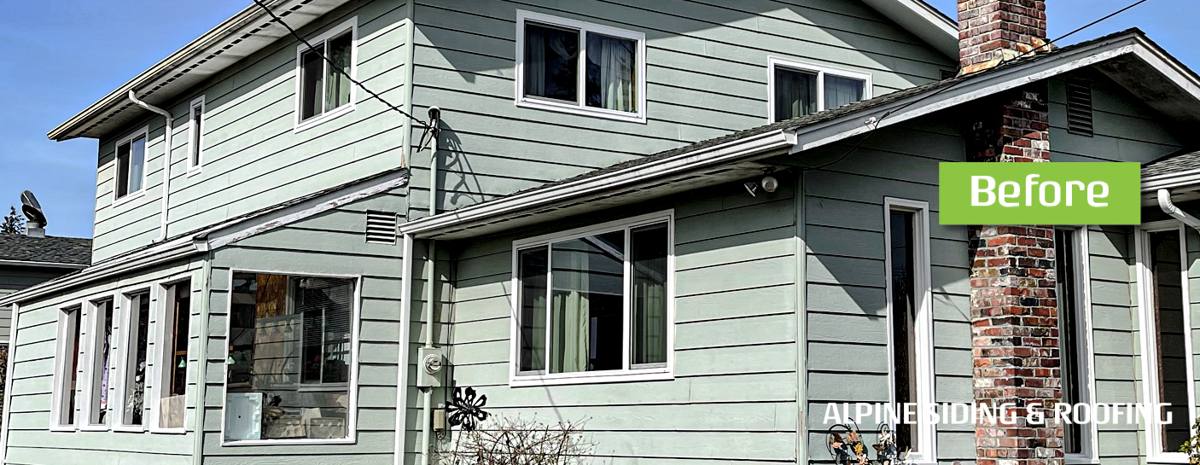
What "Correct" Siding Installation Actually Involves
Siding installation is often talked about like it's just cutting boards and nailing them up. In a marine climate like Blaine's, that's the part that matters least. The details that actually determine whether siding lasts happen underneath and around it.
Weather-Resistive Barrier and Drainage Plane
Correct installation starts with a continuous weather-resistive barrier behind the siding, properly lapped and taped at every seam, window, and penetration. Behind that, a drainage gap — created with a rainscreen or furring strips — lets any water that gets past the siding drain out and lets the wall assembly dry rather than trapping moisture against the sheathing. On a home exposed to driving coastal rain, skipping or shortcutting this step is one of the most common causes of rot that owners don't discover until it's expensive.
Flashing at Every Penetration
Windows, doors, deck ledgers, hose bibs, vents, and light fixtures are all places where water can work its way behind siding if flashing isn't installed correctly and in the right order relative to the weather barrier and the siding itself. This is detail work, and it's the difference between siding that sheds fifteen years of coastal storms and siding that hides a slow leak behind a wall.
Fastening, Clearances, and Joints
Fasteners need to be corrosion-resistant and set to the manufacturer's specified depth — not too proud, not overdriven. Butt joints need to be caulked or flashed per spec, not just butted together and painted over. And siding needs proper clearance from the ground, roofing, and decks so it isn't sitting in standing water or splashback, which is a common issue on older Blaine homes built before drainage details were standard practice.
Why We Install Only James Hardie Fiber Cement
We made a decision as a company to install one siding system — James Hardie fiber cement — and to stop installing several others we used to offer. That wasn't a marketing choice. It came from watching how different materials actually perform over years in Pacific Northwest coastal conditions, and deciding we didn't want to keep installing products we knew would create problems for homeowners down the road.
Fiber cement is non-combustible and dimensionally stable, meaning it doesn't expand and contract with moisture the way wood-based products do. That matters directly in Blaine: a material that swells when it's damp and shrinks when it dries opens up gaps at joints and fastener holes over repeated wet-dry cycles, which is exactly the cycle a bay-front climate puts a home through every week for half the year. Hardie's ColorPlus factory-applied finish is also baked on under controlled conditions, which gives it more consistent, longer-lasting color and adhesion than a coat applied on-site in variable weather — and it comes with a real transferable warranty backing that finish.
We're not going to tell you every other product is unusable everywhere. Vinyl, engineered wood, and other fiber cement brands all have a place. But we stopped installing them because, on the homes we work on in this climate, we saw too large a gap between how they perform on paper and how they hold up after a decade of Whatcom County winters.
How Materials Compare in a Coastal Climate
| Material | Moisture Behavior | Salt Air / Corrosion | Long-Term Maintenance |
|---|---|---|---|
| James Hardie Fiber Cement | Dimensionally stable; won't swell or rot | Non-combustible core resists degradation; use corrosion-resistant fasteners and trim | Repaint/refinish cycle is long with ColorPlus finish |
| Vinyl Siding | Doesn't rot, but can warp or crack in temperature swings | Fasteners and trim components still need corrosion resistance | Low upkeep but fades and becomes brittle with age; hard to patch invisibly |
| Engineered Wood (LP-type) | Wood-based core is sensitive to sustained moisture at joints and edges | No inherent corrosion issue, but edge-swelling risk rises near driving rain | Requires vigilant caulking and touch-up to protect exposed edges |
| Cedar / Primed Wood | Natural material that moves with moisture; prone to cupping and checking | Not a corrosion issue, but salt spray accelerates finish breakdown | Frequent refinishing needed to hold up on exposed coastal walls |
Our Installation Process for Blaine Homes
The process doesn't change dramatically from house to house, but the sequencing and attention to detail are what separate a job that lasts from one that doesn't.
- On-site assessment of the existing wall assembly, siding condition, and any moisture or rot already present, especially on north- and west-facing walls that take the brunt of coastal weather.
- Removal of old siding and inspection of sheathing, with repair of any damaged material before anything new goes up.
- Installation of a continuous weather-resistive barrier with taped seams and properly integrated flashing at every window, door, and penetration.
- Installation of a rainscreen or furring gap to create a drainage plane behind the siding.
- James Hardie panel or plank installation to manufacturer spec, including fastener type, spacing, and joint treatment.
- Trim, caulking, and final detailing at all clearances — ground, roofline, and deck connections.
- Final walk-through so the homeowner understands what was done and what, if anything, needs periodic attention.
Moss, Algae, and Keeping Siding Clean Long-Term
Blaine's combination of shade, moisture, and mild temperatures is close to ideal growing conditions for moss and algae on exterior surfaces. Siding itself isn't usually the root cause of moss — overhanging trees, limited sun exposure, and gutters that dump water down a wall are the bigger drivers. But the siding material affects how much that growth matters. A textured or porous surface holds moisture and gives moss more to grip; a factory-finished fiber cement surface sheds water better and is easier to rinse clean without damaging the finish.
Homeowners can do a lot to keep moss in check without professional help: keeping gutters clear so they're not overflowing onto walls, trimming back vegetation that shades a wall for most of the day, and doing a gentle rinse-down once or twice a year rather than letting growth build up over multiple seasons. Pressure washing on delicate materials can do more harm than good, which is another reason a stable, factory-finished product is worth the difference in a climate like this one.
Questions to Ask Before Hiring a Siding Contractor in Blaine
- Do they install a proper weather-resistive barrier and drainage plane, or just nail siding over existing sheathing?
- Can they explain their flashing detail at windows, doors, and deck connections specifically?
- Do they use corrosion-resistant fasteners and hardware appropriate for a salt-air environment?
- Are they licensed and insured to work in Washington, and can they provide proof?
- Do they have experience working on homes in Blaine or similarly exposed coastal areas, not just inland projects?
- What warranty backs both the material and the labor, and is it transferable if the home sells?
Why a Crew That Already Works in Blaine Matters
Coastal siding work isn't the same job as siding work twenty miles inland, even within the same county. A crew that's used to Blaine's wind-driven rain and salt exposure already knows to prioritize the drainage and flashing details that matter most here, rather than treating them as optional add-ons. They've seen how these walls behave after a few winters and adjust their approach accordingly — heavier attention to clearances near the water, more conservative fastener choices, and no shortcuts on the weather barrier.
That local pattern recognition is hard to replace with a generic installation checklist. It's the difference between a contractor who's installing siding correctly in theory and one who's watched what actually goes wrong on homes exposed to this specific stretch of Whatcom County coastline — and builds their process around avoiding it.
Get a Straight Answer About Your Siding
If your Blaine home's siding is showing moss buildup, cracked caulking, warped boards, or you're just planning ahead for a replacement, we're happy to take a look and give you an honest read on what's going on and what it would take to fix it right. Reach out for a free, no-pressure estimate — there's a form below to get started.