 Ferndale
 Why Point Roberts Windows Take More Punishment
Point Roberts sits on a peninsula bordered by Boundary Bay and the Strait of Georgia, which means most homes there get salt-laden air moving across them almost constantly. That salt air doesn't just make hardware feel gritty — it accelerates corrosion on screws, hinges, balances, and locking mechanisms, and it slowly breaks down finishes and seals that would last much longer a few miles inland.
Add in driving rain that comes off the water at an angle instead of straight down, and you get wind-driven moisture finding its way into gaps that a calmer climate would never expose. Then there's moss season — the long stretch of mild, wet Pacific Northwest winters when moss and algae take hold on shaded sills, trim, and anywhere water sits instead of draining. Moss holds moisture against wood and caulk lines for months at a time, which is exactly the condition that causes rot and seal failure.
None of these three factors — salt air, driving rain, moss season — is unique to Point Roberts on its own. What's unique is having all three working on a home at the same time, year after year, which is why windows here often show wear well before they would on a similar home in a drier or more sheltered part of Whatcom County.
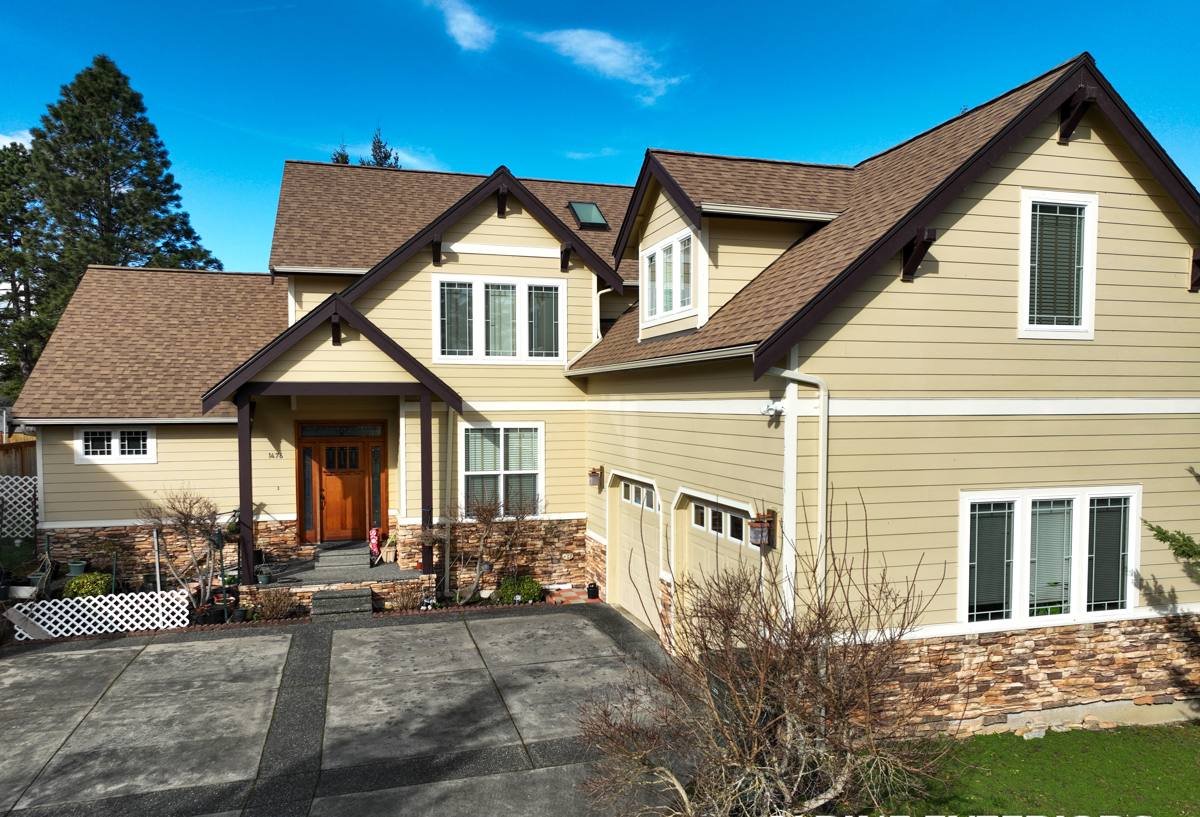
What Makes a Window Job "Custom" Here
Older homes and non-standard openings
A lot of housing stock in Point Roberts started as cabins, cottages, or seasonal properties that were built or added onto over decades, not all at once to a single plan. Rough openings in these homes are frequently out of square or sized to dimensions that don't match anything you'll find on a shelf at a big-box store. That's what "custom" actually means in this trade — not a fancier window, but one built or trimmed to fit an opening that isn't standard.
Settling, additions, and mismatched framing
Homes that have settled over time, or that had rooms added later, often have framing that shifted slightly from level and plumb. Installing a standard-size window into an opening like that either means forcing it in — which stresses the frame and shortens its life — or building out the opening correctly first. A crew that treats every opening as identical is going to run into problems on a meaningful share of Point Roberts homes.
The Border Reality: Why Logistics Matter for This Project
Point Roberts is a U.S. exclave — the only way to reach it by land is to cross into Canada and back into the United States, since it's cut off from the rest of Washington by the border. That's not a footnote, it's something that directly affects a window project. Crews, trucks, and materials all have to make that crossing, and custom windows typically come from the manufacturer on a lead time that has to be planned around, not squeezed in at the last minute.
A contractor who hasn't worked in Point Roberts before will often underestimate how much extra scheduling this adds — staging materials ahead of time, coordinating crossing windows, and building in buffer so a delay at the border doesn't leave a home with an open wall on a rainy day. This is exactly the kind of detail that separates a smooth install from a stressful one.
What a Correct Custom Window Installation Involves
Getting a window in straight and sealed is only part of the job. On a coastal, high-moisture site like Point Roberts, the details around the window matter as much as the unit itself.
- Removing the old unit and inspecting the framing and sheathing underneath for rot or water damage before anything new goes in
- Installing sill pan flashing so any water that does get past the window drains back outside instead of into the wall
- Integrating flashing correctly with the home's weather-resistant barrier, shingled so water always moves downward and outward
- Shimming and leveling the frame precisely, then using low-expansion foam or backer rod so the frame isn't bowed or stressed
- Sealing the exterior with a sealant compatible with the home's existing siding material
- Air-sealing the interior perimeter so conditioned air isn't leaking out around the frame
- Specifying corrosion-resistant hardware — stainless steel or marine-grade fasteners hold up far longer against salt air than standard-grade hardware
Skip any one of these steps and the window itself can be excellent quality and still fail early — usually through a leak, fogged glass, or a frame that swells and sticks.
Choosing Materials for Salt Air and Coastal Rain
There's no single "best" window material for every home — it depends on the home's age, style, and how exposed it is to wind and salt spray off the water. Here's how the common options generally hold up in this environment.
| Material | Salt Air & Corrosion Resistance | Maintenance | Typical Fit for Point Roberts |
|---|---|---|---|
| Vinyl | Good — won't corrode, but hardware quality varies by manufacturer | Low — occasional cleaning | Solid budget-friendly option for most homes |
| Fiberglass | Very good — dimensionally stable, resists warping from moisture cycles | Low | Strong choice for the most exposed, water-facing sides of a home |
| Aluminum-clad wood | Good exterior protection with the look of wood inside | Moderate — cladding protects the wood, but seams need periodic checking | Good where appearance matters and budget allows |
| Bare wood | Weakest in this climate without diligent upkeep | High — regular repainting and sealing required | We generally steer homeowners away from it on directly exposed elevations here |
Whatever the frame material, look for corrosion-resistant hardware and a glazing package with a good Low-E coating — it cuts down on both heat loss and condensation, which matters given how much moisture this climate throws at a home.
Our Process for a Point Roberts Custom Window Project
- On-site assessment — we look at every opening individually, check for rot or settling, and note anything that will affect fit before we quote the job
- Precise measurement — custom units are built to the actual opening, not a catalog size, so accurate measurements up front prevent delays later
- Ordering with lead time built in — we account for manufacturing time and the border crossing when scheduling, so materials are staged and ready before install day
- Removal and framing check — old units come out, and we inspect and repair any damaged framing or sheathing before the new window goes in
- Installation with proper flashing and sealing — following the steps above, not shortcuts
- Cleanup and walkthrough — we clear the site and walk the homeowner through the new windows, including any care notes specific to a coastal setting
What Drives the Cost
Every home is different, but these are the main factors that move a custom window project up or down in price. We don't publish fixed numbers because opening condition and window count vary too much from house to house — an accurate figure comes from seeing the home.
| Cost Factor | Why It Matters |
|---|---|
| Number of windows | More units means more material and labor, though per-window cost often improves with volume |
| Frame material | Vinyl, fiberglass, and clad-wood carry different material costs |
| Opening condition | Rot repair or reframing adds time and material beyond the window itself |
| Custom sizing | Non-standard dimensions cost more than stock sizes ordered in volume |
| Access and site conditions | Second-story openings or tight access can add labor time |
| Glass package | Upgraded Low-E coatings and gas fills add cost but improve performance in this climate |
Signs Your Point Roberts Home Needs New or Custom Windows
- Fogging or a hazy film between the panes of a double-pane window — a sign the seal has failed
- Soft, spongy, or visibly rotted wood at the sill or frame
- Noticeable drafts even when the window is fully latched
- Windows that stick, bind, or are hard to open and close — often a sign the frame has swollen from moisture
- Visible moss, algae, or persistent mildew staining on sills and trim
- Condensation forming on the inside of the glass regularly, not just on the coldest mornings
- Original single-pane or older aluminum-frame windows that were never upgraded
- Chalky, faded, or brittle vinyl on the exterior frame
Why a Ferndale Crew That Already Works Point Roberts Matters
Working in Point Roberts isn't the same as working anywhere else in Whatcom County, and it shows up in scheduling, material planning, and installation choices. A crew that's made the crossing before knows how to plan around it instead of being surprised by it. Just as important, we know what this specific stretch of coastline does to a window over time — which materials hold up, where flashing details matter most, and which corners simply can't be cut on a home that faces salt air, driving rain, and a long moss season every year.
If you're weighing new or replacement windows for a Point Roberts home, we're happy to take a look and give you an honest read on what your home actually needs. Reach out for a free, no-pressure estimate using the form below.