 Ferndale
 Why Bellingham's Climate Is Harder on Siding Than It Looks
Bellingham sits close enough to Bellingham Bay and the Strait of Georgia that salt-laden air is a real factor on exterior materials, not just a coastal-town cliché. Add Whatcom County's long wet season, frequent driving rain off the water, and the shaded, damp conditions that let moss and algae take hold on north- and west-facing walls for much of the year, and you have a climate that quietly wears down siding that wasn't built for it. It's rarely dramatic — no single storm does the damage. It's the accumulation of hundreds of wet-dry cycles a year, chronic moisture sitting against a wall, and organic growth that holds water against the surface long after the rain has stopped.
Homes in and around Bellingham show this wear in predictable ways: paint that fails years ahead of schedule, wood trim that softens at joints and corners, and green-black staining that keeps coming back no matter how many times it's pressure-washed off. None of that is a defect in any one product — it's what happens when a siding material's tolerance for sustained moisture is lower than what this specific location demands.
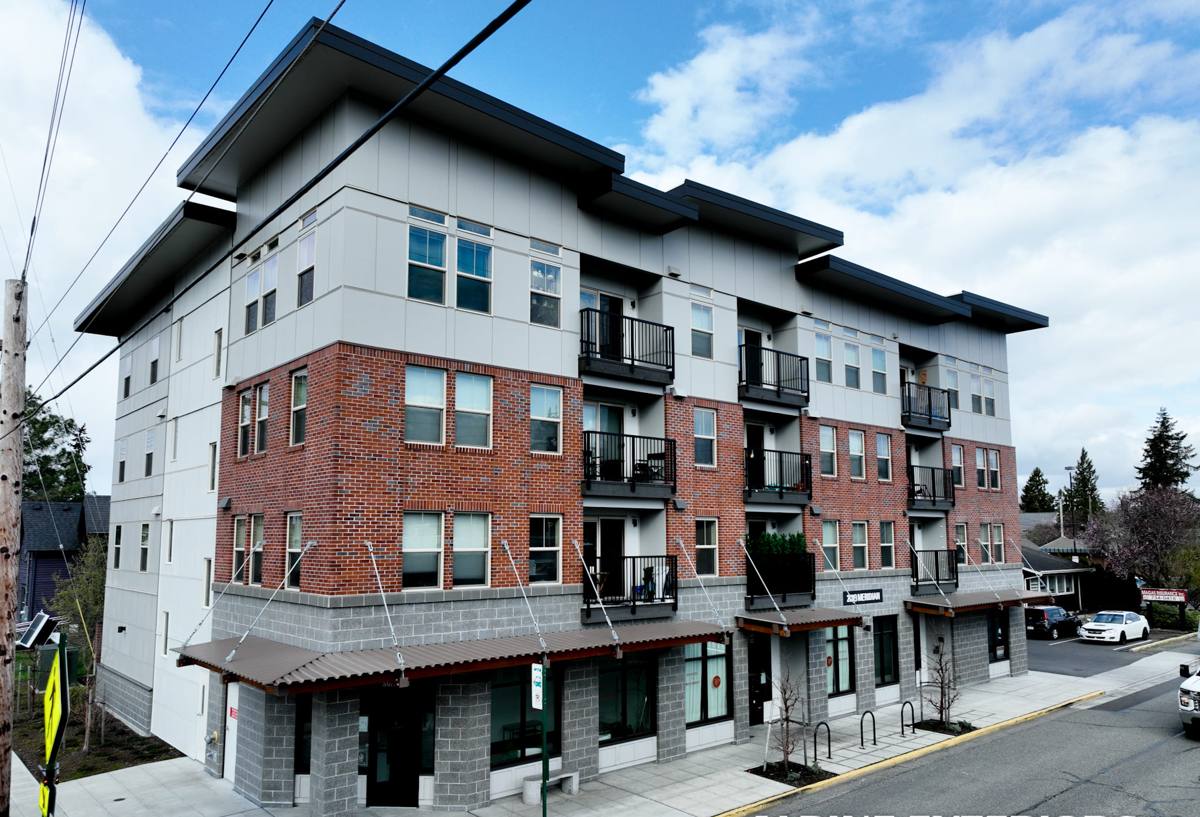
What James Hardie Brings to a Bellingham Home
James Hardie fiber cement siding is engineered from cement, sand, and cellulose fiber — an inorganic mix that doesn't absorb water the way wood-based products do and doesn't provide the organic material that moss and mildew feed on. That matters directly here: it's one of the reasons we standardized on Hardie rather than wood-fiber composite sidings or vinyl for homes in this climate zone.
Climate-Engineered for the Pacific Northwest
James Hardie manufactures its products in different formulations for different climate zones — a system the company calls HZ5. The Pacific Northwest, including Whatcom County, falls under the HZ5 engineering standard, which accounts for our freeze-thaw cycles and sustained damp conditions. It's a different product recipe than what ships to hot, dry climates, and it's part of why Hardie performs consistently here rather than being a general-purpose product stretched to fit every region.
ColorPlus Factory Finish
Most Hardie siding on Bellingham homes goes up with a ColorPlus finish — baked on in a controlled factory environment rather than painted on-site. In a climate where field-applied paint has to cure between rain systems and often doesn't get the dry window it needs, a factory finish removes that variable entirely. It also resists the fading and chalking that on-site paint jobs tend to show first, especially on south- and west-facing exposures that take the most UV and driving rain.
Non-Combustible Construction
Fiber cement doesn't support flame spread the way wood-based siding can. That's a secondary benefit for coastal Whatcom County compared to drier parts of the state, but it's still a meaningful, permanent difference in the material itself, and one more reason it's the only product we put our name behind.
What a Correct Installation Involves Here
James Hardie siding performs to its rated lifespan only when it's installed to the manufacturer's specifications — and in a wet climate, the installation details matter more than the product itself. Most premature siding failures we see on Hardie jobs in this area trace back to installation shortcuts, not the material.
- Correct rain screen or drainage plane behind the siding, so any moisture that gets past the surface has somewhere to go instead of sitting against the sheathing
- Proper flashing at every window, door, and roofline intersection — the points where water actually finds its way in
- Manufacturer-specified fastener placement and clearance, not shortcuts that void the warranty
- Correct minimum clearance between the bottom edge of the siding and the ground, decks, patios, and roof lines, so splash-back and standing water don't sit against the board
- Properly sealed and caulked joints using products rated for sustained wet exposure, not general-purpose caulk that fails after a season or two
- Panel and plank gaps set to Hardie's spec, allowing for expansion without forcing water into the seams
Skip any one of these and you can end up with premium siding that still traps moisture behind it — which defeats the entire point of choosing a moisture-resistant material in the first place.
Salt Air, Driving Rain, and Moss: The Local Details That Matter
Salt Air and Fasteners
Homes closer to the water deal with a slow, steady corrosive load on exposed metal. We use fasteners and flashing rated for coastal exposure on Bellingham jobs, because standard hardware corrodes faster here than it would inland — and a rusted fastener head is a small, ongoing leak point that's easy to prevent and expensive to fix later.
Driving Rain Exposure
Wind-driven rain off the bay doesn't just fall on siding — it gets pushed sideways into laps, seams, and trim joints. This is where the rain screen gap and correct flashing sequencing earn their keep. A wall assembly that manages water on a calm day but floods at the seams during a windy Whatcom County storm hasn't actually solved the problem.
Moss and Algae Season
Shaded, north-facing walls, homes tucked under tree cover, and anywhere gutters overflow onto the siding below are where we see the heaviest moss and algae buildup. Fiber cement doesn't feed organic growth the way wood-based products can, but growth can still take hold on any surface that stays damp long enough — good grading, working gutters, and trimmed-back vegetation near the walls all help keep it in check regardless of siding material.
James Hardie Product Lines We Install
Not every Hardie product is the right fit for every wall or every look. Here's how the main lines compare for a typical Bellingham home:
| Product | Best Use | Local Notes |
|---|---|---|
| HardiePlank Lap Siding | Primary wall siding, most homes | The most common choice; wide range of profiles and ColorPlus colors suited to Pacific Northwest architecture |
| HardiePanel Vertical Siding | Accent walls, gables, modern/farmhouse styles | Pairs well with lap siding for dimension; needs correct batten and seam detailing in a wet climate |
| HardieShingle | Accent areas, Craftsman-style detailing | Common on gable ends and porch areas around Bellingham's older neighborhoods |
| HardieTrim | Corners, window/door surrounds, fascia | Matched fiber cement trim avoids the rot risk of wood trim against Hardie panels |
Our Process for Bellingham Homes
Assessment First
We start by looking at what's actually happening on the existing wall — moisture damage patterns, where growth concentrates, how the gutters and grading are performing, and whether the current siding is failing from age, installation defects, or the wrong product for this climate. That assessment shapes the plan, not a generic spec sheet.
Moisture Management Before Cosmetics
Before any new siding goes up, we address the drainage plane, flashing, and any sheathing damage found underneath. Installing new Hardie siding over an unresolved moisture problem just hides it for a while — it doesn't fix it.
Installed to Manufacturer Spec
Every install follows James Hardie's published installation guidelines for our climate zone — fastener schedule, clearances, flashing sequence, and joint treatment — which is also what keeps the manufacturer's warranty intact.
What It Costs and What Drives the Number
Every Bellingham home is different, so a real number only comes from a site visit, but these are the main factors that move the price:
| Factor | Why It Matters |
|---|---|
| Wall condition underneath | Rot repair or sheathing replacement adds cost but is not optional if damage is present |
| Product line and profile | Lap siding, panel, and shingle products carry different material and labor costs |
| Home size and complexity | Cutouts, dormers, and multiple gables increase labor time and trim work |
| Access and exposure | Multi-story sections, steep grades, or tight lot lines affect scaffolding and staging |
| Trim and accent scope | Matched HardieTrim and accent panels add cost but keep the whole system consistent |
Why a Crew That Already Works in Bellingham Matters
Installation quality is the single biggest factor in how long Hardie siding actually lasts on a home — and installers who work Whatcom County regularly already know how the local exposure behaves: which sides of a house take the worst driving rain, where moss reliably comes back, what clearance actually holds up against local grading and drainage patterns, and how Ferndale and Bellingham permitting and inspection processes run. A crew that installs Hardie the same way regardless of region isn't accounting for any of that. We install James Hardie siding exclusively, to manufacturer spec, on homes throughout Ferndale and Bellingham — which means every job benefits from what we've already learned about how this specific climate treats an exterior wall.
If you're weighing a siding replacement or want a second opinion on an install someone else quoted, we're happy to take a look and give you a straight answer — no pressure, no upsell. Request a free estimate below and we'll walk your home with you.