 Ferndale
 Decking in a Salt Air, High-Rain Climate
Homes in and around Semiahmoo sit close enough to the water that salt air is a daily fact of life, not an occasional nuisance. Combine that with the driving rain that rolls through this part of Whatcom County for much of the year, and you've got two forces working against any deck that isn't built and finished correctly. Add a moss season that can stretch from fall well into spring, and it's easy to see why decks in this area age differently than decks fifty miles inland.
None of this means decking is a bad idea here — it means the material choice and the build details matter more than they would in a drier, calmer climate. A deck that would hold up fine in eastern Washington can fail early on a shaded, wind-exposed lot near Semiahmoo if it's built to a generic spec instead of a coastal one.
What This Exposure Actually Does to a Deck
Salt-laden air accelerates corrosion on any exposed metal — fasteners, brackets, railing hardware — faster than inland air does. Driving rain doesn't just wet a deck surface; it drives moisture sideways into butt joints, screw holes, and end grain, then that moisture sits because Ferndale-area weather doesn't give surfaces much time to fully dry between storms. And low light, shade from trees or the house itself, and near-constant dampness are exactly the conditions moss and algae need to take hold on horizontal wood surfaces, railings, and stair treads.
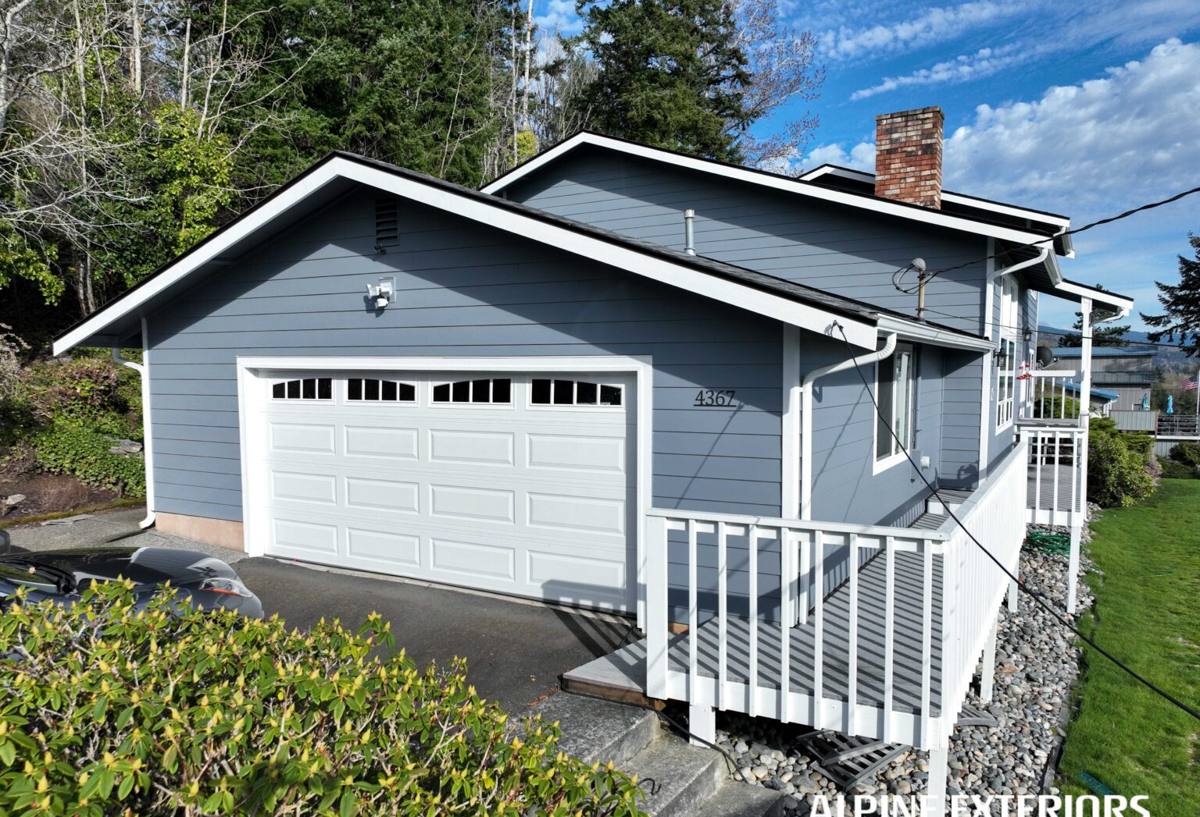
Why Composite Decking Fits Semiahmoo Homes
Composite decking — a blend of wood fiber and polymer — doesn't absorb water the way solid wood does, which matters directly in a climate that puts a deck through repeated wet-dry cycles for most of the year. It won't rot, splinter, or cup the way untreated or poorly maintained wood eventually does, and it doesn't need annual staining or sealing to keep moisture out. For a property exposed to salt air and regular driving rain, that's a real, practical advantage — not a marketing point.
That said, we don't sell composite as maintenance-free, because it isn't, especially here. Moss, pollen, and organic grime still build up on any horizontal surface in a wet, shaded climate, composite included. The difference is that a periodic wash keeps composite looking right, where the same neglect on untreated wood leads to structural decay, not just cosmetic buildup.
Capped vs. Uncapped Composite
Not all composite is built the same. Capped composite has a polymer shell wrapped around the wood-plastic core, which is what actually blocks moisture intrusion — the core itself can still wick water if it's exposed at a cut end that isn't properly treated. Uncapped composite skips that shell and relies on the core material alone, which performs noticeably worse in a high-moisture coastal climate over the long run. For decks we build in the Semiahmoo area, capped composite with correctly sealed cut ends is our standard, not an upsell.
What a Correct Composite Deck Installation Involves
Framing and Substructure
Composite boards are heavier and behave differently under load than solid wood, so joist spacing has to match the manufacturer's spec for that specific product rather than a generic lumber rule of thumb. Ledger boards get proper flashing to keep water from tracking back into the house rim joist, and any metal-to-wood contact point gets isolation tape or a coated fastener to slow the galvanic corrosion that salt air speeds up.
Drainage and Airflow Underneath
A deck built tight to grade with no ventilation underneath traps moisture against the framing, which is exactly the wrong setup for this climate. We build in airflow beneath the deck and avoid fully sealed skirting without vents, so joists and beams get a chance to dry out between rain events instead of staying damp for weeks at a stretch — which is also what keeps moss and mildew from colonizing the underside where nobody's looking.
Fasteners and Hardware
Every fastener and structural connector on a coastal build should be rated for high-moisture, high-salt exposure — stainless steel or a comparable coated fastener system, not standard-grade hardware that starts showing rust streaks within a season or two. Hidden fastener clip systems need to be matched to the specific composite brand and profile being installed; mismatched systems are a common source of board movement and squeaking down the road.
Comparing Decking Materials for a Coastal Whatcom County Property
| Material | Moisture/Salt Behavior | Maintenance | Typical Lifespan | Upfront Cost |
|---|---|---|---|---|
| Pressure-treated wood | Absorbs water, prone to cupping and checking near the coast | Annual staining/sealing, moss removal | 10-15 years with upkeep | Lowest |
| Cedar | Naturally rot-resistant but still absorbs moisture over time | Regular sealing, moss and mildew treatment | 15-20 years with upkeep | Moderate |
| Uncapped composite | Better than wood, but core can wick water at exposed cuts | Periodic cleaning | 15-20 years | Moderate |
| Capped composite | Best moisture and salt resistance of the group | Occasional washing, no sealing needed | 25-30+ years | Higher |
| PVC decking | Fully moisture-resistant, unaffected by salt air | Occasional washing | 25-30+ years | Highest |
There's no universally "right" answer here — it depends on budget, how exposed the specific lot is, and how much upkeep a homeowner actually wants to do. Our job is to walk through those trade-offs honestly rather than push the highest-margin product.
How We Approach a Semiahmoo Decking Project
We start with a site visit, not a phone quote. That means looking at how exposed the lot actually is to wind and salt drift, where the sun and shade fall through the day, how water currently moves across the yard, and what condition the existing structure — if there is one — is in underneath the surface boards. A lot of deck problems we get called out for start below the decking, not on top of it.
From there we help pick a material and board profile that fits both the budget and the exposure, pull the required permit, and build to a spec that accounts for everything above — framing, flashing, drainage, and fastener selection. We walk the finished deck with the homeowner before calling the job done, so there's no guessing about how to care for it going forward.
Moss and Mildew: The Ongoing Reality
No decking material makes moss a non-issue in a climate this wet and shaded for this much of the year — the difference is how much it matters when it shows up. On composite, surface growth is cosmetic and comes off with a periodic wash and a soft-bristle brush. On untreated wood, the same growth traps moisture against the fibers and speeds up rot underneath the surface.
Board spacing and drainage design also play a role most homeowners don't think about until it's a problem: boards installed too tight, or a deck with poor slope and no gap for water to shed, will hold standing water and organic debris longer than a properly built one — which is exactly the environment moss needs. Getting that detail right at installation saves a lot of scrubbing later.
Before You Start: A Homeowner's Checklist
- Get a written scope that specifies capped vs. uncapped composite, not just "composite decking"
- Confirm the fastener and hardware grade being used, especially given the salt air here
- Ask how the deck will be ventilated underneath and how drainage is handled
- Check that the quote includes permitting, not just labor and materials
- Ask what routine maintenance the specific product will actually need year one, year five, year ten
- Get manufacturer warranty details in writing, including what voids them
Why Local Experience on Semiahmoo Decking Projects Matters
A crew that's already worked homes in and around Semiahmoo and Ferndale knows what this climate actually does to a deck over the first few years, not just what a spec sheet says it should do. That means knowing which cut ends need extra sealing because of the salt air, which framing details fail first when a lot gets driving rain off the water, and how Whatcom County permitting works for a residential deck addition or replacement. It also means being straightforward about what a given lot needs, since not every property here has the same wind or moisture exposure, and the right build for a sheltered backyard isn't always the right build for a lot facing open water.
Decking done right in this part of Washington isn't complicated — it just requires paying attention to the details that generic installation advice skips over, and having actually seen how those details hold up locally over time.
If you're weighing decking options for a home in the Semiahmoo area, we're happy to take a look and give you a straight, no-pressure estimate — just fill out the form below.