 Ferndale
 Custer sits close enough to the water and open farmland north of Ferndale that its homes take a different kind of beating than siding in a sheltered subdivision. Wind off the Strait carries salt, storms roll through with real driving rain, and the shoulder seasons stay damp long enough for moss and algae to get comfortable on anything that holds moisture. If your siding is original to the house, or if it's a product that was never built for this kind of exposure, Custer is not a forgiving place to find out the hard way.
This page focuses on one thing: full siding replacement for homes in and around Custer, done with James Hardie fiber cement, and what separates a job that lasts decades from one that starts failing again in five years.
What Custer's Climate Actually Does to Siding
Three conditions drive most of the siding failures we see out this way:
Salt Air
Proximity to Puget Sound and the Strait of Georgia means airborne salt settles on exterior surfaces year-round, not just during storms. Salt accelerates corrosion on exposed fasteners and trim metal, and it degrades cheap paint and coatings faster than inland exposure would. Siding materials and finishes that aren't rated for coastal-adjacent conditions tend to chalk, fade, and break down noticeably sooner here.
Driving Rain
Wind-driven rain doesn't just wet the surface of a wall — it pushes water sideways and upward at laps, seams, and penetrations that would stay dry in a calmer climate. This is where installation quality matters more than product choice. Siding installed without correct overlaps, flashing, and a functioning water-resistive barrier behind it will let water in eventually, no matter what the siding itself is made of.
A Long Moss Season
Whatcom County's damp shoulder seasons stretch out longer than most of the state's, and shaded or north-facing walls in Custer often stay damp for weeks at a stretch. Moss and algae don't just look bad — on wood-based or fiberboard products, sustained moisture contact is exactly what starts rot and delamination. Siding that can't shed water quickly, or that swells when it absorbs it, loses the fight against moss season a little more every year.
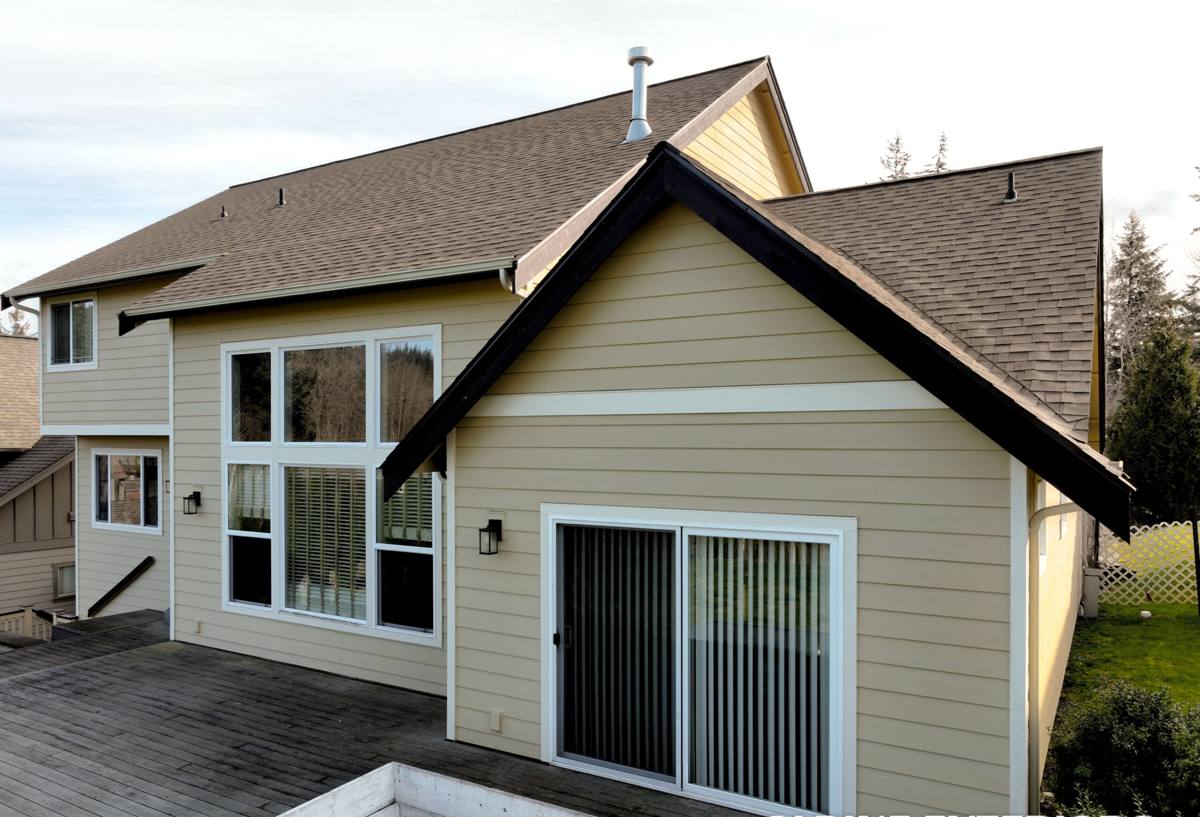
Signs a Custer Home Needs Replacement, Not Repair
Not every siding problem calls for a full tear-off. But there's a point where patching stops making sense and replacement becomes the honest recommendation. Look for:
- Soft, spongy, or crumbling sections when you press on the siding, especially near the bottom courses and around window sills
- Persistent dark staining or streaking that comes back within weeks of cleaning
- Visible gaps, warping, or buckling panels, particularly on walls that face prevailing wind and rain
- Paint that won't hold — bubbling, peeling, or needing repainting every 2-3 years instead of every 7-10
- Moss or algae that returns thick and fast on the same wall sections year after year
- Interior signs like musty smells, peeling interior paint, or soft drywall near exterior walls, which often point to moisture already past the siding
- Siding that's original to a home built more than 20-25 years ago, especially if it's a wood-based product
If you're seeing two or more of these, a full replacement is usually the more cost-effective path — patch jobs on failing siding tend to buy a year or two at best before the same problems resurface somewhere else on the wall.
Why We Only Install James Hardie Fiber Cement
We standardized on James Hardie siding for every job we do, including replacements in Custer, and we don't install vinyl, LP SmartSide, primed spruce, cedar, or other fiber cement brands. That's a deliberate call based on how these products perform in exactly the conditions described above.
| Material | How it holds up to salt air & driving rain | How it holds up through moss season |
|---|---|---|
| James Hardie fiber cement | Non-combustible cement composite; ColorPlus factory finish resists fading and chalking better than field-applied paint | Dimensionally stable when wet — doesn't swell, warp, or delaminate from prolonged moisture contact |
| Vinyl siding | Can warp or crack under UV and temperature swings; seams and J-channels are common water entry points in wind-driven rain | Traps moisture behind panels if not installed with proper drainage gap; won't rot itself but hides problems in the wall behind it |
| Wood-based composite (LP SmartSide) | Engineered wood strand product; edges and cut ends are vulnerable if field-sealing isn't done perfectly on every piece | Wood-based core is more susceptible to swelling and edge deterioration if moisture gets past the coating over time |
| Cedar / primed spruce | Natural wood requires diligent, ongoing coating maintenance to resist moisture intrusion | Most vulnerable to moss, algae staining, and rot in sustained damp conditions without regular upkeep |
None of these are junk products — vinyl and engineered wood sidings have real markets and can perform fine in the right climate with careful installation and upkeep. But for the salt exposure, wind-driven rain, and extended damp seasons Custer sees, we'd rather put one product on every home we touch and know exactly how it performs than juggle multiple systems with different maintenance demands and failure points. Hardie's fiber cement composition, factory-applied finish, and engineered HZ product lines (built specifically for climates like ours) are why it's the only siding we install.
What a Correct Siding Replacement Involves
The siding itself is maybe half the job. The other half is everything that happens before the first plank goes up, and it's where most siding failures — regardless of brand — actually originate.
Tear-Off and Inspection
Old siding comes off in full, not patched around, so the sheathing underneath can be inspected. In a wet climate like this, it's common to find soft or water-damaged sheathing behind failing siding, especially at old penetrations and past repair points. That damage gets addressed before anything new goes on — covering it up just relocates the problem.
Water-Resistive Barrier
A correctly lapped, sealed weather-resistive barrier goes over the sheathing. This is the layer that actually stops bulk water from reaching your wall assembly if wind-driven rain gets past the siding — it matters just as much as the siding itself.
Flashing at Every Penetration
Windows, doors, hose bibs, vents, and any other wall penetration need proper flashing integrated with the water-resistive barrier, shingle-fashion so water is always directed outward and down. This is one of the most common places we find water damage originating on older Custer homes — a missed or improperly lapped flashing detail that took years to show itself.
Drainage Plane
A rainscreen or drainage gap behind the siding lets any moisture that does get past the cladding drain and dry out instead of sitting against the sheathing. It's a small detail that makes a large difference in a climate with this much sustained damp weather.
Installation to Manufacturer Spec
James Hardie siding is engineered to perform when installed to spec — correct fastener type and placement, proper clearances from grade, decks, and roof lines, and correct joint treatment at seams. Installing it any other way voids the manufacturer's warranty and undercuts the whole reason to choose it in the first place. This is a big part of why installation experience matters as much as the product choice.
Our Process, Start to Finish
- Free on-site estimate — we walk the exterior with you, look at current siding condition, trim, and any signs of underlying moisture damage, and give you a straight assessment of whether replacement is warranted
- Detailed proposal — scope of work, Hardie product line and color selection, and a clear cost breakdown, no vague allowances
- Tear-off and sheathing inspection — old siding removed, any damaged sheathing identified and addressed before moving forward
- Weather barrier and flashing installation — the moisture-management layer goes in correctly, at every wall plane and penetration
- Hardie siding installation — installed to manufacturer specification, including fastening, clearances, and joint treatment
- Trim, caulking, and final detailing — the finish work that determines how clean the job looks and how well it sheds water at every edge
- Final walkthrough — we go over the finished job with you before calling it done
What Drives the Cost of a Custer Siding Replacement
| Factor | Why it matters |
|---|---|
| Home size and wall complexity | More square footage, dormers, gables, and corners mean more material and labor |
| Extent of hidden damage | Sheathing repair or replacement behind old siding adds cost but is not optional once found |
| Hardie product line selected | Lap siding, panel systems, and shingle-style products carry different material and labor costs |
| Trim and detail work | Window and door trim, corner boards, and fascia detailing affect both material use and labor time |
| Site access | Steep grades, limited driveway access, or tight lot lines around a Custer property can affect staging and labor time |
We don't publish a flat per-square-foot number because the honest answer depends on all of the above — but every estimate we give breaks the cost down by category so you can see exactly what you're paying for.
Why Local Experience Matters for This Job
A crew that already works siding jobs around Ferndale and Custer knows what to expect before the tear-off even starts — how far the salt air reaches inland on a given property, which wall orientations tend to hide moisture damage in this part of Whatcom County, and how local permitting and inspection works. That's not something a crew driving up from outside the area picks up on the first job. It shows up in fewer surprises mid-project and a finished install that's actually built for the conditions your home sits in, not a generic specification.
After Installation: What Upkeep Actually Looks Like
One of the practical advantages of Hardie fiber cement in a climate like this is how little ongoing maintenance it demands compared to wood-based or field-painted products. A rinse to knock off accumulated salt and grime, an eye kept on caulking at trim joints over the years, and touch-up paint if a panel ever gets damaged is about the extent of it. Homeowners moving from wood or engineered wood siding to Hardie in Custer often tell us the maintenance drop-off is one of the biggest differences they notice.
If your siding is showing wear, or you just want a straight assessment of what condition it's in, we're happy to come take a look. The estimate is free, there's no pressure attached to it, and you'll get a plain explanation of what we find — use the form below to get started.