 Ferndale
 James Hardie Siding, Installed for the Way Sudden Valley Actually Weathers
Sudden Valley sits on the south shore of Lake Whatcom, a private, HOA-governed community wrapped in dense second-growth forest with its own internal road network. It's one of the most heavily shaded residential settings in Whatcom County, and that combination of tree canopy and lake humidity puts a specific kind of pressure on exterior siding — different from what a home closer to open water or downtown Bellingham deals with. This page is about one thing specifically: installing James Hardie fiber cement siding correctly on a Sudden Valley home, and why that takes more than showing up with the right material.
We're based in Ferndale and work throughout Whatcom County, and Sudden Valley is a community we come back to regularly. That matters more than it might sound, because a siding job here isn't the same job as one on an open, sunny lot ten minutes away. The material has to be right, and the installation details have to account for a wall assembly that dries out slower than most.
The Regional Climate Behind Every Siding Decision We Make
Across Whatcom County, three things do most of the damage to exterior materials over time: salt-tinged marine air moving in off the Salish Sea, driving rain that hits walls sideways instead of falling straight down, and a moss and mildew season that runs long in a marine climate. Sudden Valley sits back from open saltwater, so that airborne salt effect is milder here than it is on a waterfront lot in Ferndale or Blaine — but the other two multipliers land harder. Heavy tree cover keeps walls shaded and slow to dry after every rain, and Lake Whatcom adds its own humidity on top of the county's normal rainfall pattern. The net result is a wall assembly that spends more of the year damp than a comparable home on open ground, which is exactly the condition that separates siding materials that hold up from ones that don't.
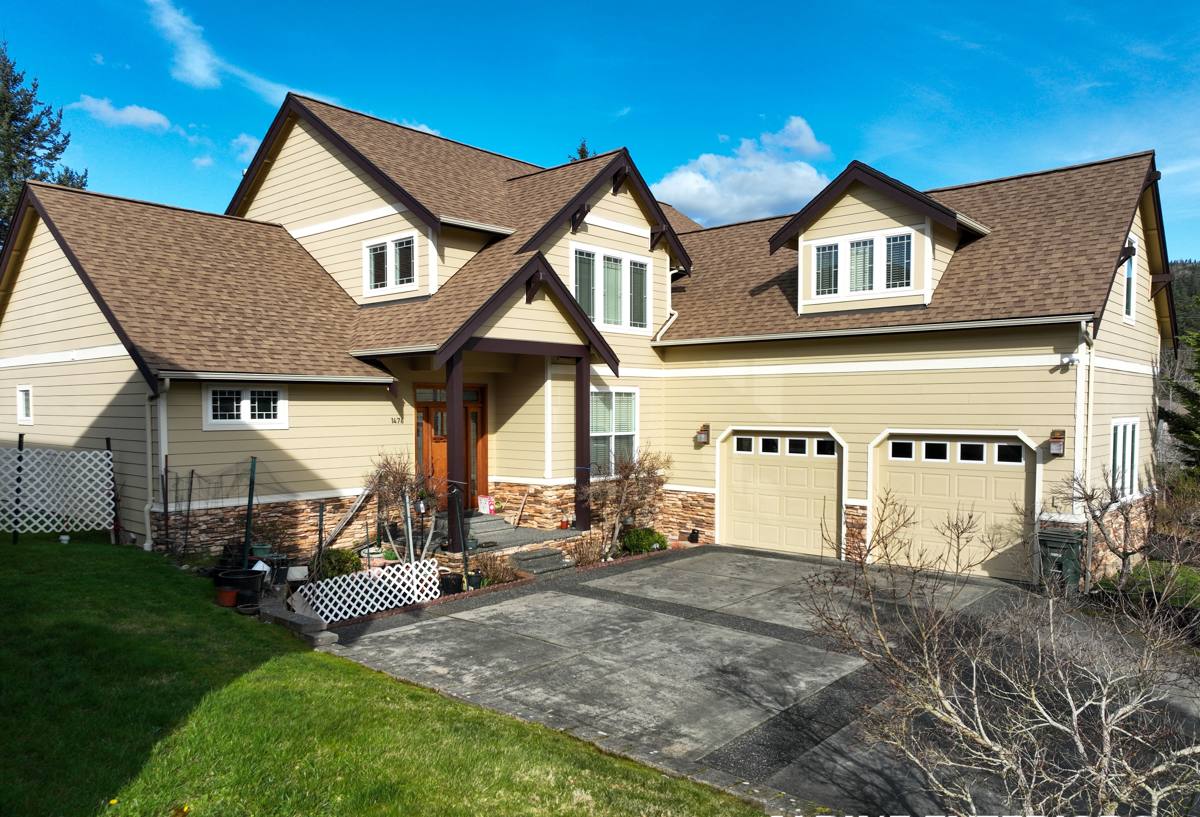
What James Hardie Fiber Cement Siding Actually Is
James Hardie siding is a fiber cement product — a mix of Portland cement, sand, and cellulose fiber, cured into rigid boards and panels. It's not a wood product with a fireproof coating, and it's not a plastic product like vinyl. That base composition is what gives it its two most useful properties for a climate like this: it's non-combustible, and it's dimensionally stable, meaning it doesn't swell, cup, or warp the way wood-based siding does when it goes through repeated wet-dry cycles that never fully finish in a shaded yard.
HZ5 Zone Engineering
Hardie doesn't make one universal product for the whole country. Its HZ product lines are engineered for different regional climate zones, and the HZ5 formulation is built for regions with heavy moisture exposure and freeze-thaw cycling rather than hot, dry conditions. That's the correct specification for Whatcom County generally, and it matters even more on a shaded, damp lot like a typical Sudden Valley property, where the siding rarely gets a full day of direct sun to dry out between storms.
ColorPlus Factory Finish
Hardie's ColorPlus finish is baked onto the board at the factory under controlled conditions, rather than brushed on in the field after installation. That finish resists fading, chalking, and moisture-driven breakdown far longer than site-applied paint — a meaningful advantage on walls that stay damp longer than average, since field-applied paint has a harder time curing and bonding properly in persistently humid conditions.
Product Lines That Make Sense for a Wooded, Lakeside Lot
Not every Hardie product is the right fit for every house, and part of a correct installation is picking the right line for the property.
HardiePlank Lap Siding
The most common choice for Sudden Valley homes, HardiePlank comes in a range of textures and exposures and works well against a wooded backdrop. Its horizontal lap design sheds water efficiently when installed with correct overlap and clearance, which matters on walls that already have less sun exposure to help them dry.
HardiePanel and Board-and-Batten
For homes going for a more vertical, cabin-style look that fits naturally into a forested lake community, HardiePanel with battens is a common alternative to lap siding. It reads differently on the wall but carries the same fiber cement performance underneath.
HardieTrim
Trim boards around windows, doors, and corners take as much weather exposure as the field siding, sometimes more. Matching fiber cement trim to fiber cement siding avoids the mismatch you get when wood trim is paired with fiber cement panels — a combination that tends to show wear unevenly because the two materials handle moisture differently.
What a Correct Installation Actually Involves
Fiber cement only performs the way it's engineered to when it's installed to Hardie's published specifications. On a shaded, damp lot, skipping or shortcutting these details tends to show up as problems faster than it would on a sunnier property, because the wall assembly doesn't get the extra drying margin to cover for a mistake.
- Correct fastener type and spacing — corrosion-resistant fasteners, driven at the intervals Hardie specifies, not "close enough"
- Proper clearance from grade, roof lines, and decks so the bottom edge of the siding never sits in standing moisture
- Rain-screen or drainage detailing behind the panels where the wall assembly calls for it, giving any moisture that gets past the surface a way out
- Properly sealed and caulked joints at every seam, corner, and penetration
- Flashing installed in the correct sequence with the water-resistive barrier, not just tucked on top of it afterward
Comparing Siding Materials for Sudden Valley's Conditions
| Material | Behavior in Shade and Humidity | Maintenance Here | Typical Longevity |
|---|---|---|---|
| James Hardie fiber cement | Dimensionally stable; doesn't swell or warp from repeated wet-dry cycling | Low; factory finish resists moisture-driven fading and chalking | 30+ years with correct installation |
| Vinyl siding | Can trap moisture behind panels in shaded, poorly ventilated walls | Low upfront, but seams and J-channels stay damp longer under canopy | Variable; often shorter on consistently shaded elevations |
| Engineered wood (LP SmartSide and similar) | Wood-based core is moisture-sensitive at cut edges and joints | Moderate to high; edge sealing matters more without sun to help dry it | Depends heavily on installation quality and upkeep |
| Cedar or primed wood | Absorbs and releases moisture readily | High; needs regular refinishing, especially in persistent shade | Shorter without consistent maintenance |
We install James Hardie exclusively — not LP SmartSide, vinyl, Cemplank, Allura, primed spruce, or cedar. That's a professional standard, not a claim that every other product is unusable everywhere. On a shaded, moisture-retentive lot like a typical Sudden Valley property, we'd rather stand fully behind one system than offer a cheaper option that quietly shifts long-term maintenance risk back onto the homeowner.
Our Process for a Sudden Valley Hardie Project
We start with an on-site walk of the existing exterior, paying particular attention to how shade and moisture have affected different walls of the house — that varies more from one elevation to the next in Sudden Valley than it does on an open lot, since a north-facing wall under heavy canopy can stay damp for days after a wall that catches afternoon sun has already dried. From there we put together a clear, written scope covering product line, color, trim details, and any sheathing repair the tear-off reveals, before any work begins. Installation follows Hardie's published fastening, clearance, and flashing specifications as standard practice, not as an upsell — on a lot like this, those details are what determine whether the siding performs for decades or develops problems within a few wet seasons.
Why a Crew That Already Works in Sudden Valley Matters
Sudden Valley is a private community with its own internal roads and an HOA, and a contractor who already works here on a regular basis understands the practical side of that before the first ladder goes up — how to schedule around community access, where material staging is realistic on a hilly lot, and how tree cover changes moisture exposure from one wall to the next even within the same property. That familiarity shows up in decisions that aren't obvious from the curb: which elevations get extra drainage detailing because they rarely see direct sun, how flashing gets lapped correctly on a steep, shaded roofline nearby, and which fastener grade holds up best in a consistently damp, wooded microclimate.
What to Ask Before Hiring Anyone for a Hardie Installation Here
- Confirm they carry current Washington contractor licensing and active liability insurance
- Ask if they're installing Hardie's HZ5 product line, which is the correct specification for this climate zone
- Ask how they handle homes with heavy shade and tree cover, and what drainage or rain-screen detailing they use on those walls
- Ask about experience working within HOA-governed or private-road communities, including access and scheduling
- Get a written scope of work, including fastener type and clearance details, before signing anything
What Affects the Cost of a Hardie Project in Sudden Valley
We don't quote pricing without seeing the property, but a few factors consistently move the scope and cost of a project here more than they might on a simpler lot:
- How much of the existing siding and sheathing needs to come off versus what can stay in place
- Whether hidden moisture damage turns up once old siding is removed — more likely on walls that have stayed shaded and damp for years
- Site access and material staging on a hilly, tree-lined lot with private-road logistics
- Trim complexity — corners, window and door surrounds, and any custom detailing
- Product line and finish selection, since HardiePanel, board-and-batten, and premium ColorPlus finishes carry different material costs than standard lap siding
If you're weighing a siding project on a Sudden Valley property, we're glad to walk the exterior with you and give a straight read on what it actually needs and what it would take to do right. Reach out using the form below for a free, no-pressure estimate.