 Ferndale
 Board & Batten in Nooksack: A Style That Fits the Valley
Board and batten has a long history in the Nooksack River valley, where the look grew out of practical farm buildings before it became a favorite for homes. The vertical lines read as clean and a little rustic at the same time, which is part of why it still shows up on new construction and remodels throughout this part of Whatcom County. But the same vertical orientation that gives board and batten its character also changes how water moves across the wall compared to standard horizontal lap siding — and that matters a lot once you factor in what this valley's weather does to a house year-round.
We install board and batten siding for homeowners in and around Nooksack using James Hardie fiber cement exclusively. This page covers what the style needs to hold up here, what a correct installation actually involves, and how we approach the job from first estimate to final caulk line.
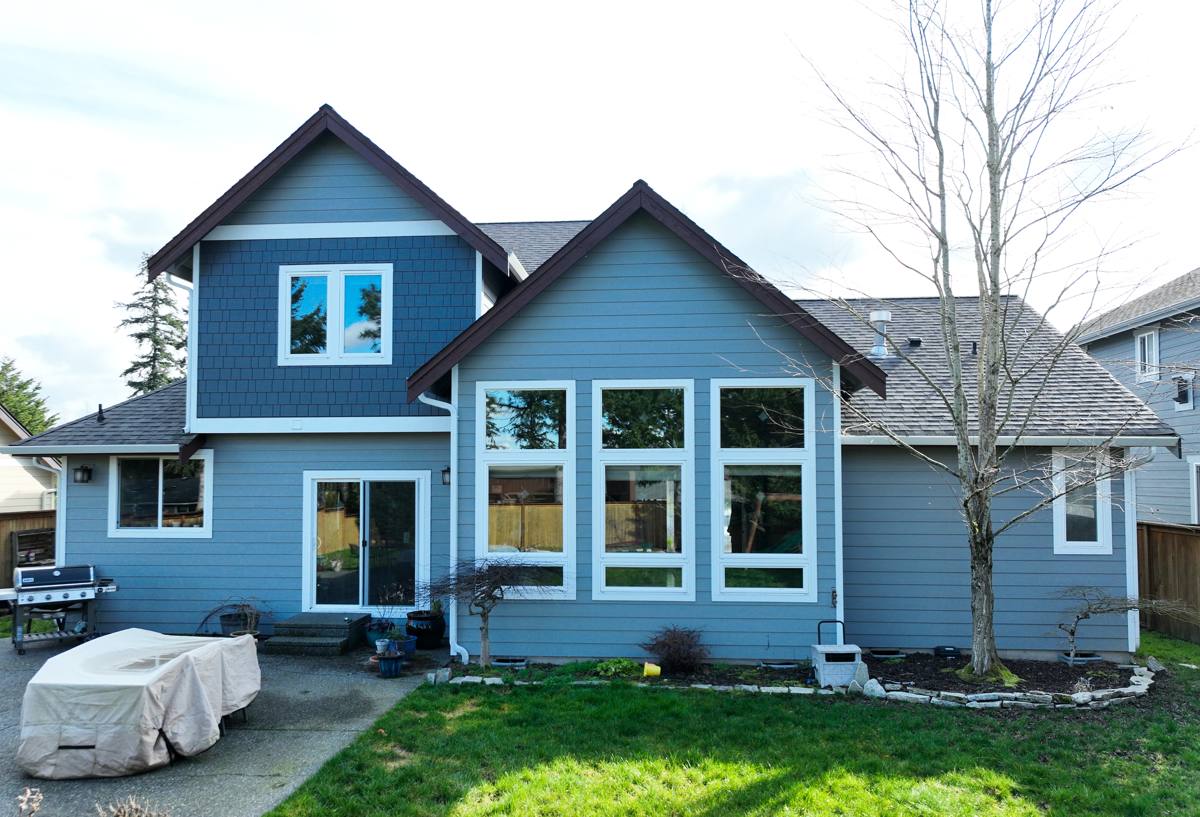
What Nooksack's Climate Does to Vertical Siding
Nooksack sits inland along the river valley, but it's still part of Whatcom County's marine-influenced weather pattern. Moisture-laden air moves in off the Salish Sea and gets pushed up against the foothills, which is a big reason this area sees so much driving, wind-blown rain rather than gentle straight-down rain. Wind-driven rain doesn't just fall on a wall — it gets pushed sideways into every seam, joint, and batten strip it can find. On a board and batten wall, that means the vertical joints between panels and the nail lines through the battens are the places most likely to take on water if they weren't detailed correctly.
The valley's shade, humidity, and long, wet stretches of the year also add up to a moss and algae season that runs longer here than in drier parts of the state. Moss holds moisture against a wall surface far longer than open air would, and on a siding material that isn't engineered to handle sustained damp exposure, that constant moisture is exactly what accelerates rot, delamination, or paint failure. None of this is a reason to avoid board and batten — it just means the material and the installation details have to be right for this specific climate, not a generic one.
Why Vertical Seams Are the Weak Point
Every board and batten wall has more vertical seams per square foot than a lap-sided wall has horizontal ones, and every one of those seams is a potential water entry point if it isn't flashed, fastened, and finished correctly. This is the single biggest reason board and batten has a reputation — fair or not — for maintenance headaches when it's installed as an afterthought rather than as a system.
Why Board & Batten Demands More Precision Than Lap Siding
Lap siding is forgiving. Each course overlaps the one below it, so gravity is doing a lot of the water-shedding work for you. Board and batten doesn't get that same natural overlap — the battens are covering a joint rather than shedding water off a lapped edge, which means the wall assembly behind the siding, not just the visible board, has to be doing real work.
- Panel joints need to land over solid backing, not just floating between studs
- Battens need consistent, correct spacing and fastening — not just even spacing for looks
- A drainage plane and rainscreen gap behind the siding give any water that does get past the surface a way out
- Flashing at windows, doors, and roof-to-wall intersections has to be integrated with the siding plan, not added as an afterthought
- Caulking has to be used at the right joints — and skipped at the ones designed to breathe
Skip any one of these and the wall can look identical for the first year or two while moisture problems build up behind the surface where nobody's looking.
The James Hardie Board & Batten System We Install
We install James Hardie fiber cement exclusively — no vinyl, no LP SmartSide, no unprimed or shop-primed wood battens. For board and batten specifically, that means HardiePanel vertical siding paired with Hardie trim battens, engineered as a matched system rather than mixed-and-matched materials from different manufacturers.
A few things about the material itself matter directly to a house in this valley:
- Fiber cement doesn't feed moss and mildew the way untreated or lightly primed wood can — the surface doesn't provide the organic material that fungal growth needs to establish itself as easily.
- It's dimensionally stable — it doesn't swell, cup, or split the way wood battens can when they take on and release moisture through repeated wet seasons.
- HZ10 formulation is James Hardie's version engineered for wetter, cooler climates like ours, built to resist moisture-related damage better than their standard formulation sold in drier regions.
- ColorPlus factory finish is baked on and warranted, so panels and battens installed at the same time weather at the same rate — no mismatched fading between field boards and trim a few years down the road.
- It's non-combustible, which matters given how dry conditions in this region can turn during the wildfire smoke season even in a generally wet climate.
What a Correct Installation Actually Involves
The material is only half the equation. We've seen good siding fail early because of installation shortcuts, and we've also seen it outlast its warranty when installed to spec. Here's what we treat as non-negotiable on every board and batten job in Nooksack:
Before the First Panel Goes Up
We check the wall sheathing and existing water-resistive barrier condition once old siding is off, since board and batten installed over a compromised barrier is just covering up a problem. We install or verify a weather-resistant barrier and a rainscreen gap so the wall can drain and dry rather than trap moisture against the sheathing.
During Installation
Panels are fastened per Hardie's specifications for this exposure zone, joints are backed by framing or blocking, and flashing is integrated at every horizontal transition — window heads, door heads, roof lines, and the base of the wall. Battens are spaced and fastened correctly, not just eyeballed for a clean look.
Finishing Details
Caulking goes where it belongs — sealing penetrations and specific joints — while other assemblies are left to drain and vent as designed. Cut edges get factory-matched touch-up so the ColorPlus finish stays uniform and the cut fiber cement isn't left exposed to weather.
Board & Batten Material Comparison
| Material | Moss & moisture resistance | Long-term stability | Finish durability |
|---|---|---|---|
| James Hardie fiber cement | Strong — doesn't feed organic growth, engineered HZ10 formulation for wet climates | Dimensionally stable, resists swelling/cupping | Factory ColorPlus finish, warranted |
| Cedar board and batten | Requires ongoing sealing/staining to resist moss and rot | Can cup, split, or twist with repeated wet/dry cycles | Finish needs recoating on a recurring schedule |
| Vinyl board and batten | Doesn't rot, but can trap moisture behind panels if installed without proper venting | Can warp or become brittle with age and temperature swings | Color is through-body but can fade and chalk over time |
| LP SmartSide | Engineered wood core is treated, but any breach in the factory coating exposes wood substrate to moisture | Sensitive to installation quality and coating maintenance | Factory finish requires careful edge sealing at every cut |
Our Process, Start to Finish
- On-site assessment — we look at your current siding, existing moisture damage if any, and the specific exposures your walls face given your lot's orientation and shade.
- Written estimate — a clear scope covering removal, any sheathing repair, barrier and rainscreen installation, and the Hardie board and batten system itself.
- Tear-off and inspection — we don't cover up existing rot or barrier failure; if we find it, we show you before closing the wall back up.
- Installation to Hardie's regional specifications — flashing, fastening, batten spacing, and joint treatment done to spec, not shortcut.
- Final walkthrough — we go over the finished job with you before we consider it done.
Living With Board & Batten Through Moss Season
Even a correctly installed Hardie board and batten wall benefits from basic upkeep, especially on the shaded or north-facing sides of a house that hold moisture longer during the wetter months. This is lighter maintenance than wood siding requires, but it isn't zero.
- Rinse siding surfaces once or twice a year, focusing on shaded areas where moss and algae establish first
- Trim back vegetation and tree branches that keep siding shaded and damp longer than the rest of the house
- Keep gutters clear so overflow doesn't run down the wall face and concentrate water at specific panels or joints
- Check caulked joints periodically and have any cracked or missing caulk replaced before a wet season sets in
- Address any impact damage promptly rather than letting a cracked panel sit exposed through a rainy stretch
Why a Crew That Already Works Nooksack Matters
A siding contractor who only occasionally works this far into the valley is guessing at exposure conditions that a crew working here regularly already knows firsthand — how much wind-driven rain a given orientation actually takes, how long moss season really runs on shaded walls, and which details on a previous job in the area held up and which didn't. That local pattern recognition shows up in the small decisions on your job: where extra flashing attention is worth it, how the rainscreen gap should be handled for your specific wall assembly, and what your particular lot's shade and drainage mean for long-term maintenance.
We stand behind board and batten as a system — James Hardie panels, Hardie battens, and an installation done to the manufacturer's specification for this climate zone — because that's the combination we've seen actually perform in Whatcom County's weather rather than just look good on installation day.
If you're considering board and batten siding for a home in Nooksack, we'd be glad to take a look and walk you through what it would involve for your specific house. Reach out using the form below for a free, no-pressure estimate.