 Ferndale
 Cordata's Climate Is Harder on Siding Than It Looks
Homes in and around Cordata sit close enough to Bellingham Bay and the Strait of Georgia that salt-laden air is a constant, low-grade presence on exterior surfaces — even on days that feel calm. Add in Whatcom County's long wet season, where driving rain off the water comes in sideways more often than straight down, and you've got an environment that tests every seam, joint, and fastener in a siding system. Then there's moss. The combination of shade from mature Pacific Northwest tree cover, persistent moisture, and mild temperatures gives moss and algae a season that runs most of the year, not just a few soggy months.
None of this is unique to one street or one subdivision — it's the reality for exterior materials across north Whatcom County. But it matters more for siding choice than most homeowners realize, because the products that look fine in a showroom or in a drier climate often perform very differently once they've spent a few winters absorbing coastal moisture and hosting moss growth against a damp wall.
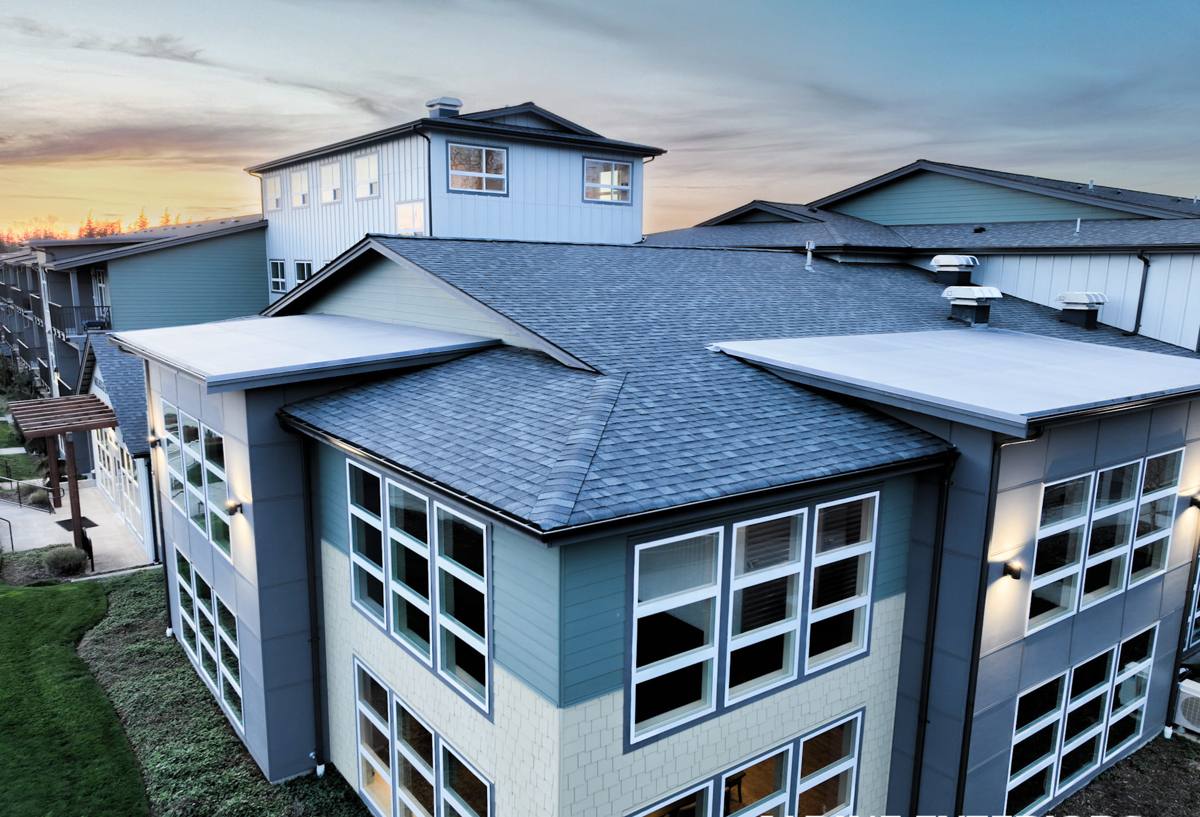
What Cordata Homes Actually Need From Their Siding
Strip away the marketing and a siding product for this area needs to do a short list of things well:
- Resist water absorption at the surface and at cut edges, since standing moisture is what starts rot, delamination, and paint failure
- Hold dimensionally stable through repeated wet-dry cycles instead of swelling, cupping, or opening up gaps at seams
- Take a factory finish that won't chalk, fade, or need repainting every few years in UV and salt exposure
- Resist moss and algae staining, or at least not give organic growth an easy foothold the way raw wood grain does
- Stay stable behind the finish coat — a product that moves with moisture will eventually crack whatever's painted on top of it, even a good paint job
This is the checklist we install against on every Cordata-area job, and it's the reason fiber cement — specifically James Hardie fiber cement — is the only siding product we put on homes here.
Why Fiber Cement Fits This Environment
Fiber cement is a mix of cement, sand, and cellulose fibers, cured into a rigid board that doesn't behave like wood or vinyl in wet conditions. It doesn't absorb water the way wood does, so it isn't feeding rot from the inside out. It doesn't expand and contract with temperature swings the way vinyl does, so seams and butt joints stay tighter over time instead of gapping. And because it's non-combustible, it adds a layer of fire resistance that matters increasingly in Washington, even on the wet side of the state.
James Hardie's HZ5 product line is engineered specifically for climates like ours — colder, wetter Pacific Northwest and northern-tier conditions — with a formulation and installation spec built around freeze-thaw cycling and sustained moisture exposure rather than dry-heat climates. That's not a marketing distinction; it changes how the board is engineered to handle water at the cut edge and how it's meant to be installed relative to grade, decks, and roof lines.
The factory-applied ColorPlus finish is the other half of the equation. It's baked on under controlled conditions rather than field-applied with a brush or sprayer, which means better adhesion and more consistent coverage than a site-applied paint job — and a finish that resists the chalking and fading that salt air and UV exposure accelerate on lesser coatings.
What a Correct Fiber Cement Installation Actually Involves
Water Management Behind the Siding
Fiber cement is only as good as what's behind it. A correct install starts with a weather-resistant barrier and properly lapped, integrated flashing at every window, door, and horizontal transition — siding is the last line of defense, not the only one. In a climate that gets sustained driving rain off the water, gaps in the drainage plane behind the siding are where problems start, and they don't show up until years later as rot in the sheathing.
Fastening and Clearances
James Hardie specifies fastener type, spacing, and placement precisely, along with minimum clearances from grade, roofing, decks, and other horizontal surfaces where water collects or splashes back. Skipping these clearances is one of the most common ways fiber cement jobs fail early — not because the board is defective, but because it was installed too close to a wet surface and never had a chance to shed water properly.
Caulking, Joints, and Trim
Butt joints, corners, and trim intersections need the right sealant, applied correctly, at every seam exposed to wind-driven rain. In a marine climate like Cordata's, a caulking shortcut that might get away with it in a drier region shows up fast here as staining, moisture intrusion, or an early paint failure at that specific joint.
How Fiber Cement Compares to the Alternatives
We get asked regularly why we don't install vinyl, cedar, primed spruce, or other fiber cement brands. Here's the honest comparison for this specific climate:
| Factor | James Hardie Fiber Cement | Vinyl | Cedar / Wood |
|---|---|---|---|
| Moisture resistance | Engineered for wet climates (HZ5), doesn't rot | Won't rot, but seams can let water behind it | Absorbs water; rot risk without diligent upkeep |
| Moss/algae resistance | Factory finish resists staining and growth | Smooth surface, but seams and J-channels trap moisture | Grain texture and moisture retention favor moss |
| Dimensional stability | Stays flat and tight through wet-dry cycles | Expands/contracts with temperature, can warp or buckle | Swells, cups, and checks with repeated moisture cycling |
| Finish longevity | Factory ColorPlus finish, long repaint interval | Color molded in but fades and chalks over time | Needs repainting or restaining every few years |
| Fire resistance | Non-combustible | Combustible, can melt or deform near heat | Combustible |
We'd add one more comparison that doesn't fit neatly in a table: other fiber cement brands, like LP SmartSide (which is engineered wood, not cement, despite sometimes being lumped in), Cemplank, or Allura. Some of these are reasonable products. Our decision to install only James Hardie isn't a claim that everything else is bad — it's that we've standardized our crews, our installation details, and our warranty conversations around one system we know inside and out, rather than switching specs and techniques from job to job. In a climate this unforgiving of installation shortcuts, consistency matters as much as the product itself.
Our Process, Start to Finish
A Cordata-area fiber cement project runs through the same sequence on every home:
- On-site inspection of the existing siding, sheathing, and any moisture damage already present, especially around windows, decks, and roof-to-wall transitions
- A written estimate that spells out the Hardie product line, profile, and color, along with the scope of trim, flashing, and water-barrier work included
- Removal of the old siding and inspection of the sheathing underneath — this is often where hidden rot or past water intrusion turns up
- Repair of any damaged sheathing before anything new goes back on the wall
- Installation of the weather-resistant barrier and flashing details at every penetration and horizontal transition
- Fiber cement installation to Hardie's fastening, clearance, and joint specifications
- Final caulking, trim, and a walk-through so you know exactly what was done and why
Every step matters more here than it would in a drier climate, because a shortcut at any one of them tends to surface as a moisture problem within a few wet seasons rather than a decade down the road.
Living With Fiber Cement Siding in a Wet, Mossy Climate
Fiber cement is genuinely low-maintenance compared to wood, but "low-maintenance" doesn't mean "no maintenance," especially with moss season running long in this part of Whatcom County. A simple annual routine keeps it performing the way it's designed to:
- Rinse the siding down once or twice a year, focusing on shaded, north-facing walls where moss and algae tend to establish first
- Keep gutters clear so overflow isn't running down the face of the siding during heavy rain
- Trim back vegetation and tree branches that keep a wall shaded and damp longer than it needs to be
- Check caulking at trim and joints every couple of years and touch up anywhere it's cracked or pulled away
- Watch for any staining or discoloration near grade, decks, or roof lines — it's usually the first sign of a clearance or flashing issue worth checking sooner rather than later
None of this is heavy work, but skipping it entirely in a climate this wet will shorten the life of any siding product, fiber cement included.
Why It Matters That We Already Work in This Area
Installation details that work in a dry inland climate don't automatically translate to a marine environment with sustained coastal rain and salt exposure. A crew that installs fiber cement across a range of climates has to relearn or double-check clearance and flashing specifics every time they land on a job like this. A crew that works Ferndale and the surrounding Whatcom County communities regularly already knows how the wind-driven rain patterns off the bay behave, where moss problems tend to start on a given wall orientation, and how the local building department expects flashing and drainage details to be documented and inspected.
That familiarity shows up in the small decisions — where extra flashing gets added even when it's not strictly the minimum code requirement, which wall orientations get an extra caulking pass, how tight the clearance is kept above a deck ledger board. Those are the details that separate a fiber cement job that looks right at handoff from one that still looks right after five wet winters.
What Drives Cost on a Cordata Fiber Cement Project
Every home is different, but the same handful of factors drive the estimate on most fiber cement projects in this area:
| Cost Factor | Why It Matters |
|---|---|
| Condition of existing sheathing | Hidden rot or water damage found during tear-off adds repair scope before new siding can go on |
| Home size and wall complexity | More corners, gables, and trim details mean more cutting, fitting, and flashing work |
| Siding profile and accessories | Lap width, trim style, and any accent details (shakes, panels) affect material and labor |
| Existing moisture or moss damage | Areas with established rot or long-term moss growth often need extra sheathing and framing repair |
| Access and site conditions | Tight lots, mature landscaping, or multi-story walls affect staging and labor time |
We won't quote a number without seeing the home, but these are the factors that move an estimate up or down, and we'll walk through each one with you during the on-site visit.
If you're weighing siding options for a home in the Cordata area, we're happy to take a look and give you a straightforward, no-pressure estimate — including an honest read on what your current siding and sheathing are dealing with before we talk about replacement.