 Ferndale
 Building Decks for Marietta's Marine Climate
Marietta sits close to the water on Whatcom County's shoreline, just outside Ferndale, and that location shapes everything about how a deck should be built here. Homes in this part of the county deal with a combination most inland builders never have to think about: salt-laced air off the bay, driving rain that comes in sideways during fall and winter storms, and a moss season that can stretch for most of the year under tree cover. A deck built to a generic spec sheet will survive a season or two before those three factors start finding the weak points. A deck built for Marietta specifically holds up for decades.
This page is about custom deck construction for homeowners in Marietta and the immediate Ferndale area — what the climate demands, what a correctly built deck actually involves below the surface, and how we approach the work as a crew that already builds in this exact environment.
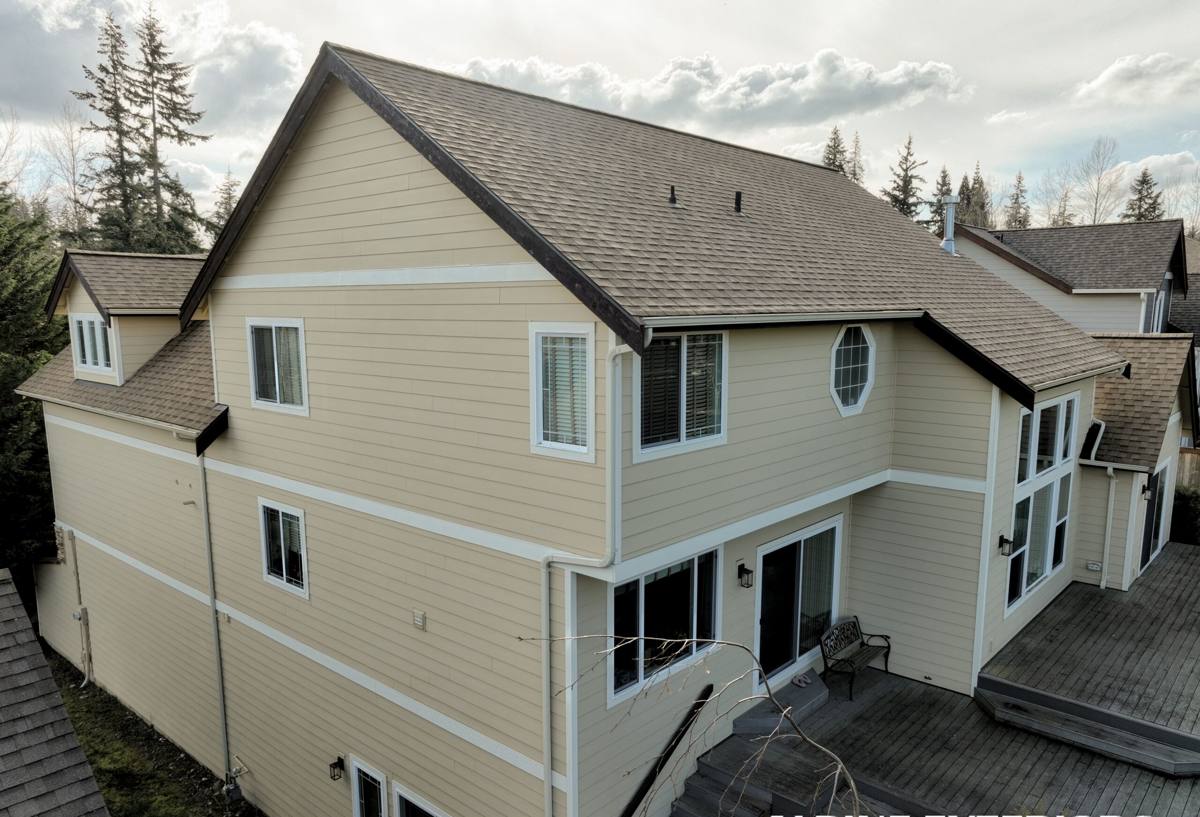
What Salt Air and Driving Rain Actually Do to a Deck
Salt air is corrosive to bare or poorly coated metal, and it doesn't take a direct ocean view for it to matter — Marietta's proximity to Bellingham Bay means airborne salt reaches decks that are nowhere near the shoreline. The fasteners, brackets, and hangers holding a deck's frame together are the parts most exposed to this, and they're also the parts a homeowner never sees once the decking boards go down. Standard electro-galvanized hardware corrodes faster in this environment than it would twenty miles inland, and once a joist hanger or ledger bolt starts rusting, it's weakening the structure from a spot nobody's checking.
Driving rain adds a second problem: water intrusion at the points where a deck meets the house. Whatcom County's winter storms don't fall straight down — wind pushes rain sideways into ledger boards, stair stringers, and any spot where decking meets siding or a door threshold. Without correct flashing at the ledger connection, water works its way behind the band board and into the house framing, and that damage is often invisible until siding or interior finishes start showing it.
The two failure points we see most
- Rusted or corroding fasteners and hardware in the substructure, invisible from the walking surface
- Missing or undersized ledger flashing at the house connection, letting rain track into wall framing
Moss Season: The Slow Problem Most Decks Never Solve
Whatcom County's moss and algae growth isn't a cosmetic nuisance — it's a maintenance and safety issue. Shaded decks, decks under conifer cover, and decks that don't get much direct sun through fall and winter stay damp for long stretches, and that damp surface is exactly what moss and algae need to take hold. On wood decking, moss holds moisture against the board and accelerates rot. On any decking material, a mossy or algae-covered surface gets slick fast, which matters on stairs and any deck used for daily foot traffic.
The fix isn't just a pressure wash every spring. It's a combination of decking material choice, board spacing that lets air move underneath, and a design that accounts for how much shade the specific lot actually gets — something that varies a lot from one Marietta yard to the next depending on tree cover and orientation.
Decking Material Options for This Climate
There's no single "best" decking material — there's a best fit for a given budget, sun exposure, and how much upkeep a homeowner wants to do. Here's how the common options actually perform under Marietta's specific conditions.
| Material | How it handles salt air & rain | How it handles moss/algae | Maintenance |
|---|---|---|---|
| Pressure-treated wood | Good if fasteners and hardware are corrosion-rated; wood itself handles moisture with proper sealing | Needs regular cleaning and re-sealing or moss takes hold fast in shaded spots | Highest — annual cleaning, periodic staining/sealing |
| Cedar | Naturally moisture- and rot-resistant, but still needs sealed fasteners | Same exposure risk as any wood in shade; needs the same upkeep | High — periodic oiling to maintain appearance and protection |
| Composite decking | Handles moisture and salt exposure well; doesn't absorb water like wood | Surface texture matters — some composites resist algae growth better than others | Low — occasional washing, no sealing or staining |
| PVC/capped polymer decking | Fully sealed surface, best resistance to moisture intrusion into the board itself | Smooth, non-porous surface sheds moss and algae most easily | Lowest — washing only, no finish to maintain |
For homes closer to the water or under heavier tree cover, we generally steer clients toward composite or PVC decking simply because the maintenance burden of wood in a damp, shaded, salt-air environment is real — not because wood is a bad product, but because it demands more consistent upkeep than most homeowners actually keep up with once the deck is a few years old.
What's Underneath Matters More Than What's On Top
A deck's decking boards get all the attention, but the framing underneath is what determines whether it lasts. In Marietta's climate, we treat the substructure as the priority, not an afterthought:
Fasteners and hardware
We use stainless steel or heavy-coated corrosion-resistant hardware throughout the frame — hangers, structural screws, ledger bolts — rated for the moisture and salt exposure this area sees. This costs more upfront than standard galvanized hardware, but it's the difference between a frame that's still sound in twenty years and one that's quietly rusting from year five.
Ledger flashing and house connection
Where the deck attaches to the house, correct flashing — installed in the right sequence with the siding or house wrap, not just caulked over the top — is what keeps driving rain from tracking into the wall framing. This is the single most common spot we find water damage on decks that were built without it done right the first time.
Joist protection and airflow
Joist tape over the top of framing lumber sheds water before it can sit and soak in, extending the life of the frame regardless of what decking material sits on top. We also design board spacing and substructure ventilation so air moves underneath the deck, which matters directly for keeping moss and algae from taking hold on the underside and around footings.
Our Process, Start to Finish
- On-site assessment — we look at sun exposure, tree cover, drainage, and how the deck will connect to the house before recommending a material or layout.
- Design and material selection — sized and specified for the actual conditions of the property, not a one-size-fits-all package.
- Permitting — we handle the permit process with Whatcom County or the City of Ferndale as applicable, so the project is inspected and compliant from the start.
- Framing and substructure — corrosion-resistant hardware, correct ledger flashing, joist protection, and structural spacing done before any decking goes down.
- Decking installation — boards, stairs, and railings installed to spec, with attention to drainage and airflow underneath.
- Final walkthrough — we go over the finished deck with the homeowner, including what maintenance the specific material and site conditions will actually require.
Permits and Local Requirements
Deck construction in and around Ferndale typically requires a building permit, with requirements around footing depth, guardrail height, and structural attachment that are inspected before and after the work. Because Marietta is close to the shoreline, some projects may also fall under additional review depending on exact location and scope. We handle this process as part of the job rather than leaving it to the homeowner to sort out, and we build to pass inspection the first time — not to the minimum that barely gets by.
Why a Crew That Already Works Marietta Matters
General contractors from outside the area can build a structurally sound deck on paper and still get the details wrong for this specific environment — the fastener grade, the flashing detail, the material choice for a shaded, tree-covered lot near the water. We work in Ferndale and the surrounding Whatcom County communities regularly, which means we're not guessing at how much moss pressure a given lot sees or how far salt air travels from the shoreline — we've already built and maintained decks under those exact conditions. That local experience shows up in the small decisions: which hardware grade to spec, how much board spacing to leave, where flashing needs the most attention on a given house.
Deck Maintenance Checklist for Marietta's Climate
Whatever material a deck ends up being, a few habits go a long way toward keeping it sound in this climate:
- Clear leaves, needles, and debris from between boards and off the deck surface regularly, especially under tree cover
- Wash the surface at least once or twice a year to keep moss and algae from establishing, more often on shaded decks
- Check stairs and any high-traffic areas for slickness after long wet stretches, particularly late fall through winter
- Have the substructure — hardware, ledger connection, framing — inspected every few years, since these are the parts most affected by salt air and rain and the least visible day to day
- Keep gutters and downspouts near the deck clear so runoff isn't dumping extra water onto or under the deck surface
If you're planning a new deck in Marietta or need an honest look at whether an existing one is holding up the way it should, we're happy to come take a look. Reach out for a free, no-pressure estimate using the form below.