 Ferndale
 Fiber Cement Siding Built for Kendall's Climate
Kendall is one of the smaller communities we work in out from Ferndale, and homes here deal with the same underlying climate pressures as the rest of Whatcom County: salt-tinged air moving through the region, rain that arrives sideways more often than straight down, and a moss and mildew season that can stretch for the better part of the year on shaded exteriors. Siding on a Kendall home isn't decorative trim, it's the first and most exposed layer of protection against all of that, year after year. This page covers fiber cement siding specifically for Kendall homes: what the climate actually demands, what a correct installation looks like, and how our process works from first estimate to final walkthrough.
We install James Hardie fiber cement siding exclusively. Not because it's the only siding product on the market, but because it's the one we've found holds up to this specific combination of moisture, salt exposure, and prolonged shade without asking a homeowner to maintain their way around its weaknesses.
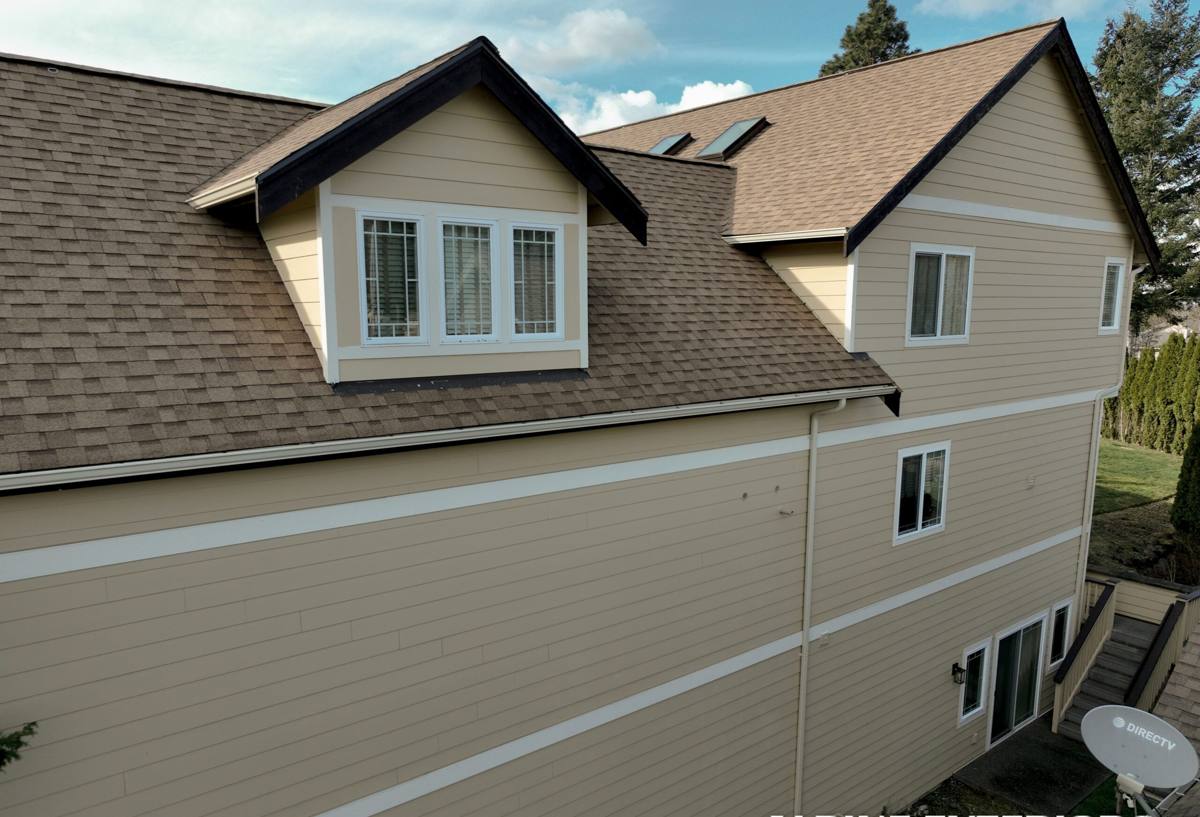
What Kendall's Weather Actually Does to Exterior Siding
Salt-Tinged Air
Homes throughout this part of Whatcom County get regular exposure to salt-laden air moving inland, and that exposure doesn't announce itself the way a storm does. It works slowly, breaking down lower-grade paint films and accelerating corrosion in fasteners, trim hardware, and anything metal left unprotected. A siding product with a weak factory finish, or one that depends on field-applied paint holding up indefinitely, tends to show that wear first at the seams and cut edges where the coating is thinnest to begin with.
Wind-Driven Rain
Rain in this part of the state rarely falls in a straight line. Wind pushes it sideways and up under laps, trim returns, and any gap in the wall assembly that wasn't detailed correctly. That's a heavier load on a siding system's water management than annual rainfall totals suggest, and it's the condition that separates a properly lapped, properly flashed installation from one that looks fine until the first real storm finds its way in.
A Long Moss and Mildew Season
Mild temperatures, tree cover, and consistent dampness combine into a moss season that runs most of the year across this region. It shows up first on north-facing walls and shaded elevations, well before it's visible from the street or driveway. Any siding material that stays wet for extended stretches becomes a growth surface, and once moss and mildew take hold, they hold moisture against the wall even longer, which speeds up whatever damage was already starting underneath.
Why We Install Only James Hardie Fiber Cement
James Hardie siding is a cement-based composite made from portland cement, sand, and cellulose fiber, cured into planks and panels. The core material is inorganic, which means it doesn't absorb water and swell the way a wood-based product can, and it doesn't give fungus or moss an organic surface to feed on the way untreated or lightly treated wood products do. Most of what we install carries the factory-applied ColorPlus finish, a coating baked on under controlled conditions rather than brushed on after the siding is already on the wall.
Hardie also builds a version of its product line, HZ5, specifically engineered for regions with heavier moisture exposure and more freeze-thaw cycling than the national average. That's a closer match for a Kendall home's actual exposure than a generic siding formulation built for a drier climate. Combine the inorganic core, the factory finish, and a climate-appropriate formulation, and you get a material with a real margin for error in a climate that doesn't offer much of one. That combination, along with a warranty structure that's typically long-term and transferable when the installation follows spec, is why we standardized on this one system instead of carrying a broader product catalog.
Matching the Right Hardie Product Line to a Kendall Home
Not every Hardie product is the right fit for every house. Style, exposure, and the look a homeowner wants all factor into which line makes sense.
| Product Line | What It Is | Best Fit For |
|---|---|---|
| HardiePlank Lap Siding | Traditional horizontal lap boards, the most common Hardie profile | Most Kendall homes; wide range of textures and exposures |
| HardiePanel Vertical Siding | Large-format vertical panels, often paired with battens | Modern builds, accent walls, or homes wanting a board-and-batten look |
| HardieShingle Siding | Staggered or straight-edge shingle-profile panels | Craftsman-style homes or accent gables |
| HardieTrim Boards | Fiber cement trim for corners, fascia, and window and door surrounds | Any full re-side, to keep trim material consistent with the field siding |
The right choice usually comes down to the home's existing architecture and how much of the exterior is exposed to direct wind and rain versus sheltered under eaves or tree cover. We walk through those options during the estimate rather than defaulting everyone to the same profile.
What a Correct Fiber Cement Installation Involves
Material choice is only half the equation. Fiber cement performs the way it's designed to only when the installation details are followed exactly, and skipping steps is how a good product ends up with early problems on an actual house.
Tear-Off and Substrate Inspection
A full tear-off down to the sheathing is the only reliable way to find moisture damage, soft spots, or rot that's been developing behind old siding, often for years before it's visible from inside the house. That inspection step matters more in a climate where trapped moisture has had a long time to do quiet damage.
Clearances and Fastening
Hardie specifies minimum clearances from grade, roofline, and other transitions, along with a fastening pattern that keeps boards secure without over-driving nails or screws that can crack the material or compromise its water resistance. Those clearances exist specifically to keep splash-back and standing moisture away from the bottom edge of the siding.
Flashing and the Weather-Resistive Barrier
Correct integration between the house wrap, flashing at windows and doors, and the siding itself is what actually keeps wind-driven rain out of the wall assembly. Most siding failures we see on tear-offs trace back to a flashing detail that was skipped or done casually, not to the siding material itself.
Joint and Seam Detailing
Butt joints, corners, and penetrations for vents, lights, and hose bibs are where water finds a way in if they're not sealed and lapped correctly. On a home with the kind of sustained wind-driven rain exposure common here, those details carry more weight than they would in a drier climate.
Our Process, Start to Finish
- Initial walkthrough and estimate: We look at the existing siding, the home's exposure, and any visible moisture issues before quoting anything.
- Product and color selection: We walk through Hardie product lines and ColorPlus color options that fit the home and the homeowner's preference.
- Tear-off and substrate repair: Old siding comes off, the sheathing gets inspected, and any rot or damage is repaired before new material goes up.
- House wrap and flashing installation: The weather-resistive barrier and flashing at every opening are installed or verified before siding starts.
- Siding installation: Boards, panels, or shingles go up to Hardie's fastening and clearance specifications.
- Trim, caulking, and final detailing: Corners, trim boards, and joints get finished and sealed.
- Final walkthrough: We go over the finished job with the homeowner and handle warranty registration.
Why Hiring a Crew That Already Works in Kendall Matters
A crew that regularly works Kendall and the surrounding Ferndale area already knows the permitting process for Whatcom County, has a working sense of how exposure varies from a sheltered, tree-lined lot to a more open one, and isn't guessing at how this climate treats an exterior over time. That local familiarity shows up in smaller, practical decisions too: timing installation around the wetter stretches of the year, staging material so it isn't sitting exposed to moisture before it goes on the wall, and knowing which details tend to get skipped by crews that don't work this area often. It also matters after the job is done. A local company is still around if a warranty question comes up years later, rather than having moved on to a different region entirely.
Cost Factors for a Kendall Fiber Cement Re-Side
| Factor | What It Affects | Why It Matters Here |
|---|---|---|
| Tear-off vs. overlay | Labor scope and access to the substrate | Tear-off is the only way to catch hidden moisture damage common in this climate |
| Substrate condition | Repair costs before new siding goes on | Years of trapped moisture behind failing siding can rot sheathing |
| Product line and profile | Material cost per square | Lap siding, panel, and shingle profiles carry different material and labor costs |
| Trim scope | Total material and labor | More corners, gables, and window trim mean more joints exposed to wind-driven rain |
| Home size and access | Labor time and equipment needs | Multi-story homes or tight lots take longer and require more setup |
Exact costs depend on the specific home and what tear-off reveals, which is why we walk the property in person rather than quoting off a generic price list.
Questions to Ask Before You Hire
- Ask which specific siding products the contractor installs and why, not just what's cheapest to bid.
- Ask how they handle a Kendall home's exposure to wind-driven rain in their flashing and sealing details.
- Ask for proof of current Washington state contractor licensing and insurance.
- Ask what happens if tear-off reveals rot or moisture damage behind the existing siding.
- Ask what the manufacturer's warranty actually requires to stay valid, including installation conditions.
If you're weighing siding options for a Kendall home, we're glad to come take a look, walk you through what we're seeing, and put together a straightforward, no-pressure estimate. Use the form below to get started.