 Ferndale
 Sandy Point sits close enough to the water that its siding problems aren't quite like the rest of Whatcom County's. Homes here take a steady diet of salt-laden air, wind-driven rain that hits walls sideways instead of straight down, and a moss season that runs longer than almost anywhere else in the region. Siding that would hold up fine a few miles inland can fail early out here — and siding repair done without accounting for those conditions tends to fail again within a few years.
This page is about one thing: repairing siding on Sandy Point homes correctly, with the local climate built into every decision, from diagnosis to material choice to the details of the install.
Why Sandy Point Siding Wears Differently
Three conditions stack on top of each other here in a way that's uncommon even for the rest of Ferndale and Whatcom County:
- Salt air: Airborne salt accelerates corrosion on fasteners, flashing, and any exposed metal trim. It also settles into porous siding surfaces and can contribute to premature paint and coating breakdown.
- Driving rain: Wind off the water pushes rain into laps, seams, and butt joints that would stay dry in a calmer inland setting. Any gap in the water-shedding details becomes a moisture entry point.
- Extended moss season: Consistent moisture and shade on north- and west-facing walls let moss establish early in fall and hang on into late spring, holding water against the siding surface for months at a stretch.
None of these conditions is unique to Sandy Point on its own. What's unique is having all three at once, which is why repair work that doesn't specifically account for coastal exposure often comes back to bite a homeowner within a couple of seasons.
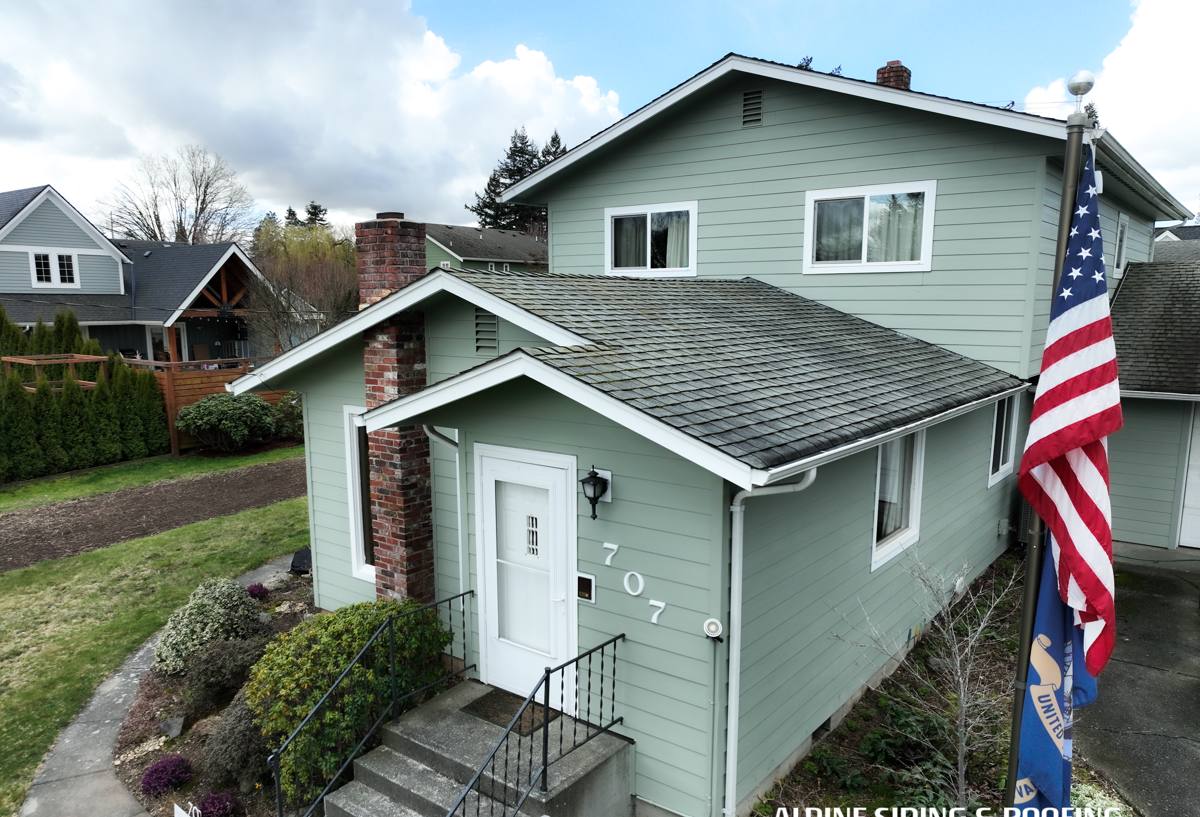
What Correct Siding Repair Actually Involves
A repair that just patches the visible damage and moves on is treating a symptom, not the cause. On a Sandy Point home, a proper repair means answering a few questions before any new material goes up:
1. Diagnose the water path, not just the damage
Cracked, swollen, or delaminating siding is almost always downstream of a water intrusion point — a failed caulk joint, a piece of flashing that's corroded through, a lap that's been pushed open by wind, or a seam where moss has been holding moisture against the wall. Replacing the damaged board without fixing the entry point just buys a year or two before the same spot fails again.
2. Check what's behind the siding
Once siding is off, we look at the house wrap or building paper, the sheathing, and any framing in the area. In coastal-exposure homes it's common to find some degree of moisture staining or soft sheathing around long-standing leaks, especially near window and door trim, roof-to-wall transitions, and low points where wind-driven rain collects. Repairing over compromised sheathing doesn't hold — it needs to be addressed as part of the same job.
3. Match or upgrade the material — deliberately
Sometimes a repair calls for matching the existing siding as closely as possible. Other times, especially on a wall that's failed more than once, it's worth switching that section to a material better suited to the exposure it's getting, even if the rest of the house stays as-is for now.
4. Rebuild the water-shedding details correctly
Flashing, kick-out flashing at roof-wall intersections, proper lap orientation, and correctly sealed (or intentionally unsealed, per manufacturer spec) joints matter more here than in a sheltered inland location. Skipping these details is the single biggest reason coastal siding repairs fail early.
Moss: A Maintenance Issue That Becomes a Repair Issue
Moss on Sandy Point roofs and walls isn't just cosmetic. Left alone through a long wet season, moss holds water directly against the siding surface, keeps that surface from drying out between rains, and — on some siding types — works into seams and joints as it grows. That sustained moisture exposure is a direct contributor to paint failure, substrate softening, and, on wood-based products, rot.
Part of an honest repair assessment is looking at where moss has been established on the walls (not just the roof) and treating that as a contributing cause, not a separate issue. In some cases that means recommending a change to a shaded wall's landscaping or drainage rather than just fixing the siding and leaving the underlying moisture problem in place.
Why We Only Repair and Replace With James Hardie Fiber Cement
We don't install vinyl, LP SmartSide, Cemplank, Allura, primed spruce, or cedar. That's a deliberate standard, not a sales preference, and it matters even more in an exposure like Sandy Point's:
- Non-combustible: Fiber cement doesn't contribute fuel to a fire the way wood-based or vinyl products can.
- Engineered for moisture exposure: James Hardie's HZ product lines are formulated and tested for specific climate zones, including wet, marine-influenced conditions like this one — that's a meaningful difference from a general-purpose siding product.
- Factory-applied ColorPlus finish: The finish is baked on under controlled conditions rather than field-painted, which holds up better against salt air and UV than most site-applied coatings, and it comes with its own finish warranty.
- Dimensionally stable: Fiber cement doesn't swell and shrink with moisture the way wood-based siding does, which means tighter, more durable joints over time — a real advantage when joints are exactly where wind-driven rain tries to get in.
- Strong transferable warranty: Backed by a manufacturer warranty that holds up over decades of coastal exposure, and transfers if the home sells.
To be fair to the alternatives: vinyl is inexpensive and low-maintenance in mild conditions, LP SmartSide and cedar have real appeal for certain looks and budgets, and primed spruce has its place in some applications. But none of them hold up to salt air, driving rain, and a long moss season as consistently as properly installed fiber cement, and we'd rather stand behind one product we trust completely than install several we have reservations about.
Our Repair Process for Sandy Point Homes
| Step | What Happens |
|---|---|
| 1. On-site assessment | We walk the exterior, identify all damaged and at-risk areas (not just the spot that prompted the call), and check moss buildup, flashing condition, and joint integrity. |
| 2. Remove damaged siding | Affected boards come off carefully so we can inspect what's underneath without unnecessary disruption to sound siding nearby. |
| 3. Inspect and repair the water barrier | House wrap, flashing, and sheathing are checked and repaired or replaced as needed before anything new goes back up. |
| 4. Rebuild details to spec | Flashing, laps, and joints are installed per manufacturer requirements for this climate zone — not just "close enough." |
| 5. Install and finish | New James Hardie siding is installed, matched to existing coursing and reveal, with ColorPlus finish where a color match is needed. |
| 6. Final walk-through | We review the completed work with the homeowner and flag anything else worth keeping an eye on, including moss-prone areas. |
Signs a Sandy Point Home Needs Siding Repair Soon
- Visible moss growth on siding itself, not just the roof or gutters
- Soft or spongy spots when pressed, especially near the bottom courses and around trim
- Paint that's bubbling, peeling, or chalking faster than expected
- Streaking or staining below joints, nail heads, or trim pieces
- Gaps that have opened up at butt joints or corners
- Rusty streaks near fasteners or flashing
- Any section that's been patched before and is showing damage again
Repair vs. Replace: How We Help You Decide
Not every damaged section needs a full re-side, and not every "just patch it" request is actually the right call. A few factors we weigh with the homeowner:
Repair usually makes sense when:
Damage is isolated to one or two areas, the sheathing and water barrier underneath are still sound, and the rest of the siding is performing well.
Replacement is worth considering when:
The same wall or area has failed more than once, damage is spread across multiple elevations, the siding is old enough that matching material is difficult, or the underlying water barrier needs broader attention that a spot repair can't address.
We'll give you a straight answer on which situation you're in — we're not trying to upsell a full re-side when a repair will genuinely hold, and we're not going to patch something that's going to fail again in a year.
Why Hire a Crew That Already Works Sandy Point
Coastal exposure changes how siding should be diagnosed and repaired, and that's not something every general contractor accounts for. A crew that regularly works Sandy Point and similar Whatcom County waterfront areas already knows which details tend to fail first in this exposure, where moss typically builds up on local homes, and how much margin to build into flashing and joint work for wind-driven rain. That local pattern recognition is the difference between a repair that lasts and one that's a temporary fix.
If you're seeing early signs of siding damage on a Sandy Point home, or you've had a repair that didn't hold, we'd be glad to take a look. We offer free, no-pressure estimates — fill out the form below and we'll get back to you.