 Ferndale
 Siding Built for Sudden Valley's Particular Climate
Sudden Valley sits in a pocket of Whatcom County where the weather doesn't behave like the rest of western Washington. Homes here are shaded by dense tree cover, sit close to the water, and rarely get a full day of direct sun in the wet months. That combination keeps siding damp longer than it should be, feeds moss growth on north-facing walls, and pushes driving rain into every gap a builder left uncaulked. Add in the salt-tinged air that moves inland off Bellingham Bay and the Strait, and you have an exterior environment that punishes the wrong siding choice within a few years instead of a few decades.
We install James Hardie fiber cement siding exclusively, and this page covers what that looks like specifically for Sudden Valley homes — not a generic rundown of fiber cement in general, but what this material needs to do here, what correct installation involves, and why a crew that already knows this neighborhood's quirks matters more than it would somewhere drier.
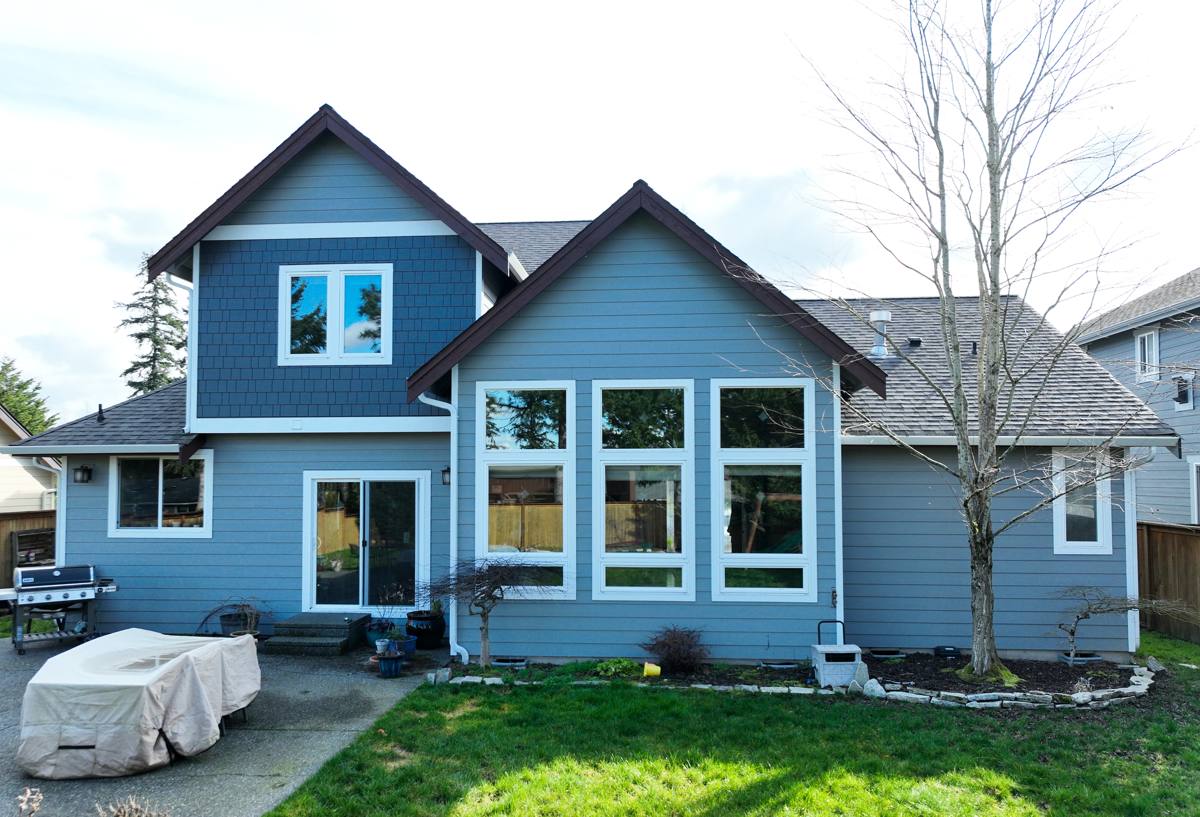
What the Local Climate Actually Does to Siding
Moss and Constant Shade
Tree-covered lots hold moisture against exterior walls long after a storm passes. Moss doesn't just look bad — its root structure holds water directly against the siding surface, and on wood-based products that moisture eventually works its way behind the surface coating. On siding with any wood content, that's the beginning of rot. Fiber cement doesn't feed moss the way wood-based siding does, but even Hardie boards need clean gutters, trimmed branches, and proper clearance from grade to keep moss from becoming a maintenance headache.
Driving Rain
Storms coming off the water hit walls at an angle, not straight down. That means water gets forced sideways into laps, seams, and penetrations — the exact spots where a rushed installation skips flashing or caulk. A house can look fine from the street and still be taking on water behind the siding for years before anyone notices a soft spot near a window.
Salt Air
Salt-laden air corrodes exposed fasteners and accelerates the breakdown of paint film on wood siding. It's a slower threat than moisture, but it compounds every other problem — corroded fasteners loosen boards, and loose boards let more water in.
Why Fiber Cement Fits This Environment
James Hardie siding is cement, sand, and cellulose fiber — there's no wood substrate to rot and nothing for moss to feed on the way it can with cedar or primed spruce. It doesn't absorb water the way wood-based products do, so the constant dampness that's normal for a shaded, lake-adjacent lot doesn't create the same long-term risk. The ColorPlus factory finish is baked on rather than field-applied, which matters directly for salt air exposure — a factory-cured finish holds up to airborne salt and UV far longer than a coat of paint applied on site in variable weather.
We specifically use Hardie's HZ5 climate-engineered product line for this region, which is formulated for areas with extended moisture exposure rather than hot, dry climates. That's not a marketing distinction — the moisture-resistance additives in the HZ5 formulation are the reason we don't sell HZ10 (the hot-climate version) to anyone in Whatcom County.
What a Correct Installation Involves
Fiber cement siding fails early almost exclusively because of installation mistakes, not the material itself. In a climate like Sudden Valley's, the margin for error is smaller than average. A correct job includes:
- Weather-resistant barrier installed and lapped correctly before the first board goes up, with all penetrations flashed and sealed
- Minimum clearance maintained between the bottom of the siding and grade, decks, patios, and roof lines — Hardie specifies these gaps for a reason, and this region's moss and moisture make them non-negotiable
- Corrosion-resistant fasteners driven correctly — face-nailed or blind-nailed per the board type, never overdriven or underdriven
- Butt joints properly flashed or backed, not just caulked over and left to hope
- Caulk used only where Hardie's install specs call for it, with the right product for a joint that will see near-constant moisture cycling
- Window and door trim integrated with the water-resistive barrier so water sheds outward, not behind the siding
- Proper starter strips and flashing at the foundation line, where splash-back and standing moisture are most common
Every one of these steps is inspectable, and every one of them is a place where a rushed crew cuts corners that don't show up as a problem for a year or two — right about when the crew that installed it has moved on to the next job.
Comparing Siding Choices for This Environment
| Material | Moisture Behavior in Shade/Rain | Moss Resistance | Salt Air Durability | Typical Lifespan Here |
|---|---|---|---|---|
| James Hardie Fiber Cement | Does not absorb or swell; no rot risk | No organic material for moss to root into | Factory-cured ColorPlus finish resists salt/UV breakdown | 30+ years to first repaint, longer structurally |
| Vinyl Siding | Sheds water but seams and panels can warp with temperature swings | Moss grows on the surface film if not cleaned | Can become brittle faster in coastal-influenced air | 15–25 years before fading/warping issues |
| Cedar or Primed Wood | Absorbs moisture readily; shaded, damp walls accelerate rot | Actively feeds moss growth | Paint film breaks down faster; repainting cycle shortens | 10–20 years before major maintenance |
| LP SmartSide (engineered wood) | Resin-treated but still wood-based; edge and cut exposure is a vulnerability | Better than raw wood, still organic | Moderate; coating maintenance still required | 15–25 years with diligent upkeep |
This isn't a knock on any of these materials in the right setting — it's why our standard for a shaded, wet, lake-adjacent lot in Sudden Valley is fiber cement, full stop.
Our Process for Sudden Valley Projects
1. On-Site Assessment
We walk the property, check for existing moisture damage around windows, decks, and the foundation line, and look at tree cover and drainage patterns specific to the lot — shaded lots and lots with poor grading need different flashing and clearance solutions.
2. Tear-Off and Substrate Check
Old siding comes off and we inspect the sheathing underneath before anything new goes up. If moisture has already gotten behind the old siding, that gets addressed before a single new board is installed — covering damaged sheathing with new siding just hides the problem.
3. Water-Resistive Barrier and Flashing
This is the step that matters most in a high-moisture area and the one that's invisible once the job is done. We install and inspect the barrier and flashing before siding installation begins.
4. Installation to Hardie Spec
Boards, clearances, and fasteners installed per James Hardie's published specifications — not shortcuts adapted for speed.
5. Final Walkthrough
We check caulk lines, trim integration, and clearances with the homeowner before calling the job finished.
Maintenance That Actually Matters Here
Fiber cement is low-maintenance, not no-maintenance. In a moss-prone, shaded environment like Sudden Valley, a short annual routine keeps siding performing the way it's supposed to:
- Keep gutters clear so overflow isn't running down the wall face during heavy rain
- Trim back branches and vegetation that keep siding in constant shade or touching the surface directly
- Rinse moss or algae buildup on north-facing walls with a soft wash rather than a pressure washer, which can force water behind laps
- Check caulk lines around windows and trim every year or two and recaulk if it's cracked or pulling away
- Watch for any soft spots, staining, or discoloration near the foundation line, which can signal a drainage or grading issue rather than a siding failure
Why Local Experience Matters for This Job
Sudden Valley's mix of shade, moisture, and lake-adjacent exposure isn't the same problem every Ferndale-area home has. A crew that already works this community knows which walls take the worst of the driving rain, how much clearance a shaded lot really needs versus the code minimum, and where moss tends to establish itself first. That local pattern recognition is the difference between a siding job that's technically to spec and one that's actually built for how weather behaves on this specific piece of ground. Whatcom County's building requirements and this region's moisture load reward a contractor who has already worked through these conditions on other Sudden Valley homes, not one applying a generic install process to a lot that doesn't behave generically.
If you're planning a siding project in Sudden Valley, we're happy to take a look at your home, walk you through what correct installation looks like for your specific lot, and give you a straightforward, no-pressure estimate — just fill out the form below.