 Ferndale
 Custom Windows Built for Kendall's Weather, Not a Showroom in Another Climate
Kendall homes deal with the same weather pattern that shapes construction decisions across this part of Whatcom County: long stretches of driving rain, moisture-laden marine air rolling in off the water, and a moss and mildew season that can run most of the year in shaded spots. Windows sit at the exact seam where that weather tries hardest to get in — the corner of the building envelope where wood, glass, flashing, and siding all have to meet perfectly or not at all. A window that was fine for a drier inland climate can fail here in a fraction of the time.
"Custom" in this context doesn't mean fancy shapes or high-end trim packages, though we do those too. It means windows sized, flashed, and installed to match the actual opening and actual wall assembly of a specific Kendall home — not a generic stock size forced into place with extra caulk to make up the difference. That distinction matters more here than in a lot of places, because a sloppy fit is exactly what this climate is designed to exploit.
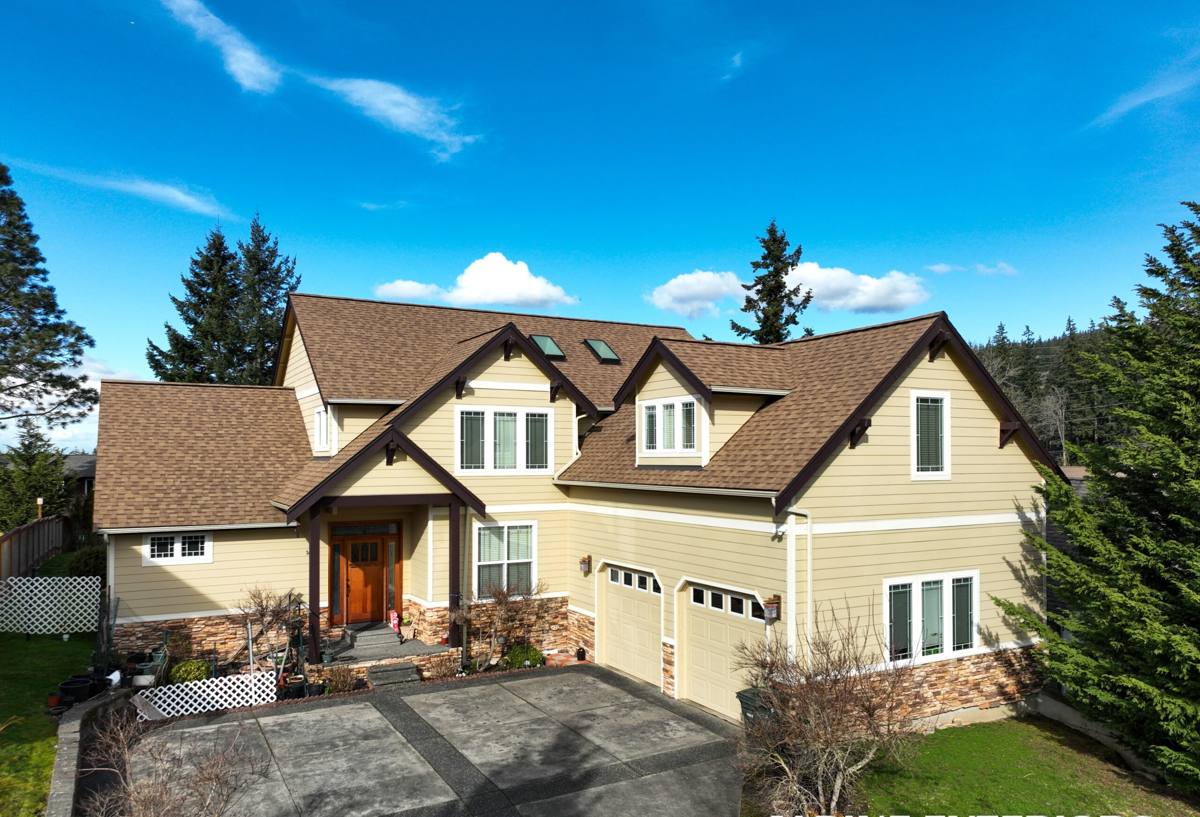
What Driving Rain and a Long Moss Season Actually Do to a Window
None of this damage happens overnight. It's cumulative, and it usually shows up in the same predictable spots.
Wind-driven rain finds the gaps
Rain that falls straight down is easy to shed. Rain pushed sideways by wind — which is common weather here for a good part of the year — gets forced into any gap, however small, around a window frame. Over time it works past caulk that was never meant to be a primary water barrier and reaches the wood framing behind it.
Moss and organic growth hold moisture against the frame
Shaded north- and west-facing walls, tree cover, and the general dampness of the region give moss, algae, and mildew plenty of opportunity to establish themselves on sills, trim, and cladding near windows. Once that growth takes hold, it holds water against the surface longer than bare wood or vinyl would on its own, extending the time the material stays wet after every rain event.
Repeated wet-dry cycling breaks down seals and finishes
Whatcom County doesn't usually get hard freezes for extended periods, but the constant cycle of saturation and partial drying is its own kind of stress. It's what causes caulk to crack, wood to swell and shrink unevenly, and insulated glass seals to fail years before their rated lifespan.
Signs a Kendall Home's Windows Are Losing the Fight
Most homeowners don't notice window failure until it's well underway. These are the early indicators worth acting on before they become a rot repair job instead of a window replacement:
- Fogging or a permanent haze between the panes of an insulated glass unit — the seal has failed and the gas fill is gone
- Soft or spongy wood at the sill or lower corners of the frame when pressed with a fingertip
- Visible moss, black staining, or persistent green growth on the exterior trim around the window
- Paint that bubbles, peels, or won't hold near the window even after repainting
- Drafts or a noticeable temperature difference near the window on windy, rainy days
- Difficulty opening, closing, or latching a window that used to operate smoothly
Custom Sizing vs. Stock: What Actually Fits a Kendall Opening
A lot of homes in this area were built or added onto over several decades, which means opening sizes are rarely uniform even within the same house. Stock replacement windows are manufactured in fixed increments, and when an opening falls between sizes, an installer has two choices: cut into the framing to make the opening fit the window, or pack the gap with extra shims and caulk to make the window fit the opening. Both are shortcuts, and both create long-term weak points in a climate that doesn't forgive them.
Custom or made-to-size windows are manufactured to match the actual opening, which means the installation can be sealed and flashed the way it's supposed to be, with proper shimming for structural support rather than gap-filling. This matters most on older Kendall homes, additions built at a different time than the original structure, and any wall assembly that isn't perfectly square — which, after a few decades of settling, describes most houses eventually.
What a Correct Window Installation Actually Involves
The window unit itself is only part of the job. Most window failures we get called out to inspect trace back to installation shortcuts, not a bad product. A correct install includes:
Removing and inspecting the old opening
Before anything new goes in, the opening gets checked for hidden rot, soft framing, or prior water damage. Installing a new window over a compromised opening just buries the problem for a few more years.
Flashing that actually sheds water downward and outward
Proper flashing — at the head, jambs, and sill — is layered so that any water that gets past the exterior cladding is directed back out, never trapped behind the window. This is the single most important step for a climate with as much wind-driven rain as this one sees, and it's also the step most likely to get skipped or done poorly by crews unfamiliar with the region.
Sealing with the right materials in the right order
Housewrap, flashing tape, and sealant each have a job, and they have to be layered correctly — like shingles — so water always moves downward and outward, never into a seam that traps it. Caulk alone is not a substitute for proper flashing; it's a finishing step, not a waterproofing system.
Setting the window level, plumb, and square
A window that's slightly out of square will bind, won't seal evenly, and puts uneven stress on the frame and hardware — problems that get worse, not better, over time.
Choosing the Right Frame Material for This Climate
There's no single "best" window material for every home — the right choice depends on the home's style, budget, and how much upkeep the owner wants to take on. Here's how the common options actually compare in a wet, moss-prone climate like this one:
| Frame Material | Moisture Behavior | Maintenance | Typical Cost Position |
|---|---|---|---|
| Vinyl | Won't rot; seams and welds need to be well-made to stay watertight | Low — occasional cleaning | Entry to mid-range |
| Fiberglass | Very stable in wet/dry cycling; minimal expansion or contraction | Low | Mid to upper-mid range |
| Wood (unclad) | Handsome but vulnerable to prolonged moisture exposure without diligent upkeep | High — regular painting/sealing | Upper range |
| Wood-clad (metal or vinyl exterior) | Exterior face resists moisture; interior wood face still needs some care | Moderate | Upper range |
| Aluminum | Durable but can conduct cold and contribute to condensation without a thermal break | Low | Mid-range |
Our standard for a wet marine climate like this one leans toward vinyl and fiberglass for most replacement projects, and wood-clad options where a homeowner wants a traditional interior wood look on a period-appropriate home. Bare exterior wood isn't something we typically recommend for full sun-and-rain exposure here — not because the material is bad, but because keeping it properly painted and sealed year after year is a real, ongoing commitment, and a missed cycle in this climate shows up fast.
What Affects the Cost of a Custom Window Project
Every Kendall home is a little different, so a real number only comes from an on-site look, but the main cost drivers are consistent:
- Number of openings being replaced and whether they're standard shapes or custom geometry (arches, bays, angles)
- Frame material selected (vinyl, fiberglass, wood-clad)
- Glass package — standard double-pane vs. upgraded low-E coatings or triple-pane glazing
- Condition of the existing opening — whether hidden rot or framing repair is needed once the old window comes out
- Access and height, particularly for second-story or awkwardly placed windows
- Trim and finish work required to match the home's existing exterior
We'll always tell you upfront if we find something in the opening that changes the scope — hidden rot is the most common surprise — rather than quoting a number that assumes a best-case wall behind the old window.
Our Process for a Kendall Window Project
- On-site assessment of the existing windows and openings, including a look at framing condition where accessible
- Straightforward, itemized estimate covering material options and what each involves
- Precise measurement of each opening for a true custom fit, not a stock-size guess
- Removal of old units with inspection of the opening before anything new is installed
- Proper flashing, sealing, and setting of the new window, matched to the home's existing wall assembly
- Exterior trim and finish work to blend with the rest of the house
- Final walkthrough so you can see and operate every window before we consider the job done
Why a Crew That Already Works in Kendall Matters
Window installation done right depends on understanding how a specific climate behaves against a specific kind of construction, and that's knowledge you build by working in an area repeatedly, not by reading a spec sheet. A crew that regularly works Kendall and the surrounding Ferndale area already knows which wall assemblies are common in local homes of different ages, how moss and moisture typically show up around openings here, and what flashing details actually hold up through a full wet season rather than just looking right on installation day.
That local familiarity also means faster, more accurate estimates — we're not guessing at regional conditions, we're working from what we already see on Whatcom County homes on a routine basis. And if a warranty issue or a question comes up after the install, you're dealing with a crew that's still working in your neighborhood, not one that's moved on to a different region entirely.
Ready for an Honest Look at Your Windows?
If your Kendall home has windows that are fogging, drafting, sticking, or showing rot or moss buildup at the frame, it's worth getting an honest, no-pressure assessment before deciding what to do next. Fill out the form below for a free estimate — we'll look at what's actually going on with your windows and give you straight answers about what it will take to fix it right.