 Ferndale
 Why Marietta's Location Is Hard on Siding
Marietta sits low and close to the water, right where Whatcom County's marine air meets a long, wet Pacific Northwest winter. That combination is harder on exterior siding than most homeowners realize. Salt-laden air off the bay accelerates corrosion on fasteners and metal trim, wind-driven rain finds every gap in a wall assembly instead of just running off the surface, and the shade and moisture that come with our tree cover and short winter days give moss and algae months at a time to get established on north- and west-facing walls.
None of this is unusual for the area — it's just the reality of building this close to the Salish Sea. But it means siding here has to do more than look good. It has to manage water at the seams, resist corrosion at every fastener, and hold its finish without chalking or fading in salt air. That's the standard we hold every Marietta job to, and it's the main reason we install James Hardie fiber cement exclusively rather than mixing in vinyl, LP SmartSide, or other wood-based products that struggle with one or more of those demands.
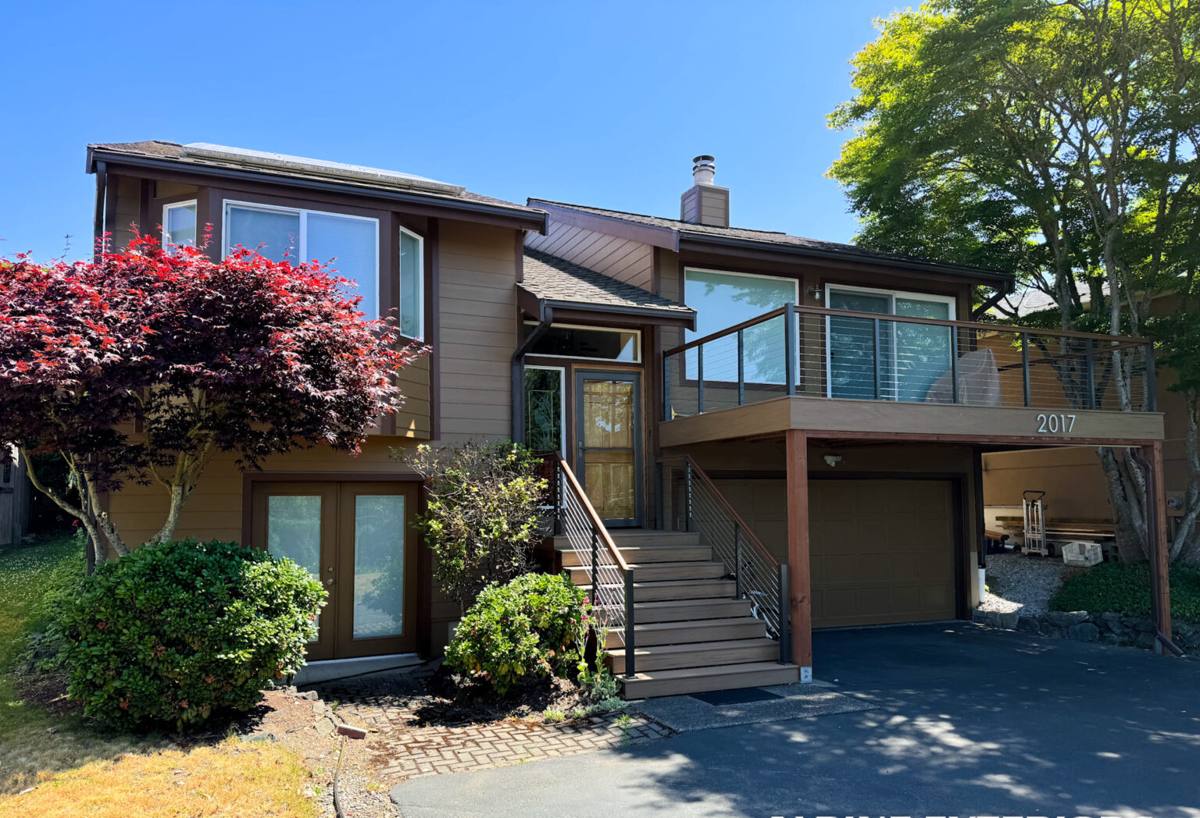
What James Hardie Fiber Cement Gets Right for This Climate
Fiber cement is cement, sand, and cellulose fiber pressed and cured into a dense, dimensionally stable board. It doesn't absorb water the way wood-based siding does, it won't rot, and it's non-combustible — a real consideration for homes near dry summer brush even in a generally wet county. James Hardie backs that base material with a factory-applied finish system that's engineered specifically for problems like ours: salt exposure, UV, and constant moisture cycling.
ColorPlus Technology
Hardie's ColorPlus finish is baked on in a controlled factory environment, in multiple coats, before the board ever reaches the jobsite. That matters here because a field-applied paint job — the kind you'd do on cedar or primed spruce trim — starts breaking down faster in salt air and constant damp than a factory-cured finish does. ColorPlus siding holds its color and resists fading, chalking, and chipping far longer than a job-site paint job, which means fewer repaint cycles over the life of the siding.
Climate-Engineered HZ Product Lines
James Hardie makes different formulations for different climate zones. The Pacific Northwest falls into Hardie's HZ5 category, engineered for regions with significant moisture exposure and freeze-thaw cycling. Using the correct HZ line isn't a marketing detail — it affects how the board performs against moisture absorption and long-term durability in exactly the kind of weather Marietta sees most of the year.
Matching the Right Hardie Product to a Marietta Home
Not every Hardie product is the right fit for every wall or every architectural style. Part of a proper estimate is walking the home and matching the product line to how each elevation is exposed to wind, rain, and sun.
| Product | Best Use | Why It Fits This Area |
|---|---|---|
| HardiePlank Lap Siding | Full wall replacement, most common on Marietta homes | Classic lap profile sheds driving rain efficiently when installed with correct overlap and flashing |
| HardiePanel Vertical Siding | Accent walls, gables, modern facades | Clean vertical lines drain water fast on steep or exposed gable ends |
| HardieShingle | Accent sections, dormers, Craftsman-style details | Adds texture without the moisture risk of real cedar shingles |
| HardieTrim & Soffit | Corners, window/door trim, eaves | Resists the swelling and cracking that wood trim shows first in this climate |
Most Marietta homes end up on a mix — lap siding as the field material with trim and an accent product for visual interest — but the mix should be chosen for the house, not defaulted to a single catalog page.
What a Correct Installation Involves
Fiber cement is only as good as the installation behind it. James Hardie's own warranty is tied to installation meeting their published specifications, and in a wet, salty climate the details that get skipped on a rushed job are exactly the ones that cause problems in year three or four, not year one.
Water Management Behind the Siding
A weather-resistive barrier and correctly lapped flashing at every window, door, and penetration have to be in place before the first board goes up. In a location with as much wind-driven rain as Marietta gets, water that gets behind the cladding needs a clear path back out — not a place to sit against sheathing.
Fastener Pattern and Clearance
Hardie specifies fastener type, spacing, and placement for a reason — get it wrong and you invite splitting, blow-off in wind, or water intrusion at the fastener head. Corrosion-resistant fasteners matter more here than in a dry inland climate, since salt air is hard on standard hardware over time.
Grade and Joint Clearance
Siding that sits too close to grade, a deck, or hardscaping traps moisture and gives moss a head start. Hardie's specifications call for clear separation at the bottom edge, and every butt joint should be caulked and painted or properly flashed, not just butted together.
- Weather-resistive barrier installed and lapped correctly before siding starts
- Flashing integrated at every window, door, and roof-to-wall intersection
- Correct HZ5 product line and factory ColorPlus finish specified
- Manufacturer-specified fasteners, spacing, and nailing pattern
- Minimum clearance maintained from grade, decks, and roof lines
- All joints and seams properly sealed, flashed, or shiplapped
Mistakes We See on Fiber Cement Jobs Near the Water
We've corrected enough installs done by out-of-area or inexperienced crews to know where the shortcuts show up. The most common: caulk used as a substitute for flashing instead of alongside it, siding run directly to grade or embedded in hardscaping, standard fasteners used instead of corrosion-resistant ones, and boards butted tight with no expansion gap or sealant. Every one of these looks fine on install day. Every one of them shows up as a callback within a few wet seasons in a climate like ours, usually as staining, soft trim, or paint failure right at the seam.
What Affects the Cost of a Hardie Job in Marietta
Every home is different, so we don't quote sight unseen — but these are the factors that move the number most in this area.
| Factor | Why It Matters |
|---|---|
| Existing siding & sheathing condition | Rot or water damage found during tear-off has to be repaired before new siding goes on |
| Home size & wall complexity | More corners, gables, and window trim mean more labor and cutting |
| Product mix | Lap siding alone costs less than lap plus shingle accents and vertical panel sections |
| Trim & detail work | Full HardieTrim replacement at corners and openings adds cost but extends the life of the whole job |
| Access & site conditions | Tight lots, slopes, or limited staging area affect labor time |
Our Process, Start to Finish
- On-site inspection of existing siding, trim, and sheathing to assess condition and scope
- Product and color selection walkthrough, matched to the home's exposure and style
- Written estimate with a clear scope — no surprise add-ons mid-project
- Tear-off, sheathing repair as needed, and weather-resistive barrier installation
- Full installation to James Hardie's published specifications, including flashing and fastener detail
- Final walkthrough and punch list before we consider the job done
Living With Fiber Cement in a Salt Air, Moss-Prone Climate
Correctly installed Hardie siding is low-maintenance, not no-maintenance. A rinse-down once or twice a year clears salt residue and organic buildup before moss and algae get a real foothold, especially on shaded north-facing walls. Keeping gutters and downspouts clear keeps concentrated water from running down one section of wall repeatedly, which is where staining shows up first. Because the ColorPlus finish is factory-cured, most homeowners go many years before any touch-up paint is needed at all — a real difference from wood trim or field-painted siding in this climate.
Why a Crew That Already Works Marietta Matters
A contractor who only occasionally works this close to the water can still install Hardie siding — but they're guessing at exposure conditions a Ferndale-area crew already knows firsthand: which elevations take the worst of the wind-driven rain, where moss establishes fastest, and how much clearance actually holds up against local grade and drainage patterns over a full Whatcom County winter. That local pattern recognition is what turns a correct-on-paper installation into siding that still looks and performs right ten years in.
If you're weighing options for your home in Marietta, we're happy to walk the property, look at what your walls are actually dealing with, and put together a straightforward, no-pressure estimate — just fill out the form below to get started.