 Ferndale
 Why Nooksack-Area Roofs Take a Different Kind of Beating
Nooksack sits in the part of Whatcom County where weather doesn't do anything halfway. Winters bring long stretches of steady, driving rain rather than short storms, which means a roof here isn't just shedding water for a few weeks a year — it's under load for months at a stretch. Add in the salt-laden air that moves inland off the Strait and the Sound on a west wind, and you've got a climate that quietly works on fasteners, flashing, and coatings even when nothing looks wrong from the ground.
Then there's shade and moisture together, which is the real driver of moss. Homes tucked near tree lines or on north-facing slopes barely dry out between rain events, and that's exactly the environment moss and moulds prefer. On an asphalt shingle roof, moss roots into the granules and lifts them over time. On a metal roof done correctly, moss has almost nothing to hold onto — but "done correctly" is doing a lot of work in that sentence, and it's the difference between a metal roof that outlasts everything else on the house and one that develops problems in the first five years.
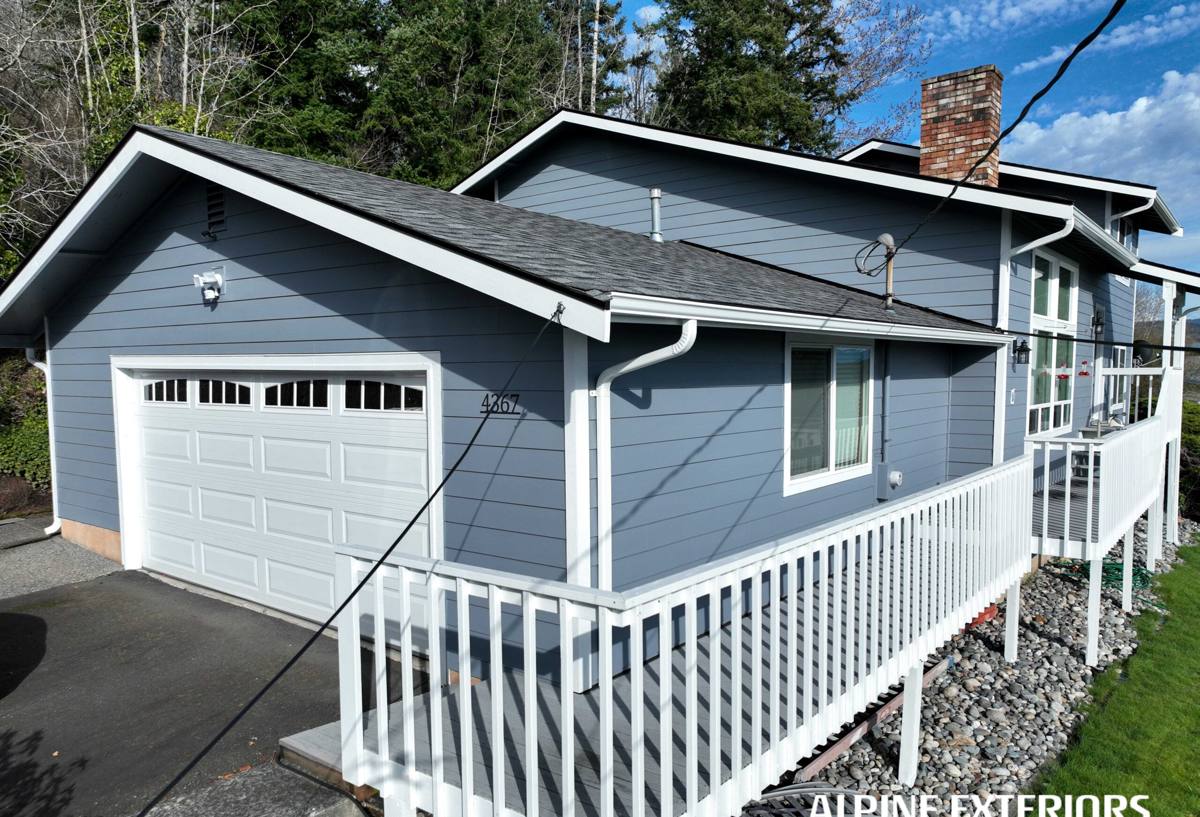
Why Metal Roofing Fits This Climate
Metal roofing isn't the right call for every house or every budget, but for the rain-and-moss cycle that defines a Whatcom County winter, it solves several problems at once instead of trading one for another.
- Sheds water fast. A steep-enough metal panel run gives water almost nowhere to sit, which matters when rain is measured in days, not hours.
- Doesn't hold moss the way shingles do. Smooth or ribbed metal panels give algae and moss spores a much harder surface to grip, so growth stays on the surface where a routine rinse handles it instead of rooting in.
- Handles wind uplift well. Panels that are properly fastened and seamed resist the gusty, sideways rain events that come through the county far better than lightweight shingle systems on an aging deck.
- Long service life against the coatings that fail first. The weak point on any metal roof isn't the steel or aluminum itself — it's the paint or coating system, which is why coating quality and warranty terms matter more than the base metal.
None of that means metal is maintenance-free. It means the maintenance it does need is predictable and manageable, instead of the slow, hidden deterioration that happens under lifted shingle granules.
What a Correct Metal Roofing Job Actually Involves
Metal roofing has a reputation for being simple to install, and the panels themselves are. The problem is that most of what determines whether a metal roof performs for 30-plus years or starts leaking in year six happens in details that are invisible once the job is done.
Deck and Underlayment
The roof deck gets inspected and repaired before anything goes down — soft spots, old fastener holes, and water-damaged sheathing all get addressed first. Over that, a high-temperature synthetic or self-adhered underlayment goes down as the actual waterproofing layer. This matters more in this climate than in drier regions, because the underlayment is what protects the structure during the install itself and during any wind-driven rain that gets under a panel seam over the years.
Panel Layout and Fastening
Panels need to run in a way that respects the roof's actual water flow, with laps and seams oriented so wind-driven rain off the west can't work its way underneath. Fastener type and spacing are specified for the panel profile being used — mismatched fasteners are one of the more common causes of early leaks and premature rust streaking on metal roofs in this region.
Flashing and Penetrations
Valleys, chimneys, skylights, vent stacks, and wall transitions are where nearly every metal roof failure actually starts — almost never in the flat field of panels. Correct flashing means custom-formed metal at every transition, sealed and lapped in the right order so water is always directed onto the next surface down, never trapped against it.
Ventilation
A metal roof over a poorly ventilated attic can trap moisture instead of shedding it, which defeats a lot of the benefit of switching materials in the first place. Ridge and soffit ventilation gets checked and corrected as part of the job, not treated as a separate afterthought.
Comparing Metal Roofing Options for This Climate
Not all metal roofing is the same product wearing different colors. The panel type changes cost, maintenance, and how the roof actually behaves in sustained rain and coastal-influenced air.
| Panel Type | Typical Cost Factor | Moisture & Moss Performance | Maintenance Needs |
|---|---|---|---|
| Standing Seam | Highest | Excellent — concealed fasteners, no exposed penetrations for water to find | Low; periodic rinse and gutter checks |
| Exposed-Fastener Panel | Mid-range | Good, but fastener washers age faster in wet, salt-influenced air | Moderate; fastener inspection every few years |
| Stone-Coated Steel | Mid-to-high | Good; textured surface sheds water well but can trap debris in valleys | Moderate; valley and debris checks |
| Corrugated/Ribbed Steel | Lower | Fair; performs well but relies heavily on correct fastening and coating quality | Moderate to higher over time |
For most homes in this area, we lean toward standing seam or a well-specified exposed-fastener system with quality washers and a proven paint system, because the concealed or well-protected fastener approach holds up better against the amount of sustained moisture this climate delivers. Cheaper coated panels can look identical to a better system on day one and diverge sharply by year ten.
Warranty Structure — What to Actually Read
Metal roof warranties typically split into two separate coverages: a paint/finish warranty (covering fading and chalking) and a substrate warranty (covering the metal itself against rust-through). They're not the same, and a strong-sounding "lifetime" claim on one doesn't guarantee anything about the other. We walk homeowners through exactly what's covered, what voids it, and what's actually the installer's responsibility versus the manufacturer's before any contract gets signed.
Common Problems We See on Older Metal and Transitioning Roofs
A lot of the calls we get in this area aren't about brand-new installs — they're about roofs that were done adequately somewhere else, or converted from asphalt without addressing the details underneath.
- Rust streaking at fastener heads — usually a sign of the wrong fastener/coating combination for the panel, not a flaw in the metal itself.
- Leaks at valleys and chimney flashing — the panels are almost never the problem; the custom flashing work around them is.
- Moss buildup in low-slope sections or valleys — even metal roofs need enough pitch and clean drainage paths; moss finds the spots where water and debris linger.
- Oil-canning (visible waviness in flat panel areas) — a cosmetic issue tied to panel gauge and installation technique, more common with thinner, lower-cost panels.
- Ventilation-related condensation — moisture showing up on the underside of the deck, traced back to blocked or missing attic airflow rather than the roof surface itself.
How Our Process Works
We keep the process the same regardless of whether it's a full replacement or a metal roof over an area we didn't originally install.
- On-site inspection. We look at the deck, current ventilation, flashing points, and roof pitch before quoting anything — not a drive-by estimate from photos.
- Written scope and product selection. You get a clear breakdown of panel type, underlayment, flashing plan, and fastener spec, with the actual warranty documents, not just a verbal summary.
- Deck prep and repair. Any soft, rotted, or previously damaged sheathing gets replaced before a single panel goes down.
- Underlayment and flashing install. The waterproofing layer and all custom flashing go in first, checked before panels are set.
- Panel installation. Panels are run, seamed or fastened per the manufacturer's spec for the profile, with attention to wind-driven-rain orientation.
- Ventilation check and correction. Ridge and soffit airflow gets verified as part of the same job, not billed as a surprise add-on later.
- Final walkthrough and cleanup. We walk the roof and the property with you, remove debris and fasteners from the yard, and go over maintenance expectations before we leave.
Maintenance Checklist for Metal Roofs in This Climate
A properly installed metal roof needs far less upkeep than shingles, but "far less" isn't "none." A short annual routine keeps small issues from becoming roof-replacement issues.
- Clear gutters and downspouts before the fall rains set in — clogged gutters back water up under eave flashing.
- Rinse off accumulated moss, pollen, and organic debris, especially in valleys and shaded slopes.
- Check for loose or lifted fasteners on exposed-fastener panels every couple of years.
- Look at flashing around chimneys, vents, and skylights for gaps or sealant that's dried and cracked.
- Trim back overhanging branches that keep sections of the roof shaded and slow to dry.
- After any major wind event, do a visual check for lifted panel edges or displaced flashing.
Why Hiring a Crew That Already Works Nooksack Matters
Metal roofing done wrong doesn't usually fail in an obvious way right away — it fails quietly, at a flashing detail or fastener choice that looked fine at handoff. A crew that regularly works this part of Whatcom County has already seen how the local rain pattern, wind exposure, and moss cycle expose those shortcuts, because we're the ones who get called back to fix them.
That local pattern-recognition shows up in practical ways: knowing which valleys and roof transitions tend to collect debris on homes near tree cover, sizing ventilation correctly for the moisture load this area actually sees, and specifying fasteners and coatings that hold up against sustained wet, salt-influenced air instead of the driest-case scenario a spec sheet is written for. It also means we're familiar with the permitting expectations for this part of the county, so the paperwork side of the job doesn't stall the work side.
If you're weighing metal roofing for a home in the Nooksack area, we're glad to come take a look, walk the roof, and give you an honest read on what your specific house needs — no pressure, no scare tactics, just a straightforward estimate you can use to make the call. The form below gets you started.