 Ferndale
 Why Lummi Island Puts Extra Stress on a Roof
A roof on Lummi Island earns its keep. Sitting out in Rosario Strait and Puget Sound exposure, homes here take a steadier beating than most houses just a few miles inland in Ferndale or elsewhere in Whatcom County. Three things do most of the damage over time: salt-laden air that accelerates corrosion on fasteners, flashing, and metal components; driving, wind-pushed rain that finds its way under poorly sealed laps and flashing instead of just running off; and a moss season that, thanks to our wet Pacific Northwest winters and heavy tree cover on much of the island, can run nearly eight months of the year.
None of that means island roofs fail faster because of bad luck. It means the margin for error in materials, fastening, flashing detail, and ventilation is smaller. A roof system that would hold up fine on a sheltered lot in town can wear out years early once you add salt exposure and constant moisture. Replacement on Lummi Island isn't just "put new shingles on" — it's matching the assembly to the site.
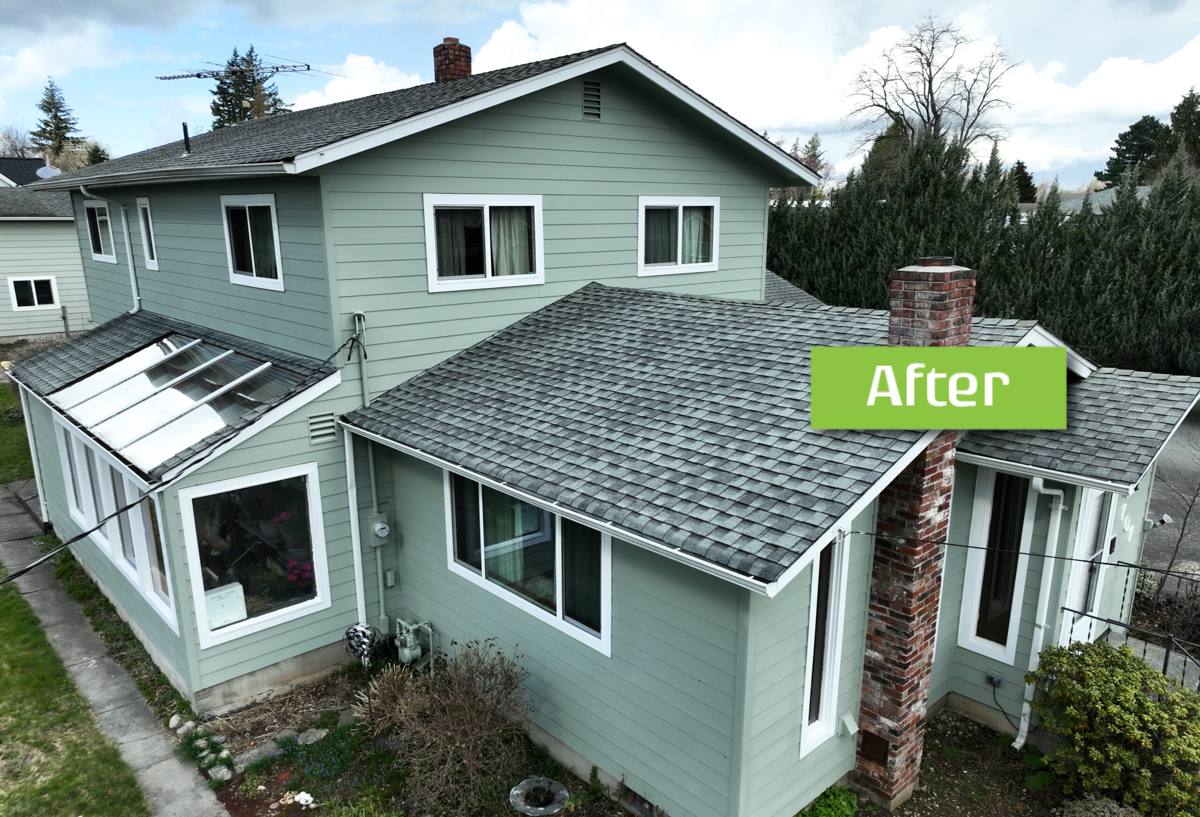
When Repair Isn't Enough: Signs You Need Full Replacement
Plenty of roofing problems can be patched. But there's a point where repair is throwing good money after bad, and homeowners in this climate hit that point sooner than they expect because moisture damage tends to hide until it's advanced. Watch for:
- Granule loss heavy enough that you can see bare, shiny patches on asphalt shingles, especially on south and west-facing slopes that take the worst sun and wind
- Moss or algae established at the shingle tabs, not just the ridge — surface growth is cosmetic, but moss that's lifted tabs or worked under them is a moisture problem
- Soft spots or sag when walked on, which usually means the deck underneath has taken on water
- Rust streaking or corrosion at flashing, valleys, or fasteners — a strong signal of the salt-air effect at work
- Daylight visible through the attic sheathing, or damp insulation, which points to failed underlayment or flashing rather than a single leak
- A roof approaching or past 20–25 years old (asphalt) even if it "looks okay" from the ground — the wear you can't see from a ladder is usually the wear that matters most
If you're seeing two or more of these at once, that's usually the point where a full tear-off and replacement is the more honest recommendation than another round of patching.
Choosing Roofing Materials for Marine Exposure
What matters here that doesn't matter as much elsewhere
Every roofing material has trade-offs. In a marine, high-moss environment like Lummi Island, the trade-offs that matter most are corrosion resistance of the metal components (fasteners, flashing, drip edge), how the material sheds moisture in wind-driven rain rather than just vertical rain, and how resistant the surface is to moss and algae colonization.
| Material | Salt-Air / Corrosion Behavior | Moss & Algae Resistance | Wind-Driven Rain Performance | Relative Cost |
|---|---|---|---|---|
| Architectural asphalt shingle (algae-resistant) | Good with stainless or coated fasteners; standard steel fasteners corrode faster near the water | Algae-resistant granules slow growth but don't stop it; still needs periodic cleaning | Good when properly nailed and sealed; poor if underlayment/flashing details are cut short | Low–Moderate |
| Standing seam metal | Excellent when specified in a coastal-rated finish; poor if an inland-grade coating is used near the water | Very good — smooth surface sheds moisture and gives moss little to hold onto | Excellent — continuous panels with fewer laps | Moderate–High |
| Cedar shake | Neutral — wood doesn't corrode, but fasteners and flashing still need marine-grade hardware | Poor without diligent maintenance; wood holds moisture and feeds moss | Fair — relies heavily on correct underlayment since shakes alone aren't fully sealed | High |
| Synthetic/composite shingle | Good; most hardware packages are corrosion-rated | Good — dense, low-absorption surface | Good | Moderate–High |
We don't push one material on every house. What we do insist on is matching fasteners, flashing, and drip edge to the exposure — meaning stainless steel or heavy hot-dip galvanized hardware near the water, not the standard-grade fasteners that are fine forty minutes inland. That single decision affects how the roof looks and performs a decade in, long after the shingles themselves would otherwise be fine.
What a Correct Roof Replacement Involves on Lummi Island
A tear-off and replacement done right is not just stripping old shingles and nailing down new ones. On an exposed island roof, the steps that get skipped on a rushed job are exactly the ones that determine whether the new roof lasts 10 years or 30.
Deck inspection and repair
Once the old roofing is off, the decking gets inspected board by board (or sheet by sheet on OSB/plywood roofs). Soft, delaminated, or water-stained decking gets replaced before anything new goes down — covering over a compromised deck is the single most common shortcut that leads to early failure.
Underlayment built for the climate
Given the amount of wind-driven rain this area sees, we install synthetic underlayment across the full roof and self-adhering ice-and-water shield at the vulnerable spots — eaves, valleys, around penetrations, and along walls — where wind can push rain uphill under standard laps.
Flashing and fasteners rated for salt exposure
Valley metal, step flashing, chimney flashing, and drip edge all get upgraded hardware where the site calls for it, not just wherever it's convenient. This is the detail that separates a roof that still looks tight after a decade near the water from one that's streaking and staining after three or four years.
Field installation
Shingles, panels, or shakes go down to the manufacturer's nailing and exposure specs — not "close enough." Under-driven or over-driven fasteners are a leading cause of early wind and water damage, and it's an easy thing to get wrong when a crew is moving fast.
Ventilation and Moss: The Long-Term Battle
Moss isn't just a cosmetic nuisance here — it's a symptom of a roof that stays damp longer than it should. Two things control that: how much sun and airflow a slope gets naturally (which we can't change) and how well the attic is ventilated (which we can). A roof that's properly vented lets heat and moisture escape instead of condensing against the underside of the deck, which keeps the roof drier overall and slows moss colonization from below as well as above.
During replacement, we check intake ventilation (soffit vents) and exhaust ventilation (ridge vent or equivalent) and balance the two — one without the other does little good. On heavily shaded, tree-covered lots, which describes a lot of Lummi Island properties, we'll also talk through realistic moss-control expectations: no roof in this environment stays moss-free without some periodic attention, but the right ventilation and materials stretch out how often that attention is needed.
Our Process, Step by Step
- On-site assessment. We walk the roof and attic, check the deck condition where accessible, and look at exposure — which slopes take the worst wind and rain, and how the current ventilation is set up.
- Written estimate. Material options, scope of work, and a clear price — no vague allowances that turn into surprise add-ons mid-project.
- Scheduling around the island. Getting crews, dumpsters, and material deliveries onto Lummi Island means working around the ferry schedule, not a mainland job's usual logistics. We build that into the timeline up front so there are no delays discovered mid-project.
- Material staging. Everything needed for the job is staged and confirmed on-island before tear-off starts, so the roof isn't left open longer than necessary waiting on a delivery.
- Tear-off and deck inspection. Old roofing comes off, the deck gets inspected and repaired as needed, and any surprises are discussed with you before we move forward.
- Underlayment, flashing, and installation. Installed to spec, with hardware matched to the marine exposure.
- Cleanup and magnetic nail sweep. Full site cleanup, including a nail sweep, before we consider the job done.
- Final walkthrough. We go over the finished roof with you, answer questions, and make sure you know what maintenance (if any) it needs going forward.
Why Hire a Crew That Already Works the Island
Roofing on Lummi Island isn't logistically the same as roofing in downtown Ferndale, and a crew that's never dealt with it can turn a straightforward job into a frustrating one. Ferry scheduling affects when crews and materials can arrive and leave — miss a window and a workday shrinks fast. Waste disposal and dumpster logistics take more planning than they do on the mainland. And because homes here take more weather than average, we've seen firsthand what actually fails first — usually fasteners and flashing, not the field material itself — which shapes the upgrades we recommend and where we spend the budget.
Hiring a crew already familiar with those realities means fewer surprises: no discovering mid-project that a delivery can't make the last ferry, no guessing at which hardware upgrades are worth it versus which are unnecessary cost. It also means a contractor who understands Whatcom County permitting and can plan the project timeline realistically instead of promising a mainland-standard schedule that the island logistics won't actually support.
After the Install: Keeping a New Roof Performing
A correctly installed roof in this climate still benefits from a little regular attention. None of the following is expensive or time-consuming, but skipping it is how a 25-year roof turns into a 15-year roof.
- Have moss and debris cleared from the roof and gutters at least once a year, ideally before the wet season sets in
- Keep overhanging branches trimmed back where practical — shade and organic debris are what feed moss growth
- Check attic ventilation isn't blocked by insulation or storage that's crept in over time
- Have flashing and fastener condition checked every few years, especially anywhere close to the water — this is the first place salt exposure shows up
- Address small leaks or granule loss promptly rather than waiting — early intervention is almost always cheaper than the repair it prevents
If you're seeing signs of wear, dealing with recurring moss, or just want an honest read on how much life is left in your current roof, we're happy to take a look. A free estimate costs you nothing and comes with no pressure — just a clear picture of your options and what they'd actually involve.