 Ferndale
 Siding Built for Sandy Point's Waterfront Exposure
Sandy Point sits right up against the water, and that changes what a house needs from its exterior. Homes here take on a combination most inland Whatcom County properties never deal with at the same intensity: salt-laden air drifting off the water, wind-driven rain that gets pushed sideways into wall assemblies, and a long damp season that keeps north- and shade-facing walls wet and shaded long enough for moss and algae to take hold. Any siding product installed here is being asked to do more work than the same product installed a few miles inland in Ferndale proper.
Fiber cement siding, specifically James Hardie's engineered lines, is the product we install on Sandy Point homes because it holds up to that combination without the maintenance spiral that comes with wood-based products in a marine environment. This page covers what that actually looks like in practice — not a generic pitch, but what correct fiber cement siding work involves on a Sandy Point property specifically.
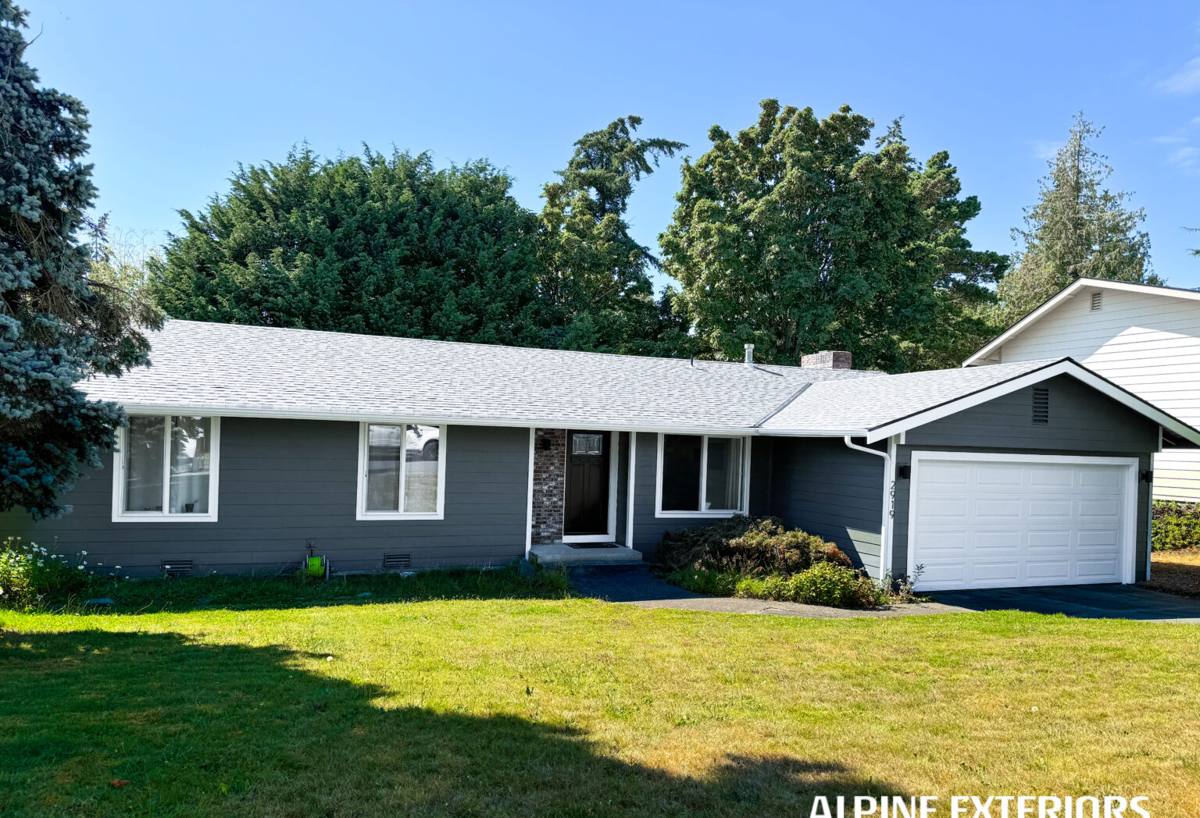
What Salt Air, Driving Rain, and Moss Season Actually Do to Siding
Salt Air
Airborne salt is corrosive to exposed metal fasteners, flashing, and trim, and it accelerates the breakdown of finishes that weren't engineered to resist it. On wood and wood-composite sidings, salt exposure combines with moisture cycling to speed up paint failure, checking, and edge deterioration — especially on the water-facing elevations that catch the most direct exposure off the Strait.
Driving Rain
Wind off the water doesn't just drop rain on a wall — it pushes it into laps, seams, and any gap in the water-resistive barrier. A siding system with a weak lap design, undersized overlaps, or fasteners in the wrong spot gives that wind-driven water a path behind the cladding. Once moisture gets behind the siding on a coastal lot, it dries out slower than it would inland, because the ambient humidity stays higher for more of the year.
Moss and Algae Season
Whatcom County's wet season stretches long, and shaded or north-facing walls at Sandy Point stay damp for extended stretches. That's the exact condition moss and algae need to establish. Porous or textured surfaces give spores something to grip; on a wood-based or improperly coated surface, that growth holds moisture against the substrate and shortens its service life. A dense, factory-finished fiber cement surface gives moss far less to grab onto and doesn't feed the growth the way organic or lightly-primed materials can.
Why James Hardie Fiber Cement Fits This Exposure
We install James Hardie exclusively — not vinyl, not LP SmartSide, not primed wood or cedar, not other fiber cement brands. On a Sandy Point property that decision matters more than it does on a sheltered inland lot, because the exposure here punishes shortcuts faster.
- Non-combustible core: fiber cement doesn't burn, feed, or fuel fire spread the way wood-based sidings can.
- Engineered for moisture cycling: the cement composition resists the swell-shrink-crack pattern that plagues wood and wood-composite products under repeated wetting.
- ColorPlus factory finish: a baked-on finish applied under controlled conditions holds color and resists fading, chipping, and the salt-accelerated breakdown that job-site-applied paint is more prone to.
- HZ5 product engineering: James Hardie makes climate-specific formulations; the HZ5 line is built for the Pacific Northwest's wet, moderate climate rather than a one-size-fits-all product.
- Dense surface resists organic growth: less texture for moss and algae spores to establish on than raw or lightly coated wood substrates.
- Strong transferable warranty: backed by a manufacturer warranty structure that holds up when the installation itself is done to spec — which is the other half of the equation.
What a Correct Installation Involves on a Water-Facing Home
Fiber cement is only as good as the assembly behind it. On a property exposed the way Sandy Point homes are, the details behind the siding matter as much as the siding itself.
Water-Resistive Barrier and Drainage Plane
A continuous weather-resistive barrier goes down first, lapped correctly from bottom to top so gravity moves any incidental water out and down, never in. On wind-driven rain sites, we pay close attention to that overlap sequence and to how the barrier integrates with window and door openings, since those transitions are where wind-pushed water most often finds a way in.
Rainscreen or Drainage Gap
A gap between the back of the siding and the water-resistive barrier lets any moisture that does get past the cladding drain and dry instead of sitting against the wall assembly. On a coastal, high-humidity site, that drainage path is what keeps incidental moisture from turning into a slow, hidden problem behind the siding.
Flashing at Every Transition
Windows, doors, roof-to-wall intersections, and deck ledgers are the places wind-driven rain finds a way in if flashing is missing, undersized, or installed out of sequence. Correct flashing details are boring to talk about and easy to skip — they're also the single biggest factor in whether a fiber cement job holds up on an exposed lot.
Fastening and Clearances
James Hardie specifies fastener type, spacing, and minimum clearance from grade, decks, and roof lines. On salt-air sites, using the corrosion-resistant fasteners the manufacturer specifies — not whatever's cheapest — is part of what keeps the system performing over the long run instead of developing streaking and corrosion at the fastener heads.
Caulking and Sealant Discipline
Sealant belongs at specific transitions, not everywhere, and it has to be the right product for the joint it's protecting. Over-caulking a lap siding system can trap moisture instead of letting it drain; under-caulking leaves a gap wind-driven rain can exploit. Getting this balance right is a judgment call that comes from experience installing this specific product, not a generic "caulk it all" approach.
Cost Factors on a Sandy Point Project
Every fiber cement job is priced around the same core factors, but a waterfront property shifts a few of them compared to a typical inland Ferndale home.
| Factor | How It Affects a Sandy Point Job |
|---|---|
| Home size and wall complexity | More corners, dormers, and transitions mean more cutting, flashing, and labor time regardless of location. |
| Existing siding removal | Tear-off of old wood, vinyl, or wind-damaged siding adds labor and disposal cost before new siding starts. |
| Sheathing and moisture condition | Coastal homes are more likely to have hidden moisture damage behind old siding; any rot found during tear-off needs to be addressed before new siding goes on. |
| Access and site exposure | Waterfront lots can have tighter access, wind exposure that affects scaffolding and staging, or drainage considerations that add setup time. |
| Product line and profile | Lap, shingle, and panel profiles, plus color selection within the HZ5 line, carry different material costs. |
| Trim and detail work | Corner boards, window trim, and fascia detailing in fiber cement add cost but are what makes the flashing and drainage details actually work. |
We give real numbers after walking the specific property — broad estimate ranges without seeing the exposure, the existing wall condition, and the scope aren't useful to a homeowner trying to plan a project.
Why a Crew That Already Works Sandy Point Matters
Fiber cement installation is not forgiving of guesswork, and a coastal lot leaves even less room for it. A crew that has already worked properties in this specific stretch of Whatcom County knows what exposure a given elevation is likely to see, where wind-driven rain tends to concentrate, and which details on a water-facing wall need extra attention versus a sheltered inland wall. That's not something a manufacturer spec sheet alone teaches — it's pattern recognition built from installing on this coastline specifically.
It also means fewer surprises during tear-off. A crew that regularly opens up siding on salt-air properties knows what condition to expect behind old cladding and how to handle it correctly rather than treating it as a change order to negotiate mid-project.
Signs a Sandy Point Home May Need New Siding Soon
- Persistent moss or algae staining on north- or shade-facing walls that returns shortly after cleaning
- Soft spots, bubbling, or visible warping in wood or wood-composite siding, especially near grade or roof lines
- Paint that's peeling, chalking, or failing faster than the repaint cycle would suggest it should
- Visible gaps or separation at laps, corners, or trim where wind-driven rain could be getting behind the siding
- Fastener corrosion or staining bleeding through the siding surface
- Musty smell, staining, or softness on interior walls that back onto exterior siding, which can point to moisture already behind the cladding
What Our Process Looks Like
We start with a walk-through of the property, looking at each elevation's exposure — which walls take the direct wind and rain off the water, which stay shaded and damp longer, and what condition the existing siding and sheathing are in. From there we put together a scope and estimate specific to that property, not a generic per-square-foot number. If tear-off reveals sheathing or framing issues, we address them before new siding goes on rather than covering a problem up. Installation follows James Hardie's specifications for fastening, clearances, and flashing, with the water-resistive barrier and drainage details built to handle the wind-driven rain this location sees. We stand behind the workmanship, and the product itself carries James Hardie's manufacturer warranty when installed to spec.
If you own a home in Sandy Point and want a straight answer on what your siding needs and what it would cost to do right, we're happy to take a look. The estimate is free, there's no pressure, and you'll get a scope based on your actual property — just fill out the form below.