 Ferndale
 Why Sandy Point Homes Wear Out Siding Faster
Sandy Point sits right up against the water, and that location is exactly why siding here fails sooner than it does on homes a few miles inland in Ferndale or elsewhere in Whatcom County. Salt-laden air rides in off the water almost constantly, and it doesn't just sit on the surface of your siding — it works into seams, fastener heads, and any spot where the factory finish has been compromised. Add in wind-driven rain that hits exposed walls at an angle instead of falling straight down, and you've got a siding system that's under attack from two directions at once: moisture trying to get behind the panels, and salt breaking down whatever's trying to keep it out.
Then there's moss. Whatcom County's long, wet stretch from fall through spring gives moss and algae months to establish themselves on any siding surface that stays damp, especially on north-facing walls and areas shaded by trees or neighboring structures. Moss holds moisture against the siding surface far longer than open air would, which accelerates rot in wood-based products and can stain or degrade lower-quality finishes even when the substrate underneath is fine.
None of this means siding is a lost cause on Sandy Point — it means the material and the installation details matter more here than they would in a drier, more sheltered part of the state.
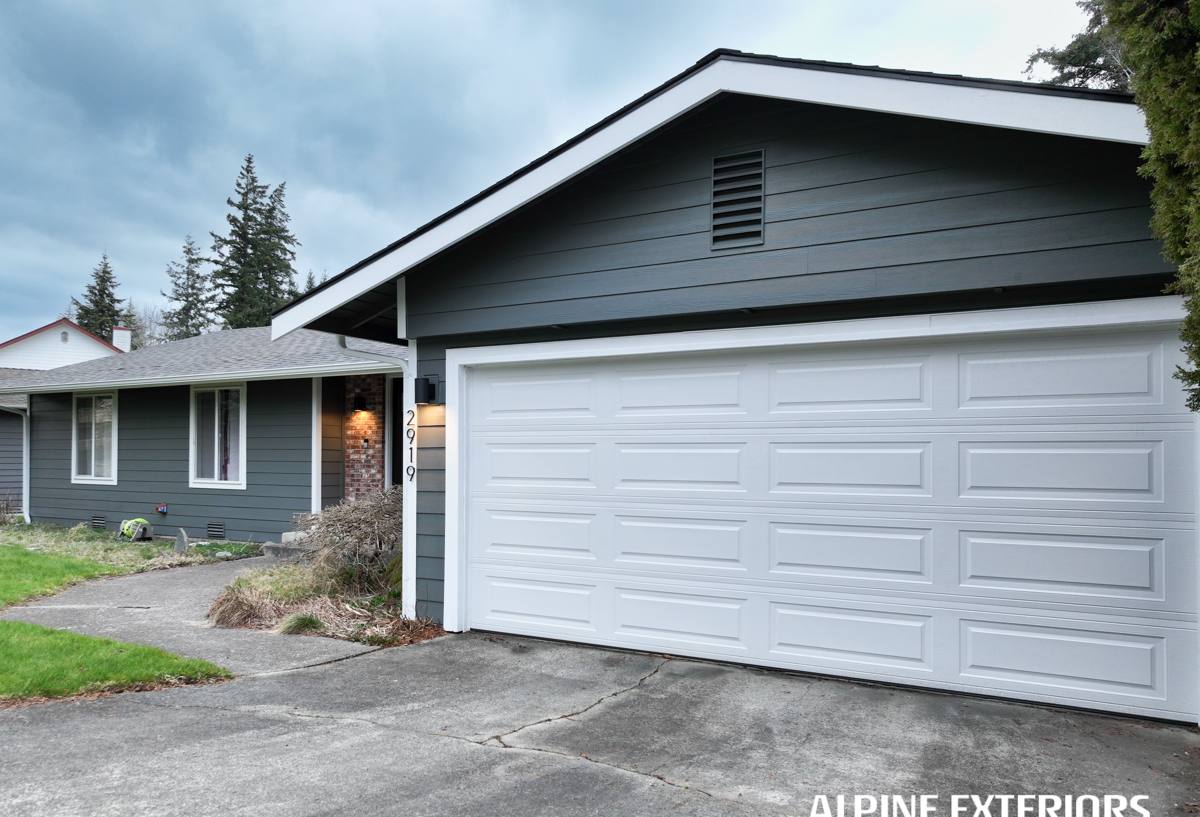
Signs a Sandy Point Home Needs Siding Replacement
Because salt air and moisture work slowly, a lot of siding damage in Sandy Point develops behind the surface before it's obvious from the street. Here's what we tell homeowners to watch for:
- Soft or spongy spots when you press on the siding, especially near the bottom courses and around window and door trim
- Visible moss or algae growth that keeps coming back within weeks of cleaning
- Paint that's peeling, bubbling, or chalking faster than the repaint cycle you'd expect
- Streaking, staining, or discoloration running down from seams, joints, or fastener locations
- Gaps opening up at butt joints, corner boards, or trim where caulk has failed
- A musty smell or visible mold on interior walls that back up to exterior siding
- Warping, cupping, or delamination — common on wood and engineered wood products once moisture gets in
Any one of these can be a minor fix. Several at once, especially on the water-facing side of a Sandy Point home, usually means the siding system as a whole has reached the end of its useful life and patch repairs won't hold.
What a Correct Siding Replacement Job Involves Here
Siding replacement isn't just swapping old panels for new ones. In a coastal, moss-prone environment like Sandy Point, the details underneath the visible surface are what determine whether the new siding lasts 10 years or 40.
Moisture Management Comes First
Before any new siding goes up, the water-resistive barrier (WRB) behind it needs to be intact, properly lapped, and sealed at every penetration — vents, hose bibs, light fixtures, anything that punches through the wall. On a wind-driven-rain site like Sandy Point, we pay close attention to how water is meant to drain down and out rather than getting trapped, including making sure there's a drainage gap where the siding system calls for one so moisture that does get behind the cladding has somewhere to go.
Fastening for Wind and Salt Exposure
Fastener choice matters more here than inland. Corrosion-resistant fasteners, installed at the correct spacing and depth per the manufacturer's specification, resist the salt-air corrosion that causes streaking and eventually loosens panels. Overdriven or underdriven fasteners are one of the most common causes of premature siding failure we see, and it's a detail that's easy to rush and hard to spot from the ground once the job is done.
Trim, Flashing, and Clearances
Every horizontal trim piece, window head, and roof-to-wall intersection needs flashing that actually sheds water away from the wall assembly, not just decorative trim caulked in place. We also keep proper clearance between the bottom of the siding and grade, decks, roofs, and walkways — a gap that's too tight traps moisture and gives moss a permanent foothold right where you can't see it easily.
Why We Only Install James Hardie Fiber Cement
We install James Hardie fiber cement siding exclusively — not vinyl, not LP SmartSide, not primed wood or cedar. That's not a marketing position, it's a standard we hold because of what we see on coastal homes like the ones in Sandy Point. Fiber cement is non-combustible and dimensionally stable, meaning it doesn't expand, contract, warp, or cup the way wood-based and engineered-wood products can when they cycle through wet Whatcom County winters and drier summers. Hardie's ColorPlus factory finish is baked on under controlled conditions, which gives it better adhesion and fade resistance than field-applied paint — a real advantage against direct sun and salt exposure on a waterfront lot.
Hardie also builds region-specific product lines engineered for different climate demands (their HZ5 line, for example, is built for wetter, colder climates like ours), and backs installations with a strong transferable warranty when the work is done to their specification. For a site facing salt air, driving rain, and a long moss season, that combination of moisture resistance, finish durability, and manufacturer backing is why fiber cement is what we put on homes here — and why we don't install alternatives we don't think hold up as well in this exact environment.
How Siding Materials Compare in a Coastal, Moss-Prone Climate
| Factor | James Hardie Fiber Cement | Vinyl | Wood / Primed Spruce |
|---|---|---|---|
| Salt air resistance | Strong — non-corrosive substrate, factory finish holds up well | Can become brittle and discolored over time in salt air | Vulnerable — salt accelerates finish breakdown and grain raising |
| Moisture / moss behavior | Dimensionally stable, resists water absorption | Doesn't rot, but seams and gaps can trap moisture behind panels | Absorbs moisture readily; moss and rot risk highest |
| Wind-driven rain performance | Holds tight with correct fastening and flashing | Can rattle, warp, or blow off in sustained high wind | Performs only as well as ongoing maintenance allows |
| Maintenance burden | Low — occasional wash, repaint on a longer cycle | Low upfront, but color fades and can't be repainted easily | High — regular repainting and moisture inspection required |
| Fire resistance | Non-combustible | Combustible, can melt/warp near heat sources | Combustible |
This is why, on a site like Sandy Point where salt air and moisture are constants rather than occasional stressors, we don't recommend cutting corners on material even when a lower-cost option looks tempting up front.
Our Siding Replacement Process for Sandy Point Homes
- On-site assessment — we walk the exterior, check for hidden moisture damage around trim, windows, and lower courses, and look at how your home's orientation to the water affects wear patterns.
- Tear-off and sheathing inspection — old siding comes off and we inspect the sheathing underneath for rot or soft spots before anything new goes up, since covering damaged sheathing just hides a bigger problem.
- WRB and flashing installation — a new water-resistive barrier is installed and lapped correctly, with flashing detailed at every penetration and transition.
- James Hardie siding installation — panels, boards, or shingles are installed to manufacturer spec, with correct fastener type, spacing, and clearances for a coastal environment.
- Trim, caulking, and final detailing — corner boards, window and door trim, and joints are sealed with exterior-grade materials rated for sustained moisture exposure.
- Final walkthrough — we go over the finished work with you before calling the job done.
What to Expect Timeline-Wise
Most single-family siding replacements take anywhere from several days to a couple of weeks depending on the size of the home, how much sheathing repair is needed underneath, and Whatcom County weather cooperation. We schedule around rain where we can, since a dry substrate at the time of installation matters for long-term performance — rushing a coastal job into a wet window is one of the more common ways siding fails early.
Why a Crew That Already Works Sandy Point Matters
Siding installation isn't one-size-fits-all, and a crew that regularly works waterfront and near-waterfront properties in Whatcom County already knows the things that trip up out-of-area or inexperienced installers: how tight to run clearances given local moisture patterns, which fastener specs actually hold up against salt air over years rather than months, and where moss tends to establish itself first on a given home's orientation. That local pattern recognition doesn't replace following manufacturer specs — it's what makes sure those specs get applied correctly to the specific conditions a Sandy Point home faces, rather than a generic approach that might work fine 30 miles inland but falls short here.
It also means we're not guessing about how a James Hardie installation will hold up on your property — we've seen how these installations perform in this exact climate over time, and we build every job around that experience.
Get a Straight Answer on Your Sandy Point Siding
If your siding is showing wear — moss that won't stay gone, soft spots, peeling paint, or gaps opening at the trim — it's worth getting an honest look before small problems turn into sheathing repairs. We offer free, no-pressure estimates for Sandy Point homeowners: we'll walk the exterior with you, tell you what we actually see, and lay out what a correct James Hardie replacement would involve for your specific home. Use the form below to get started.