 Ferndale
 Asphalt Shingle Roofing Built for the Semiahmoo Spit
Semiahmoo sits out on a narrow spit between Semiahmoo Bay and Drayton Harbor, at the edge of Blaine near the Canadian border, with open water on more than one side and almost nothing to break the wind before it hits a roof. That's a harder environment than most of Whatcom County sees, and it's the environment an asphalt shingle roof out here actually has to perform in — not the environment described on a shingle sample board at a supply house. Asphalt shingles remain the most practical, cost-effective roofing material for the large majority of Semiahmoo homes, and they hold up well against this climate when the product, the underlayment system, and the installation details are all matched to what salt air, driving rain, and a long moss season actually demand.
This page focuses specifically on asphalt shingle roofing for homes in the Semiahmoo area. If you're comparing roofing materials generally or trying to figure out how to vet a contractor, that's broader ground than we're covering here — this is about what a correctly built asphalt shingle roof needs to hold up on this particular stretch of coastline.
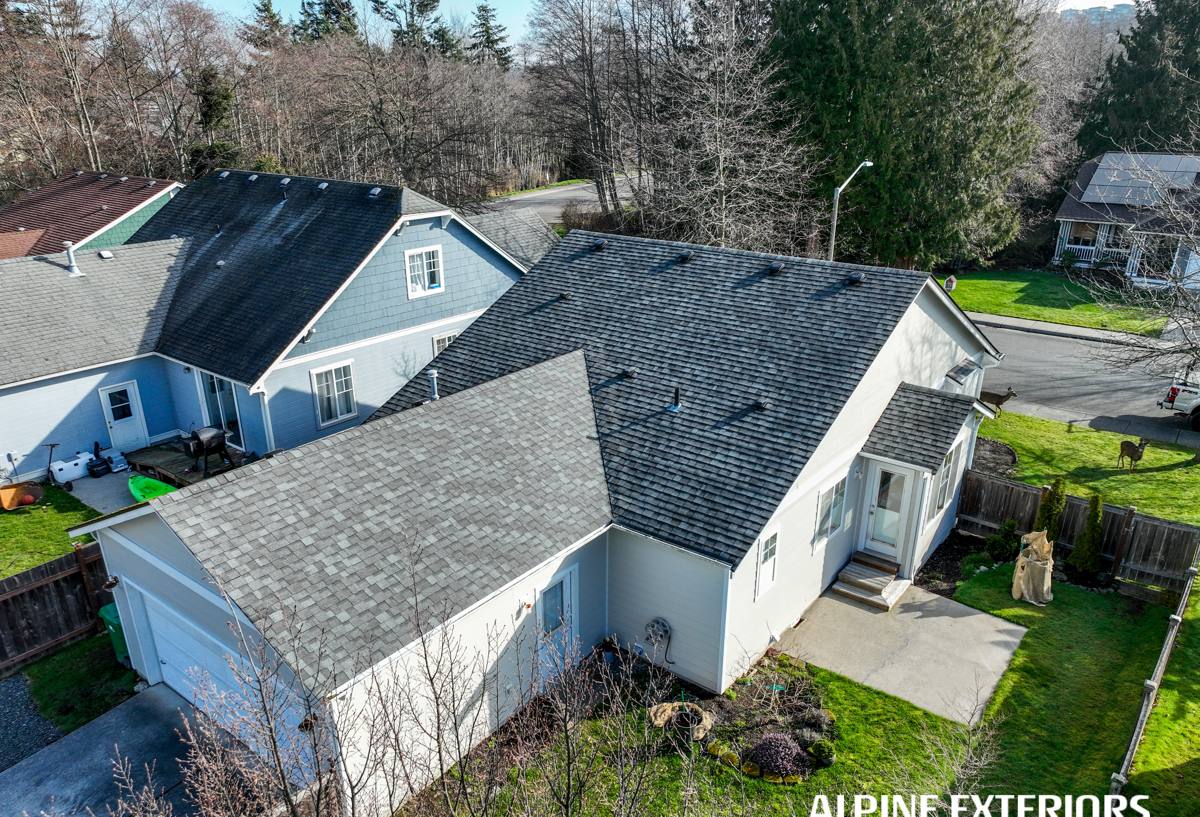
What Semiahmoo's Climate Does to an Asphalt Shingle Roof
Salt Air From More Than One Direction
Because the spit has water on multiple sides, salt-laden air reaches a Semiahmoo roof from more directions than it would on a typical inland Ferndale or Blaine property. Salt accelerates corrosion in exposed roofing metal — flashing, drip edge, nail heads, and vent hardware — faster than it would a few miles inland. Asphalt shingles themselves aren't directly damaged by salt the way metal is, but every metal component tied into the roof system is, and a roof is only as watertight as its weakest flashing point.
Wind-Driven Rain, Not Just Rainfall Totals
With little to break the wind, rain on the spit gets pushed sideways and up under shingle edges instead of falling straight down and running off. That matters more for asphalt shingle performance than the region's annual rainfall number suggests, because sideways-driven rain tests the sealant strip bond, the shingle overlap, and the underlayment laps in ways a calmer inland lot rarely experiences. A shingle roof built for average regional rainfall, without accounting for wind-driven intrusion specifically, can develop leaks at valleys and edges well before the shingles themselves have worn out.
A Moss Season That Runs Most of the Year
Mild temperatures and near-constant humidity give Whatcom County a long moss and algae season, and shaded, north-facing roof slopes on Semiahmoo properties see it worst. Moss holds moisture against the shingle surface, works into the granule layer, and can lift shingle edges as it grows, which is a slower but just as real threat to roof lifespan as any single storm.
Choosing the Right Asphalt Shingle for This Setting
Not every asphalt shingle product is built the same, and on an exposed coastal property the differences matter more than they would on a sheltered inland lot. Three-tab shingles are lighter, less expensive, and generally carry lower wind ratings. Architectural (laminated) shingles are heavier, carry a stronger sealant bond and higher wind rating, and hold up better against the kind of sustained wind-driven rain the spit sees. For most Semiahmoo homes, that added durability is worth the modest price difference over the life of the roof.
| Shingle Type | Typical Wind Rating | Algae Resistance | Fit for Semiahmoo |
|---|---|---|---|
| Standard 3-tab | Lower wind rating, lighter weight | Usually not included; can be added on some lines | Workable on sheltered slopes, weaker choice on exposed sides |
| Architectural / laminated | Higher wind rating, heavier construction | Commonly available as an algae-resistant option | Better match for open, wind-exposed roof planes on the spit |
| Impact-resistant architectural | Same as standard architectural, plus impact class rating | Commonly available | Worth considering on roofs with overhanging trees or debris exposure |
Algae-resistant shingles use copper-infused granules that slow the dark staining and organic growth that plain granules develop within a few years in a climate like this. Given how long the moss and mildew season runs here, that feature earns its modest upcharge on most Semiahmoo roofs, particularly on shaded north-facing slopes.
Color and Heat Considerations
Darker shingle colors absorb more heat and can show granule wear slightly faster over time, while lighter colors reflect more heat but show algae staining more visibly before it's cleaned. Neither is wrong for this climate — it's a genuine trade-off between appearance and how visible normal weathering will be, and worth talking through before ordering material.
What Correct Installation Requires on a Semiahmoo Roof
An asphalt shingle is only as good as the system underneath it. On an exposed spit property, several details matter more than they would on a calmer inland roof.
- Self-adhered membrane at valleys, eaves, and penetrations: These are the spots most likely to see wind-driven water intrusion, and a self-adhered underlayment seals around fastener penetrations in a way felt or standard synthetic underlayment doesn't.
- Synthetic underlayment across the field: Holds up to wind and job-site exposure better than older felt products, and resists the wrinkling that can telegraph through shingles over time.
- High-wind fastening pattern: An additional nail per shingle beyond the standard four-nail pattern, driven correctly and not overdriven, materially improves uplift resistance on an open, wind-exposed roof.
- Corrosion-resistant flashing and fasteners: Given the salt exposure from multiple directions, flashing metal and fastener coatings need to be rated for that environment, not just standard-grade hardware.
- Properly lapped step and counter flashing: At chimneys, walls, and roof-to-wall transitions, where most real-world roof leaks actually start rather than in the open field of shingles.
- Balanced intake and exhaust ventilation: Keeps the attic and roof deck able to dry out between storms instead of trapping moisture that accelerates deck rot and moss growth from underneath.
None of these are upgrades in this setting — they're the baseline for a shingle roof that's actually built for where it sits. A roof that skips them can look identical to a correctly built one on the day it's finished and still fail years earlier.
Signs a Semiahmoo Asphalt Shingle Roof Needs Attention
- Moss buildup in valleys or on shaded slopes that keeps returning shortly after cleaning
- Granules collecting in gutters or at the base of downspouts
- Shingle edges that look lifted, curled, or cupped, especially on wind-exposed slopes
- Flashing around chimneys, vents, or skylights that's visibly rusted, lifted, or missing sealant
- Water staining on interior ceilings near exterior walls after a windy storm off the water
- Bald or shiny patches where granule loss has exposed the underlying mat
Repair or Replace: What Actually Drives That Decision
Not every issue on a Semiahmoo roof means full replacement. The right call depends on the roof's age, how localized the damage is, and what condition the decking underneath is in.
| Factor | Leans Toward Repair | Leans Toward Replacement |
|---|---|---|
| Roof age | Well within the shingle's expected service life | At or beyond typical asphalt shingle lifespan for this climate |
| Damage location | Isolated to one flashing point or a small shingle area | Spread across multiple slopes or both wind-exposed sides |
| Decking condition | Solid, no soft spots found on inspection | Soft or delaminating decking discovered underneath |
| Granule loss pattern | Light and even, consistent with normal aging | Heavy, patchy, or concentrated on wind-facing slopes |
| History of leaks | First occurrence, clear single cause identified | Repeated leaks in different spots over recent seasons |
A straightforward flashing repair or a section of replaced shingles can be the right, honest answer for a roof that's otherwise sound. We'll say so when that's the case rather than defaulting to a full tear-off, because a roof that doesn't need full replacement yet doesn't need to be sold as one.
Our Process for Semiahmoo Roofing Projects
We start with an on-site inspection of the roof, the decking where it's accessible, and the ventilation system, and we look specifically at how the current roof has handled wind and moisture exposure over time — not just its overall age. From there we put together a written scope covering underlayment type, shingle product, flashing detail, and ventilation work, along with a clear price and timeline, before any work begins. During the job, tear-off exposes the decking so any hidden moisture damage gets addressed rather than covered back up, and flashing, fastening, and underlayment are treated as standard practice on a property like this rather than optional add-ons. We finish with a walkthrough and a gutter and ground cleanup, including a magnetic sweep for stray fasteners.
Why a Crew That Already Works Semiahmoo Matters
A roofing crew that regularly works this stretch of the Whatcom County coastline already knows how salt air, open wind exposure, and a long wet season behave differently here than they do even a short distance inland. That shows up in specific, practical decisions — which fastener grade holds up, how much extra attention valleys and wall transitions get, where an added course of self-adhered membrane earns its cost. A crew without that local track record can still do a competent job, but they're more likely to build to a generic standard that doesn't fully account for what an exposed spit property actually goes through over a wet Pacific Northwest winter.
If you're thinking about repairing or replacing an asphalt shingle roof on a Semiahmoo property, we're happy to take a look, walk you through what your roof actually needs, and give you a straightforward, no-pressure written estimate. Reach out using the form below.