 Ferndale
 Point Roberts Puts Siding Through More Than Most Homes Ever See
Point Roberts sits on its own peninsula, with water on three sides and nothing but the Strait of Georgia and Boundary Bay between the neighborhood and open marine weather. That geography is part of what makes the community special, and it's also exactly why siding here ages differently than siding fifteen miles inland. Salt-laden wind off the water works on caulk, paint, and fasteners year-round. Driving rain off the same exposure finds every unsealed joint and butt seam. And the mature tree cover that shades many Point Roberts lots keeps those same wet surfaces from drying out, which stretches the moss and algae season far longer than it runs in more open, sun-exposed parts of Whatcom County.
None of that means siding repair here is exotic. It means the person doing the repair needs to actually understand what's failing and why, instead of patching the visible symptom and leaving the underlying cause to keep working on the wall.
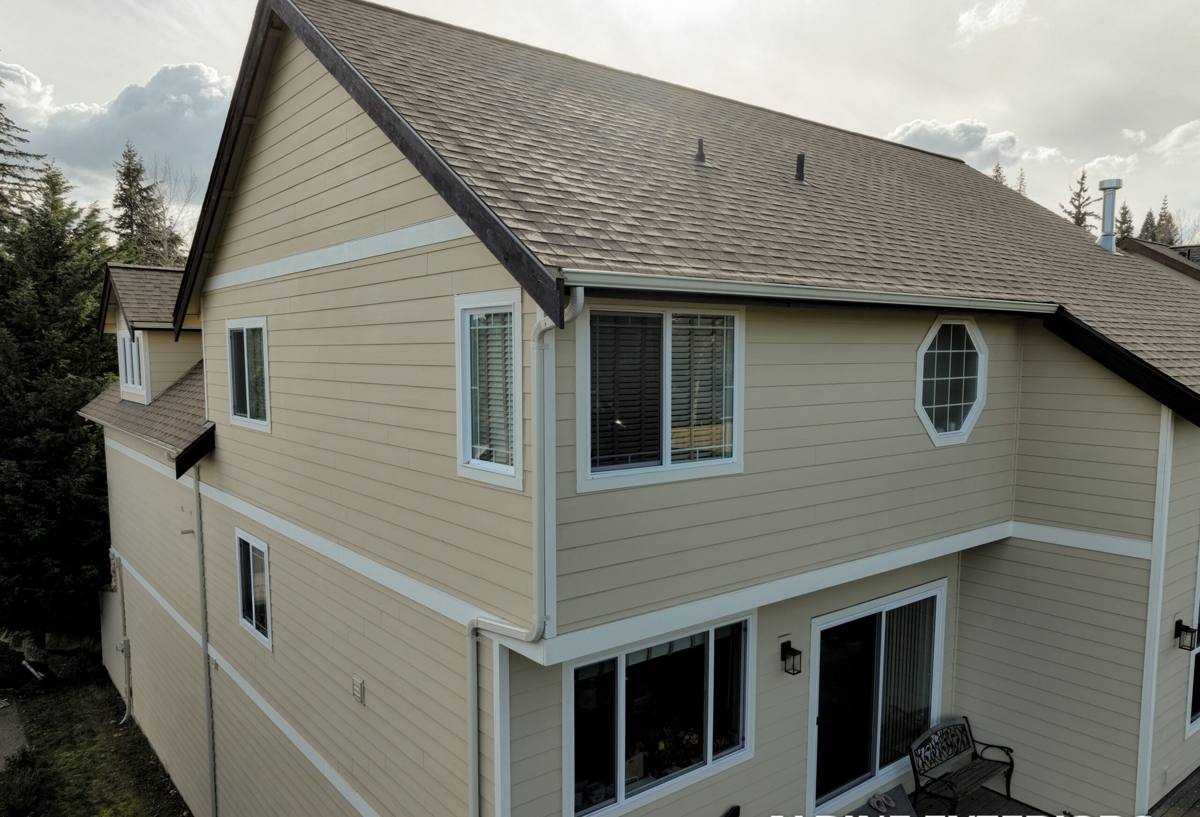
Signs Your Siding Needs Repair, Not Just a Wash
Homeowners often call us after noticing something cosmetic, but the cosmetic issue is frequently a signal of something happening behind the siding, not just on the surface. Before scheduling a repair, walk your exterior and look for the following:
- Bubbling, peeling, or chalking paint, especially on walls facing the water
- Soft, spongy, or crumbling spots when you press gently on the siding
- Persistent green or black staining that comes back quickly after cleaning
- Gaps opening up at butt joints, corners, or where siding meets trim
- Visible warping, cupping, or separation of individual boards or panels
- Fastener heads showing rust streaks below them
- Interior signs like discoloration or a musty smell on an exterior-facing wall
Any one of these is worth a look. Several together, especially on the sides of the house that face the water or stay shaded, usually mean moisture has been getting behind the siding for a while.
What a Proper Repair Actually Involves
Diagnosis before repair
The first thing we do on any repair call is figure out whether we're looking at a cosmetic problem or a moisture problem, because the fix is completely different. Cosmetic issues — surface mildew, faded paint, minor caulk cracking — can often be addressed without opening anything up. Moisture problems require pulling the affected boards or panels to check the water-resistive barrier and framing underneath. Patching over a moisture problem without checking behind it just seals the damage in and lets it keep spreading out of sight.
Matching materials honestly
If your home has older cedar, vinyl, LP SmartSide, or another fiber cement product, we'll tell you plainly what your repair options are. Sometimes a like-for-like patch on a small, isolated area makes sense. Other times, especially with aging cedar or engineered wood siding that's already showing widespread wear, patching a few boards just delays a bigger job and rarely matches the existing material's color or texture well. We'll be straightforward with you about which situation you're in rather than selling a patch that won't hold.
Doing the repair right
A correct repair on a marine-exposed home means:
- Removing and replacing damaged material back to solid, dry substrate — not just the visibly rotten piece
- Checking and repairing the water-resistive barrier and flashing behind the removed section
- Using corrosion-resistant fasteners rated for coastal exposure
- Re-caulking joints with a sealant rated for the movement and moisture cycling this climate creates
- Priming and finishing repaired sections to match, so the repair doesn't stand out as a patch
Repair vs. Replacement: When Patching Isn't Enough
Not every siding problem in Point Roberts needs a full re-side, but some do, and it's worth knowing the difference going in. A single damaged board from an impact, one failed joint, or isolated moisture intrusion caught early is usually a straightforward repair. Widespread paint failure across multiple walls, siding that's original to a home built decades ago, or moisture damage found in more than one location during inspection are signs the material itself is reaching the end of its useful life, and repeated patch repairs will cost more over a few years than one correctly done replacement.
We install James Hardie fiber cement exclusively, and when a home's existing siding is beyond reasonable repair, that's the direction we'll recommend and explain why — not because we won't patch what can be patched, but because we don't want to keep sending a crew back out to chase the same failing product board by board.
Repair vs. Replacement: Quick Comparison
| Situation | Repair usually works | Replacement makes more sense |
|---|---|---|
| Damage location | Isolated to one board or small area | Spread across multiple walls |
| Cause | Impact damage, one failed joint | Widespread material fatigue or age |
| Moisture found behind siding | None, or contained to one spot | Present in multiple locations |
| Material condition elsewhere | Sound and holding paint well | Chalking, cupping, or soft throughout |
| History | First repair on this wall | Second or third repair on the same section |
Our Repair Process
We keep repair jobs straightforward and don't add steps that don't serve the house:
- Inspection — we walk the full exterior, not just the spot you called about, since salt air and shade tend to affect more than one wall at similar rates
- Diagnosis — we identify whether we're dealing with cosmetic wear, isolated moisture, or a broader material issue
- A clear plan — you get a straight explanation of what we found, what we recommend, and why, before any work starts
- The repair — removal of damaged material, correction of anything wrong underneath, replacement or patching with appropriate materials and fasteners
- Finish and cleanup — matching paint or finish, resealing joints, and leaving the site clean
Materials and Fasteners That Actually Hold Up to Salt Air
Repair quality lives in details most homeowners never see once the work is done. In a marine environment like Point Roberts, that means stainless steel or coated fasteners instead of standard galvanized, sealants formulated for UV and moisture cycling rather than general-purpose caulk, and paint or factory finish that resists the chalking salt air accelerates on lesser coatings. When we're patching with James Hardie fiber cement, that's less of a concern to begin with — Hardie's HZ5 product line is engineered for harsher climate zones, and the factory-applied ColorPlus finish is baked on and warranted against fading in a way field-applied paint on other materials isn't. When a repair does call for matching an existing non-Hardie material, we use the best available fastener and sealant practice for the exposure, and we'll tell you honestly where that repair's limits are.
Cost Factors for Point Roberts Siding Repairs
| Factor | Why it matters here |
|---|---|
| Extent of moisture damage | Framing repair behind the siding adds time and material beyond the siding itself |
| Material match availability | Older cedar or discontinued vinyl/LP profiles can be harder to match exactly |
| Wall exposure and access | Water-facing or hard-to-reach walls with heavier salt exposure often need more prep |
| Number of repair locations | Multiple smaller repairs across a home cost more in aggregate than one focused section |
| Paint or finish matching | Blending a repair into existing color, especially faded original paint, takes extra care |
Why a Crew That Already Works Point Roberts Matters
Point Roberts is a U.S. exclave — reaching it by road means crossing the Canadian border twice, and that logistics reality shapes who's willing to take siding jobs there and how well they plan for it. Contractors who don't regularly work the area often treat it as a special trip: they price in the crossing time, bundle it awkwardly with other jobs, or simply decline calls from the peninsula altogether. A crew that already works Point Roberts on a regular basis has that logistics solved — border documentation sorted out, tools and materials staged and ready to cross, and a realistic sense of how long a job actually takes once travel is factored in. That translates into fewer scheduling surprises and a crew that shows up prepared instead of figuring it out on the fly.
Familiarity with the area also means familiarity with how the marine exposure actually behaves on real homes here — which walls take the worst of the salt wind, which lots hold moisture longest under tree cover, and which repair shortcuts don't hold up a second winter. That's knowledge you only get from doing the work in this specific place repeatedly, not from a general siding background applied to an unfamiliar location.
Living With Salt Air and Moss: What Helps Between Repairs
A few habits make a real difference in how long a repair — or a full Hardie installation — holds up in this climate. Keep gutters clear so water isn't sheeting down siding it wasn't meant to run across. Trim back vegetation that keeps walls shaded and damp longer than they need to be. Rinse salt residue off exterior walls periodically, particularly on water-facing sides. And don't ignore small caulk cracks or paint chips — in a marine climate, small gaps turn into moisture problems faster than they would somewhere drier, and catching them early is almost always the cheaper path.
If you're seeing any of the warning signs above, or you just want an honest read on what's going on with your siding, we're glad to take a look. We offer free, no-pressure estimates for Point Roberts homes — fill out the form below and we'll get a repair plan in front of you with no obligation attached.