 Ferndale
 Why Storm Damage Hits Bellingham Roofs Differently
Bellingham sits close enough to the water that roofs here deal with a combination most inland towns never see: salt-laden air off Bellingham Bay and the Strait of Georgia, wind that funnels through the low hills and gaps around the bay, and driving rain that comes in sideways during winter fronts instead of falling straight down. On top of that, Whatcom County's long wet season keeps roofs damp for months at a stretch, which is exactly the environment moss needs to take hold. None of these factors are dramatic on their own, but together they wear on a roof faster than the shingles' age alone would suggest.
Storm damage in this area is rarely one dramatic event. More often it's a windstorm that lifts a few shingle tabs, followed by weeks of rain finding that opening before anyone notices a problem inside the house. Understanding that pattern is the first step to catching damage early instead of after it's already caused a ceiling stain.
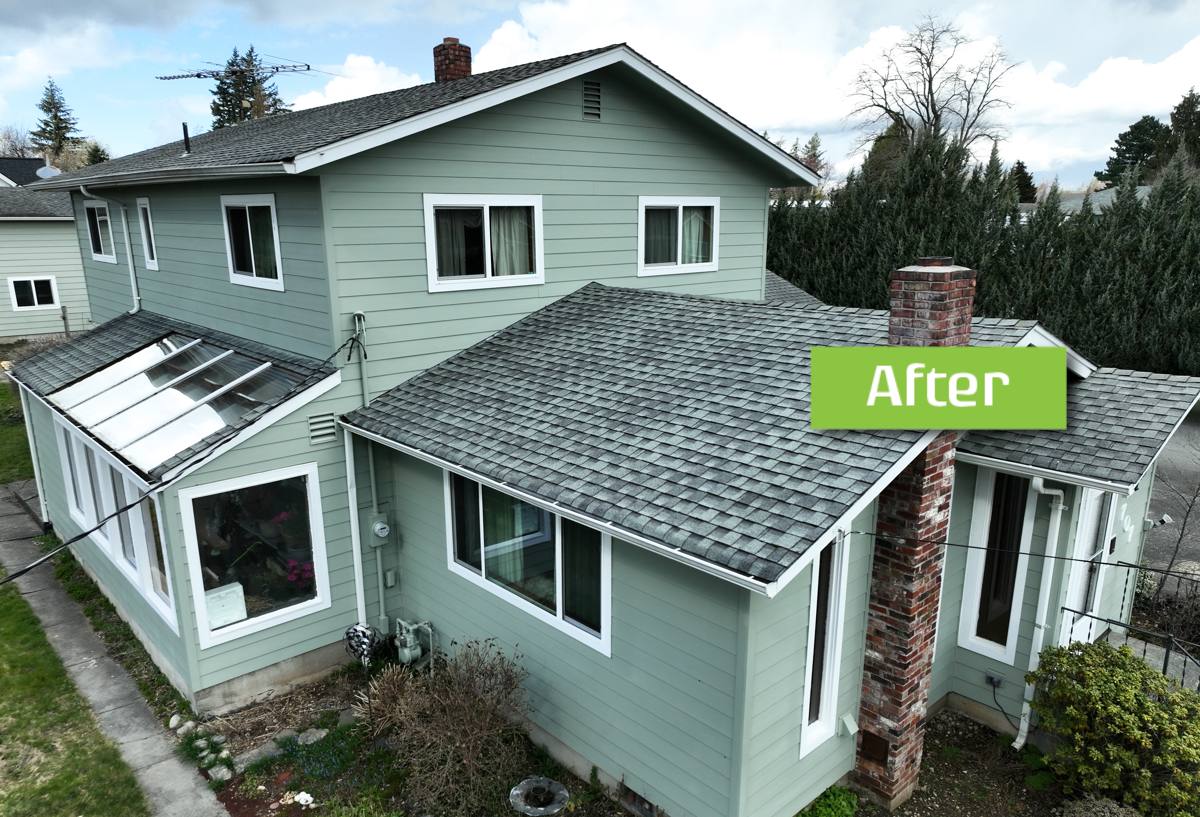
What Actually Counts as Storm Damage
Wind Damage
Wind off the water doesn't need to be a named storm to do damage. Sustained gusts can work shingle tabs loose, crease them, or pop nails partway out without tearing anything off completely. A roof can look intact from the ground and still have dozens of compromised shingles.
Wind-Driven Rain Intrusion
When rain comes in at an angle, it can get up under shingle edges, around flashing, and into vents that are designed to shed water falling straight down. This is one of the more common ways Bellingham roofs leak without any obvious missing material.
Impact Damage
Falling branches and debris are a real factor in neighborhoods with mature trees, which describes much of the area around Bellingham. Impact damage can crack shingles, dent metal flashing, or knock granules loose in a way that isn't visible unless someone gets up on the roof.
Moss-Accelerated Damage
Moss itself isn't storm damage, but it makes storm damage worse. Moss holds moisture against the roofing material, lifts shingle edges as it grows, and gives wind and rain an easier path underneath the roof surface. A roof with a moss problem going into a windstorm season is at meaningfully higher risk than a clean one.
Signs You Might Have Storm Damage
Most homeowners don't get up on their own roof, and honestly, they shouldn't have to. These are the signs worth watching for from the ground or from inside the house:
- Shingle granules collecting in gutters or at downspout outlets after a windy week
- Shingles that look curled, cracked, or slightly out of alignment compared to the rest of the roof
- A ceiling stain or musty smell in an upstairs room or closet, especially after a stretch of heavy rain
- Visible gaps, lifted edges, or bent flashing around chimneys, vent pipes, or skylights
- Moss buildup concentrated on one section of roof, which often signals a shaded, slower-drying area more prone to trapped moisture
- Debris on the roof surface after a storm that hasn't been cleared
What a Correct Storm Repair Actually Involves
A Full Inspection, Not Just a Look at the Obvious Spot
The leak you can see is rarely the only damage. A proper storm repair starts with checking the whole roof plane, not just the area over the stain, because wind-driven rain can travel several feet under shingles before it finds a gap in the underlayment and shows up inside.
Matching Materials and Installation Method
Patching a repair with mismatched shingles, wrong nail placement, or the wrong exposure pattern creates a weak point that's likely to fail again in the next storm. A correct repair uses compatible materials and follows the same fastening pattern the rest of the roof was installed with, so the repaired section performs the same as the surrounding roof rather than becoming the next problem area.
Flashing and Underlayment Get Checked, Not Ignored
Flashing around chimneys, vents, and roof-to-wall transitions is where a lot of storm leaks actually originate, even when the visible damage is a few feet away on the shingle field. Underlayment that's been wet repeatedly can lose its ability to protect the deck even if the shingles above it look fine. Both need to be part of the inspection, not an afterthought.
It's Not Just a Patch Job
A repair that only addresses the surface without checking the roof deck underneath for soft spots or rot isn't a complete repair. If water has been getting in for a while before it was noticed, the deck itself may need attention before new shingles go back down.
Repair or Replace? What Actually Decides It
Not every storm-damaged roof needs a full replacement, and not every roof is a good candidate for another repair. The honest answer depends on a handful of factors:
| Factor | Repair Usually Makes Sense | Replacement Worth Considering |
|---|---|---|
| Roof age | Under roughly 15 years, or well-maintained | Nearing or past its expected service life |
| Extent of damage | Localized to one section or slope | Spread across multiple areas of the roof |
| Deck condition | Solid, no rot found during inspection | Soft spots or rot found under the shingles |
| Moss history | Minor, treatable buildup | Long-term moss damage affecting multiple sections |
| Repair history | First or second repair on the roof | Several prior repairs in different spots |
Cost is obviously part of this conversation too. A single-slope shingle repair is a relatively contained job, while replacing damaged decking or re-roofing a full section costs more because of the added labor and materials. We'll walk through where your roof actually falls on that spectrum before recommending either option — there's no reason to sell a full replacement when a repair will genuinely hold up, and no reason to keep patching a roof that's past the point of it making financial sense.
Our Storm Damage Repair Process
- Inspection and documentation. We get on the roof, photograph the damage, and check adjacent areas that might be affected even if they aren't the source of a visible leak.
- Straight talk on scope. We tell you what we found, what it means, and whether we're looking at a repair or something larger — before any work starts.
- Insurance paperwork, if it applies. If the damage is likely to be a claim, we provide the documentation your insurer will ask for so you're not chasing that down yourself.
- The repair itself. Matching materials, correct flashing and underlayment work, and deck repair if it's needed — not just new shingles laid over a problem that's still underneath.
- Cleanup and a final walk-through. Debris removed, gutters checked, and a look at the finished repair together before we consider the job done.
Why a Ferndale-Based Crew Matters for Bellingham Homes
We work out of Ferndale, a few minutes up the road from Bellingham, which means two practical things. First, response time after a storm isn't dependent on a crew driving in from out of the county — we already know the roads and the neighborhoods. Second, we're not guessing at how Whatcom County weather behaves. We've seen how moss builds up on shaded north slopes near the tree line, how wind off the bay tends to hit certain roof orientations harder than others, and how a roof that looks fine in July can be hiding a slow leak that started with a February windstorm.
That local familiarity matters more than it sounds like it should. A crew that only occasionally works this area might treat a Bellingham roof the same as one in a drier, calmer climate. We don't, because that's not how these roofs actually age.
Keeping Your Roof Ready for the Next Storm
Storm damage repair fixes what's already happened. Reducing how much damage the next storm causes is a separate, ongoing effort, and it's worth doing given how long the wet season runs here.
- Keep gutters clear so wind-driven rain has somewhere to go instead of backing up under the roof edge
- Address moss buildup before it spreads across a whole slope, not after
- Trim back branches that overhang the roof, since they're a common source of impact damage in wind
- Have the roof looked at after any significant windstorm, even if nothing looks wrong from the ground
- Don't ignore a small ceiling stain — it's almost always cheaper to address early than after it's spread
If a recent storm has you wondering whether your roof took damage, or you've just noticed something that doesn't look right, we're glad to come take an honest look. The estimate is free, there's no pressure to move forward, and you'll get a straight answer about what — if anything — actually needs to happen next.