 Ferndale
 Why Sudden Valley Roofs Take a Different Kind of Beating
Sudden Valley sits in a pocket of Whatcom County where wooded lots, lake-effect moisture, and long stretches of overcast, wet weather combine to shorten the life of an ordinary roof faster than homeowners expect. It's not one thing — it's the layering of several. Driving rain off the water gets pushed sideways under eaves and around penetrations. Tree cover keeps roof surfaces shaded and damp for days after a storm has passed, which is exactly what moss needs to take hold. And the marine-influenced air common across western Whatcom County carries enough salt and moisture to slowly work on fasteners, flashing, and coatings that weren't specified for it.
A composition shingle roof in this setting is fighting an uphill battle from day one. Metal roofing, installed correctly, is built for exactly these conditions — but "correctly" is doing a lot of work in that sentence. A metal roof installed the way it would be in a dry inland climate will underperform here. This page covers what a metal roof actually needs to hold up on a Sudden Valley home, what a proper installation looks like, and why local experience on this specific terrain matters more than most homeowners realize.
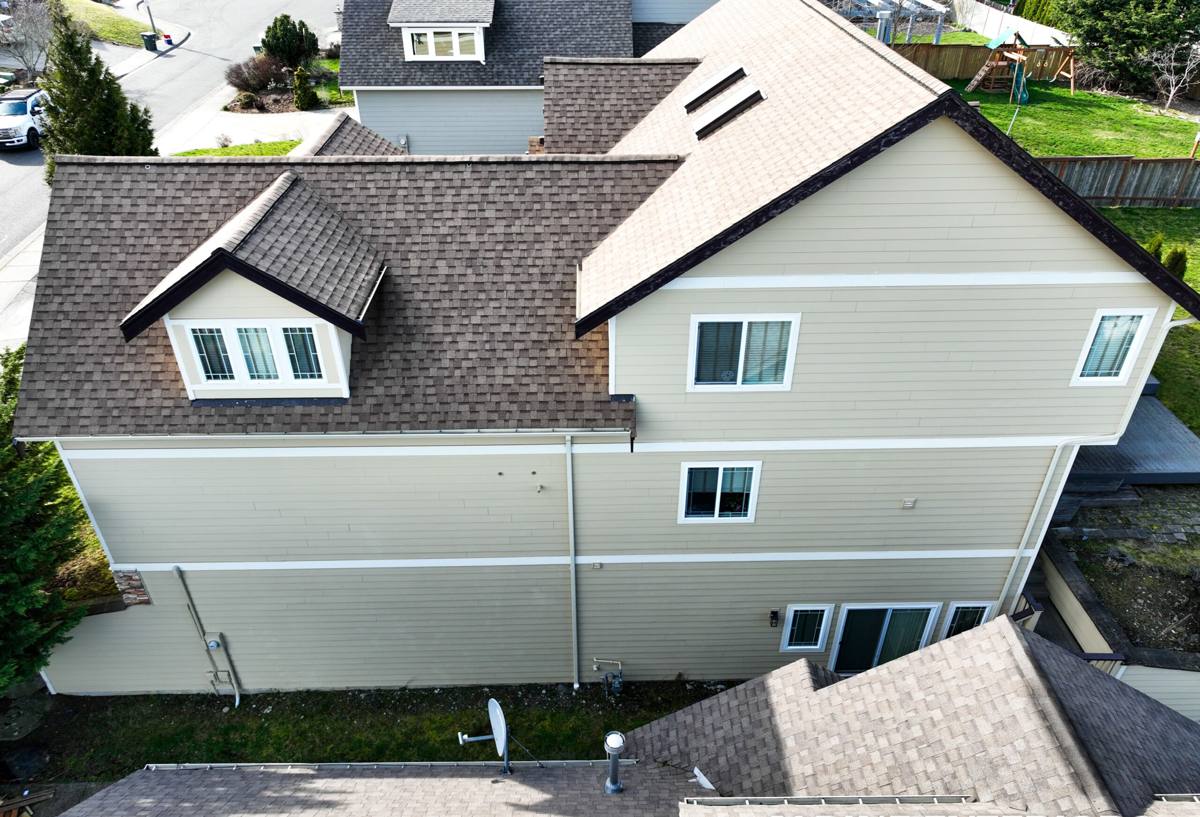
What the Local Climate Actually Demands From a Roof
Moss Season Is Longer Than Most Homeowners Think
In much of Whatcom County, moss isn't a once-a-year nuisance — it's close to a year-round condition on north-facing slopes and shaded roof planes. Moss holds moisture directly against roofing material, and on the wrong substrate that moisture works its way into seams, fastener holes, and underlayment. Metal roofing doesn't feed moss growth the way organic shingle granules do, but a metal roof still needs the right panel finish, slope, and drainage detailing to keep moss from gaining a foothold in valleys and low-slope sections.
Driving Rain Finds Every Weak Point
Wind-driven rain doesn't just fall on a roof — it gets pushed uphill under laps, around chimneys, and into any gap in flashing that was cut short. A metal roof's watertight performance depends almost entirely on how the details were executed: underlayment overlap, flashing sequencing, and fastener sealing. The panels themselves are close to bulletproof against water; the places where two materials meet are where failures happen.
Salt-Influenced Air and Metal Fatigue
Homes closer to open water or exposed to prevailing coastal winds see accelerated corrosion on unprotected metal — fasteners, flashing, and any exposed cut edges. This is a material-selection problem as much as an installation problem: the coating system and fastener grade have to match the exposure the home actually gets, not a generic spec sheet.
What a Correct Metal Roof Installation Involves
A metal roof is a system, not a single product. Skipping or downgrading any one layer shows up as a leak, a rust streak, or a warranty claim a few years down the road — usually right when a homeowner assumes the roof is maintenance-free. A proper installation for this climate includes:
- Full tear-off inspection of the roof deck for rot or soft spots before anything new goes down — covering damaged decking with new material just traps the problem.
- Ice-and-water shield at eaves, valleys, and around every penetration, not just where code minimums require it.
- Synthetic underlayment rated for the panel type, providing a secondary water barrier if wind-driven rain ever gets past the panel laps.
- Proper panel fastening — concealed clips for standing seam systems that allow the panel to expand and contract with temperature swings without stressing fasteners.
- Correctly sequenced flashing at every roof-to-wall transition, chimney, skylight, and vent — installed shingle-style so water is always directed over the next layer down, never into it.
- Matched fastener and flashing metallurgy so dissimilar metals aren't left in contact with each other, which causes galvanic corrosion over time.
- Ventilation that keeps the attic space dry underneath the roof deck, preventing condensation from the inside working against the roof from below.
Standing Seam vs. Exposed-Fastener Panels
Both are legitimate metal roofing systems, but they perform differently in a wet, moss-prone climate like this one, and the right choice depends on the home's roof pitch, budget, and how long the owner plans to stay in the house.
| Panel Type | How It's Fastened | Performance in Heavy Rain / Moss Conditions | Typical Lifespan |
|---|---|---|---|
| Standing Seam | Concealed clips under raised, interlocking seams | No exposed fastener holes to fail; seams shed water and resist moss buildup well | 40-70 years |
| Exposed-Fastener (Ag panel / R-panel) | Screws driven through the panel face with rubber washers | Reliable when installed and maintained well, but washers age and need periodic checking | 25-40 years |
On lower-slope sections common in valley and lakeside lots, we lean toward standing seam because there's no exposed fastener for water to find under sustained rain. On steeper, simpler roof planes, a well-installed exposed-fastener system is a legitimate and more affordable option — the key is matching the system to the roof geometry rather than defaulting to whichever is cheaper across the board.
Metal Roofing Compared to Other Common Options
Homeowners weighing a re-roof in this area are usually comparing metal against asphalt composition shingles or, less often, cedar shake. Here's how they stack up specifically against the conditions Sudden Valley homes deal with:
| Material | Moss & Moisture Resistance | Driving Rain Performance | Long-Term Maintenance |
|---|---|---|---|
| Metal (standing seam or panel) | Doesn't feed moss growth; sheds water fast off a smooth surface | Excellent when flashing and laps are installed correctly | Low — periodic debris clearing and flashing checks |
| Asphalt composition shingle | Granules trap moisture and organic debris; moss takes hold readily | Good when new, degrades as granule loss increases | Moderate — moss treatment, periodic shingle repair |
| Cedar shake | Highly susceptible to moss and rot without diligent upkeep | Good initially, weakens as wood ages and cups | High — regular treatment, more frequent replacement |
Metal isn't automatically the right answer for every home or budget, but for a Sudden Valley property under heavy tree cover or exposed to lake wind, it's the material that asks the least of the homeowner over the following decades.
Our Process, Start to Finish
1. On-Site Assessment
We walk the roof and the attic, not just the exterior. Roof pitch, existing deck condition, ventilation, tree cover, and drainage paths all factor into the panel system and detailing we recommend — a roof shaded by mature trees on the north side gets different valley and moss-prevention detailing than one in full sun.
2. Written Scope and Material Selection
Before any work starts, the homeowner gets a clear, written scope: panel type, gauge, coating, underlayment, and flashing plan, along with a realistic cost range. No verbal promises that don't make it into the paperwork.
3. Tear-Off and Deck Inspection
Old roofing comes off down to the deck so we can actually see what's underneath — this is the step that gets skipped by crews doing quick overlay jobs, and it's where hidden rot or ventilation problems get caught before they're sealed under a new roof.
4. Underlayment, Flashing, and Panel Installation
Ice-and-water shield and underlayment go down first, then flashing is sequenced at every transition before panels are installed. This order matters — flashing installed after panels instead of woven into the sequence is one of the most common sources of later leaks.
5. Final Walkthrough
We walk the finished roof with the homeowner, cover what maintenance (if any) the system needs, and provide documentation for the material and workmanship warranties.
Maintaining a Metal Roof in This Climate
Metal roofing is genuinely low-maintenance compared to shingles, but "low-maintenance" isn't "zero-maintenance," especially with the moss and moisture load common across Whatcom County. A short annual routine keeps a metal roof performing at its best for decades:
- Clear needles, leaves, and debris from valleys and gutter lines, especially after fall storms — buildup here is what starts moss colonies even on metal.
- Check gutters and downspouts are flowing freely; standing water backed up against roof edges is a common source of slow leaks.
- Visually inspect flashing around chimneys, vents, and skylights for lifted edges or sealant that's cracked or shrunk.
- On exposed-fastener systems, check that screw washers haven't hardened or pulled loose — this is the single most common maintenance item on that panel type.
- Trim back overhanging branches that keep sections of roof shaded and damp longer than the rest.
Cost Factors Worth Understanding
Metal roofing costs more upfront than asphalt shingles, and the range on any given home depends on more than just square footage. Homeowners weighing the investment should know what actually moves the price:
| Factor | Why It Affects Cost |
|---|---|
| Panel system (standing seam vs. exposed-fastener) | Standing seam requires more labor and material for concealed clips and seaming |
| Roof complexity | Valleys, dormers, and multiple penetrations all add flashing labor |
| Deck condition | Rot or soft decking found during tear-off adds repair cost before new roofing goes on |
| Coating and gauge | Heavier-gauge metal and higher-grade coatings cost more but last longer in wet, salt-influenced air |
| Access and site conditions | Steep pitches, tree cover, or limited staging area affect labor time |
A metal roof typically costs two to three times what an asphalt shingle roof does upfront, but with a lifespan two to three times as long and far less maintenance in between, the cost per year of service is often closer than the sticker price suggests. We'll walk through the specifics for your roof rather than quoting a number that doesn't reflect your actual conditions.
Why Local Experience in Sudden Valley Actually Matters
A roofing crew that's worked houses in and around Sudden Valley already knows what an outside crew has to learn on the job: how the tree cover and lake proximity on different lots change moss and moisture exposure, which roof details tend to fail first in this specific mix of rain and humidity, and how to plan material staging and access on wooded or sloped lots without tearing up landscaping. That familiarity shows up in fewer surprises during tear-off and a roof detailed for the conditions it will actually face — not a generic spec pulled off a national install guide.
As a Ferndale-based crew working across Whatcom County, we're not driving in from out of the area to quote a job we won't be around to service. If a flashing detail needs a second look two years after installation, or a warranty question comes up, we're local and reachable — not a name from a lead-generation site that won't answer the phone once the invoice is paid.
If you're weighing a metal roof for a home in Sudden Valley or elsewhere in Whatcom County, we're happy to walk the roof, look at your specific conditions, and put together a straightforward, no-pressure estimate — just fill out the form below.