 Ferndale
 Why Blaine Homes Wear Out Siding Faster Than Most
Blaine sits right on the water at the top of Whatcom County, close enough to the Salish Sea that salt air is a daily fact of life rather than an occasional nuisance. Add in wind-driven rain coming off the water and the long, damp moss season that defines western Washington winters, and you have three separate forces working against exterior siding at the same time — not in sequence, but all year, every year. A siding product that performs fine forty miles inland can fail early here simply because it wasn't built to handle salt-laden air, sustained moisture, and the shaded, slow-drying conditions that let moss and algae take hold.
This page is specifically about siding replacement for homes in the Blaine area, not a general overview. If you're weighing whether your home needs a full replacement versus a repair, and what that job should actually involve given this coastal, moss-prone climate, this is written for you.
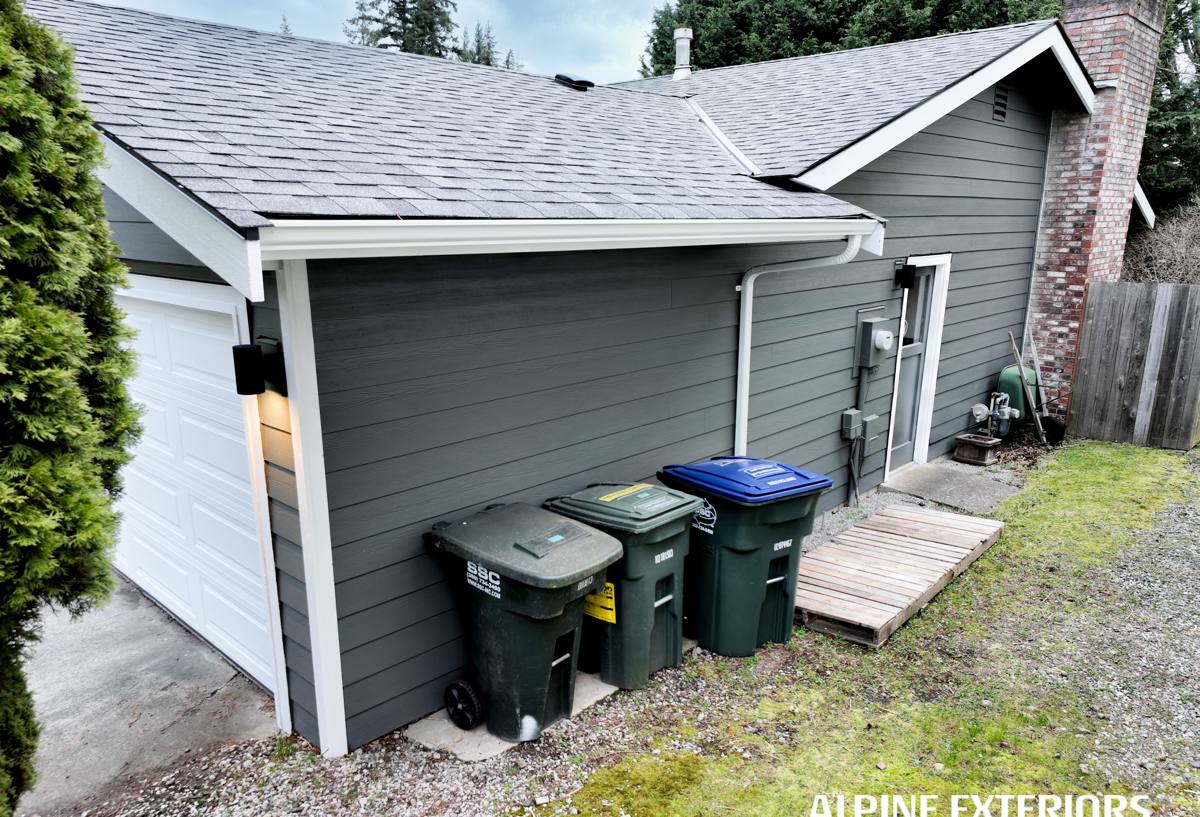
How Coastal Exposure Actually Damages Siding
Salt Air
Airborne salt is corrosive to metal fasteners, flashing, and trim, and it also accelerates the breakdown of some siding finishes over time. Homes closer to open water see this first — chalking, fading, and fastener corrosion that shows up years ahead of what an inland home would experience.
Driving Rain
Wind off the water doesn't just drop rain straight down — it pushes it sideways, into laps, joints, and any gap in the water-resistive barrier behind the siding. A siding system that isn't installed with the right overlaps, flashing, and clearances will let that wind-driven rain find its way behind the cladding, where it does the real damage: rot in the sheathing, saturated insulation, and mold.
Moss and Algae
Whatcom County's shoulder seasons stay damp and shaded for weeks at a time. Moss and algae don't just look bad — they hold moisture against the siding surface far longer than a dry, sun-exposed wall would, which is exactly the condition that lets rot and paint failure take hold on organic or moisture-sensitive materials.
Signs a Blaine Home Needs Replacement, Not Just Repair
Not every siding problem calls for a full tear-off. But there's a point where patching stops making sense — where the underlying material or the original installation is compromised enough that new siding is the only real fix. Watch for:
- Soft or spongy spots when you press on the siding, especially near the bottom courses and around windows
- Persistent black or green staining that returns within a season of cleaning
- Visible cupping, buckling, or separation at the seams
- Paint or finish that's failing across large sections rather than one or two boards
- Interior signs — peeling paint, musty smell, or soft drywall near exterior walls
- Siding that's original to a home built more than 20-25 years ago, especially wood-based products
If you're seeing one or two of these in a small area, a repair may genuinely be enough. If several are showing up across the house, that usually means moisture has been getting behind the siding for a while, and patching the surface won't address what's happening underneath.
What a Correct Siding Replacement Actually Involves
Siding replacement isn't just pulling off old boards and nailing up new ones. In a climate like this, most of what determines whether the new siding lasts happens in the layers homeowners never see again once the job is done.
Tear-Off and Sheathing Inspection
Once the old siding is off, the sheathing underneath gets inspected for rot or damage. This is the point where hidden moisture problems from years of wind-driven rain usually surface — and it needs to be dealt with before anything new goes up, not covered over.
Water-Resistive Barrier
A new weather barrier goes on correctly lapped, shingle-style, so water is shed downward and outward rather than trapped. In a driving-rain climate, this layer matters as much as the siding itself.
Flashing at Every Penetration
Windows, doors, vents, and any other penetration through the wall need proper flashing integrated with the water-resistive barrier — not just caulk. Caulk fails; correctly lapped flashing doesn't rely on a sealant staying intact for twenty years.
Fastening and Clearances
Fiber cement siding has specific fastening patterns and minimum clearances from grade, decks, and roof lines. Getting this wrong is one of the most common causes of early failure, and it's an installation issue, not a product issue.
Why We Install Only James Hardie Fiber Cement
We standardized on James Hardie fiber cement siding for every project, including here in Blaine, because it's the product we trust to hold up to salt air, driving rain, and moss season without the maintenance burden or moisture vulnerabilities that come with other options. It's non-combustible, holds a factory-applied ColorPlus finish that resists fading and chalking far better than field-applied paint, and Hardie engineers specific product lines (their HZ5 line, in particular) for climate zones with exactly this kind of moisture exposure. It also carries a strong, transferable warranty when installed to manufacturer specification — which is part of why correct installation, not just the material, is the whole point of this page.
We don't install vinyl, LP SmartSide, cedar, primed spruce, Cemplank, or Allura. Each of those has legitimate uses elsewhere, but for the specific combination of salt air, wind-driven rain, and sustained damp shade that Blaine homes deal with, we've made Hardie fiber cement our standard rather than offering multiple options.
Comparing Materials in This Climate
| Material | Typical Real-World Lifespan Here | Behavior in Salt Air & Driving Rain | Ongoing Maintenance |
|---|---|---|---|
| Cedar / wood lap | 15-25 years | Absorbs moisture, prone to rot without diligent upkeep; moss and algae take hold quickly in shade | Regular repainting/staining, moisture monitoring |
| Vinyl | 20-30 years | Doesn't rot, but can warp, fade, and crack in temperature swings; seams can allow water intrusion behind panels | Low, but limited repair options once damaged |
| LP SmartSide (engineered wood) | 20-30 years | Wood-based core is moisture-sensitive at cut edges and seams; performance depends heavily on installation and caulking upkeep | Moderate — edge sealing and caulk inspection |
| James Hardie fiber cement | 30-50 years when installed to spec | Fiber cement core doesn't rot or support insect damage; factory finish resists salt-air fading and chalking | Low — periodic cleaning and inspection |
These are general ranges, not guarantees — actual lifespan always depends on installation quality, sun/shade exposure, and how close a given home sits to open water. But the pattern holds across coastal Whatcom County: moisture-sensitive materials need more upkeep, and upkeep is easy to fall behind on.
Our Process for a Blaine Siding Replacement
- On-site assessment — we look at your current siding, sheathing condition where visible, and any problem areas you've noticed
- Scope and product selection — we walk you through the appropriate Hardie product line and profile for your home and exposure
- Tear-off and sheathing check — old siding comes off and the wall is inspected before anything new is installed
- Weather barrier and flashing — new water-resistive barrier and flashing installed at every window, door, and penetration
- Hardie installation to spec — correct fastening, clearances, and joint treatment per manufacturer requirements
- Final walkthrough — we review the finished work with you before calling the job done
Why Working With a Crew That Already Knows Blaine Matters
Coastal exposure isn't uniform even within one town — a home facing open water deals with more direct salt air and wind-driven rain than one set back and sheltered by trees or neighboring structures. A crew that already works in the Blaine and greater Ferndale area has a feel for that variation: which details need extra attention on a more exposed elevation, how moss tends to establish on shaded north-facing walls, and what local permitting and inspection expects. That local pattern-recognition doesn't replace following manufacturer spec — it's what makes sure the spec gets applied correctly to your specific site conditions.
What to Ask Before Hiring for Siding Replacement
Whoever you hire, these are worth confirming up front:
- Are they licensed and insured to do exterior work in Washington State?
- Do they provide manufacturer-specific installation training or certification documentation for the product they're installing?
- Will they inspect and address sheathing condition before installing new siding, not just cover it?
- What does their flashing and water-resistive barrier detail look like at windows and penetrations?
- Is the manufacturer's warranty transferable, and does it require certified installation to stay valid?
- Can they explain why they recommend one product over another for your home's specific exposure?
A contractor who can answer these clearly, without hedging, is usually one who understands the difference between siding that looks right on day one and siding that's still performing correctly fifteen years later.
If your Blaine home's siding is showing signs of wear, or you're just planning ahead before the next wet season sets in, we're happy to take a look and give you an honest assessment — no pressure, no obligation. Use the form below to request a free estimate.