 Ferndale
 Roof Replacement for Custer's Open, Weather-Exposed Homes
Custer sits in the agricultural flatland north of Ferndale, a few miles inland from the Salish Sea but still fully within reach of the marine air, wind, and long wet stretches that define this part of Whatcom County. The open, flat terrain around Custer doesn't offer much windbreak, so storms coming off the water push rain sideways into roof planes rather than letting it fall straight down and run off. Combine that with salt-tinged air working on exposed metal year after year, and a moss season that can run most of the calendar on shaded or north-facing slopes, and you get a specific set of demands on a roof that a generic install isn't built to handle.
This page is specifically about full roof replacement for Custer properties — not a general roofing overview, and not a repair page. Replacement is a bigger decision than a repair, with a longer list of things that need to go right, and it's worth understanding what that actually involves before you're comparing bids.
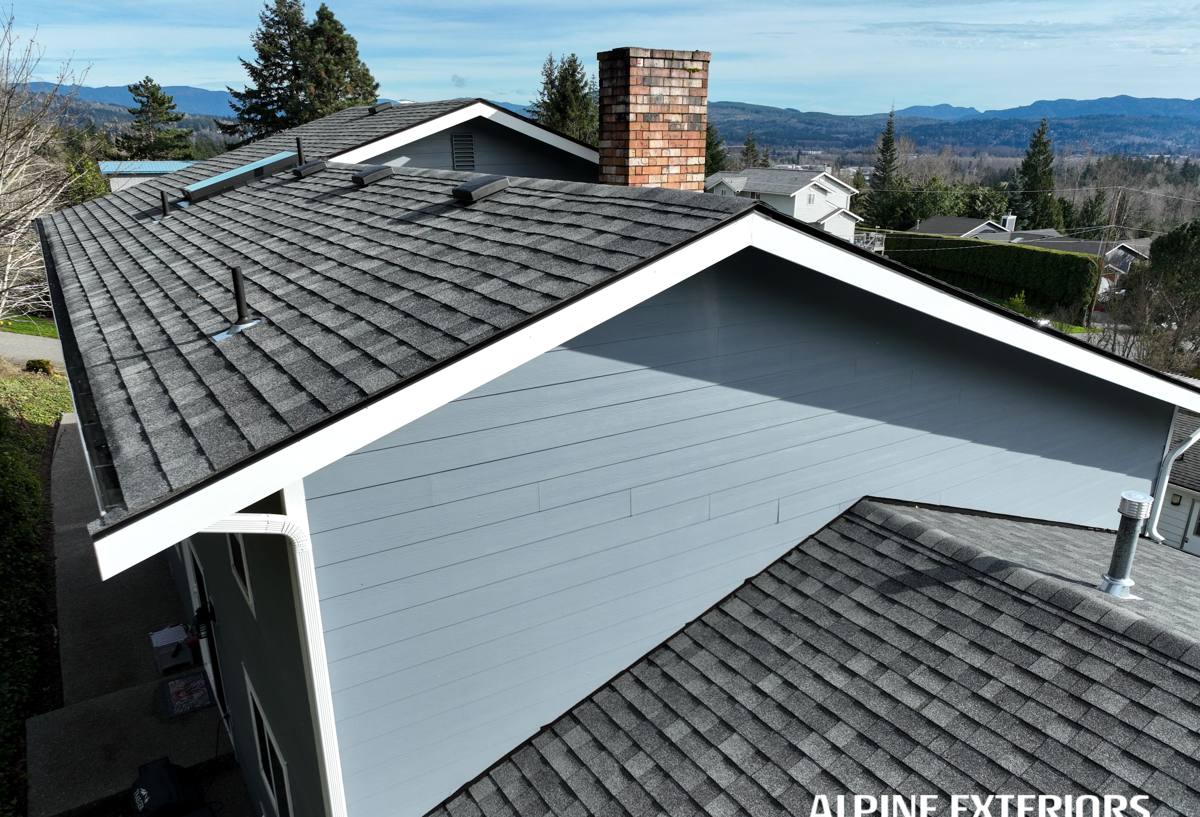
Repair, Reroof, or Full Replacement?
Not every aging or damaged roof needs full replacement, and we don't default to recommending it. The honest answer depends on the roof's age, how much of the deck is still sound, and whether the damage is isolated or spread across the whole roof plane.
When Repair Usually Makes Sense
A handful of cracked or lifted shingles from a wind event, a single flashing failure at one chimney or valley, or isolated granule loss on a roof that's otherwise mid-life are usually repair situations. If the deck underneath is dry and sound and the rest of the roofing is holding up, patching the specific problem is the honest recommendation, not a full tear-off.
When Full Replacement Is the Right Call
A roof at or past its expected service life, widespread granule loss, multiple past repairs that haven't held, soft or spongy decking in more than one spot, or interior water staining that keeps reappearing after repairs are all signs that patching has stopped being the economical answer. At that point, continuing to chase individual repairs usually costs more over a few years than one properly done replacement.
What Custer's Climate Demands From a Replacement Roof
Wind-Driven Rain
Open agricultural land and flat terrain give storms coming off the Georgia Strait a clear run at Custer roofs, and that means rain arrives sideways and gets forced up under shingle edges and laps rather than draining off the way it would in a sheltered setting. A replacement roof here needs underlayment and flashing detailing built for that reality, not the minimum a drier inland market would call for.
Salt-Tinged Marine Air
Even set back from the water, Custer gets enough marine-influenced air carried inland on winter storms to accelerate corrosion on undersized or lower-grade fasteners and flashing metal. That corrosion works slowly, over years, which is exactly why it's easy to underspec metal and fasteners on a bid that only has to hold up long enough to pass a final walkthrough.
A Long Moss Season
Mild, damp conditions through fall, winter, and spring give moss and algae a long growing window on shaded and north-facing roof planes, and a new roof that doesn't account for that will show streaking and buildup within a few years. Trapped moisture under organic growth is also where a lot of roof deck problems quietly start, well before anything is visible from the ground.
Tear-Off Versus Overlay: Why It Matters on a Real Replacement
An overlay, where new shingles go down directly over the old layer, is sometimes marketed as a faster and cheaper alternative to a full replacement. It's rarely the right call for a Custer home, and it's worth understanding why before it shows up as a line item on a bid.
| Approach | What It Actually Does | Why It Matters Here |
|---|---|---|
| Full tear-off | Removes old roofing down to the deck, exposing it for inspection and repair | Only way to find and fix hidden moisture damage before it's sealed under a new roof for another 20-30 years |
| Overlay / recover | New shingles installed over the existing layer | Buries any existing deck rot or trapped moisture, and adds weight without addressing the underlying problem |
| Partial replacement | Replaces only the worst-affected roof plane or section | Can make sense for isolated damage, but leaves aging roofing nearby that may need attention again soon |
Given how often moisture problems in this climate start below the visible shingle layer, we do full tear-offs on replacement jobs. It's the only approach that lets us actually see what's underneath before closing it back up.
What a Correct Roof Replacement Involves
Deck Inspection and Repair
Once the old roofing is off, the deck gets inspected board by board. Soft spots, delaminated sheathing, or rot around old penetrations get cut out and replaced before anything new goes down. Skipping this step is the single most common reason a replacement roof fails early.
Underlayment and Ice-and-Water Shield
Synthetic or self-adhered underlayment gives real water resistance under the shingle field, which matters directly when wind-driven rain is getting forced under tabs instead of running off. Ice-and-water shield at eaves, valleys, and other vulnerable transitions adds another layer of protection at the spots most likely to see water intrusion.
Flashing at Valleys, Chimneys, and Walls
Most roof leaks in this region trace back to flashing, not the open field of the roof. Valleys, chimney and skylight penetrations, and wall-to-roof intersections all need flashing that's properly lapped and integrated with the underlayment, not caulked as an afterthought.
Ventilation
Balanced intake and exhaust ventilation keeps the underside of the deck dry, which extends the life of a new roof and reduces the moisture that feeds moss growth from below. A replacement that reuses inadequate ventilation is starting the new roof's clock with a handicap already built in.
Materials for a Custer Roof Replacement
Asphalt shingles remain the right, cost-effective choice for most Custer homes, but the specific product tier is worth choosing deliberately rather than defaulting to the cheapest option on the sample board.
- Architectural (laminated) shingles are heavier and better wind-rated than basic 3-tab shingles, and they're the practical baseline for a full replacement in this climate.
- Algae-resistant granules are worth the modest upcharge on any roof plane with shade or tree cover, given how long the local moss season runs.
- Corrosion-resistant flashing metal and fasteners should be standard on a replacement here, not an upgrade you have to specifically request.
- Metal roofing is a longer-lived, higher-upfront-cost option some homeowners consider at replacement time, particularly on open, wind-exposed lots where shingle wind rating is a bigger factor.
Permits, Disposal, and What Belongs in a Real Bid
A full roof replacement in unincorporated Whatcom County, which includes Custer, generally requires a building permit, and pulling it is part of running the job correctly rather than an extra we tack onto the price later. Tear-off also means a full layer of old shingles, felt, and any damaged decking needs to be hauled away, and a magnetic sweep of the yard for stray nails is a basic courtesy step, not an optional extra.
| Bid Line Item | Why It Should Be Itemized |
|---|---|
| Permit | Confirms the job is pulled and inspected properly, not done off the books |
| Tear-off and disposal | Full removal and haul-away, not a partial overlay dressed up as a replacement |
| Deck repair allowance | Sets expectations for hidden damage before it's found, instead of a surprise change order |
| Underlayment grade | Determines how well the roof resists wind-driven rain intrusion |
| Flashing scope | Should name valleys, chimneys, and wall intersections specifically |
| Ventilation work | Affects long-term moisture control and how long the new roof actually lasts |
A bid that lists these separately tells you far more than a single lump-sum number, and it's worth asking any contractor to walk through what's actually included before you compare prices.
How Our Replacement Process Works
- In-person inspection: We get on the roof and into the attic in person, not from a photo, and document actual condition before quoting anything.
- Written, itemized bid: Permit, tear-off, deck repair allowance, underlayment, flashing, and ventilation are each spelled out, not bundled into one number.
- Permit and scheduling: We pull the required permit and build reasonable flexibility into the schedule, since wet-season delays are a normal part of working in this area.
- Full tear-off: Old roofing comes off completely, and the deck gets inspected before anything new goes down.
- Deck repair: Any soft or damaged sheathing found is replaced, with the actual scope reviewed with you before we move forward.
- Underlayment, flashing, and shingle installation: Each layer goes on to manufacturer specification, with extra attention at valleys, penetrations, and wall transitions.
- Final walkthrough and cleanup: We review the completed roof with you and do a full site and magnetic nail sweep before calling the job done.
Why Hiring a Crew That Already Replaces Roofs in Custer Matters
A crew that regularly does replacement work in and around Custer already knows how far marine-influenced air reaches inland on this open, flat stretch of land, how hard wind-driven rain tests underlayment and flashing on an unsheltered lot, and which roof orientations hold moss longest through the wet season. Those aren't abstractions on a job this size — they show up as specific decisions in the underlayment grade specified, how much lap a flashing detail gets, and which fasteners actually go on the order.
It also matters after the job is finished. A workmanship warranty on a roof replacement is only as good as the company standing behind it years later, and a contractor with an ongoing, established presence in the area is the one you can actually reach if a question comes up well after the crew has packed up.
A Practical Checklist Before You Commit to a Full Replacement
- Is the bid a true full tear-off, with deck inspection, not an overlay dressed up as a replacement?
- Does the bid name the permit as a separate line item, and confirm who's pulling it?
- Is flashing work at valleys, chimneys, and walls explicitly scoped, not just "flashing as needed"?
- Does the underlayment grade get specified by name, not just described as "quality underlayment"?
- Do they carry current WA contractor licensing, liability insurance, and workers' compensation?
- Can they point to recent, verifiable replacement work in or near Custer?
Signs Your Custer Roof May Be Ready for Replacement
- Granules collecting heavily in gutters, signaling shingles worn thinner than they should be
- Curling, cracking, or lifted shingles across more than one roof plane
- Persistent moss or algae buildup on shaded or north-facing slopes despite cleaning
- Interior water staining near valleys or penetrations that keeps returning after spot repairs
- Visible sagging along the roofline, which often points to deck-level moisture damage
- A roof approaching or past its expected service life, even without obvious visible damage
If several of these apply, it's worth getting a straight answer on repair versus replacement before the next stretch of driving rain forces the decision for you.
If you're weighing a roof replacement on a Custer property, we're glad to walk the roof and attic in person and give you an honest, itemized estimate to compare against anything else you've received. Use the form below to request a free, no-pressure estimate.