 Ferndale
 Building Decks for Everson's Nooksack Valley Climate
Everson sits along the Nooksack River in Whatcom County, in a stretch of the Pacific Northwest where wet weather isn't the exception, it's the baseline. Homes here deal with long stretches of driving rain, heavy morning fog off the river bottoms, and a moss season that can run from October well into May. Add in the humidity swings between summer and winter, and a deck built without that climate in mind will show problems years before it should: soft spots, cupped boards, green film on the walking surface, and rust bleeding from fasteners. A deck built for Everson has to be built for water first, everything else second.
That's a different design mindset than building a deck in a dry climate. It changes how we frame, what we fasten with, how we flash the ledger board, and even how we orient the boards relative to drainage. None of it is exotic or expensive to get right if it's planned in from the start — it's expensive and disruptive to fix later.
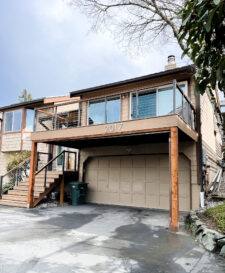
What Everson Homes Need From a Deck
Most of the decks we see failing early in this area aren't failing because of bad materials — they're failing because of decisions made during construction that ignored how much water this region actually sees. A correctly built deck for an Everson property needs to address a few things specifically:
- Positive drainage away from the house at the ledger connection, not just at the outer edge
- Proper ledger flashing so water can't wick behind the siding and into the rim joist
- Fasteners and hardware rated for wet, humid exposure — not just "exterior grade"
- Board spacing and airflow underneath that lets the structure actually dry out between storms
- A walking surface that stays reasonably slip-resistant once moss and algae start growing on it
- Footings set to the frost depth and soil conditions actually found on the property, not a generic assumption
Skip any one of these and the deck can still look fine for a season or two. The problems show up in year three, four, or five — right when they're hardest to trace back to the original build.
Moss and Algae: The Slow Damage Nobody Notices
Moss on a deck isn't just cosmetic. Once it establishes on a board, it holds moisture against the wood or composite surface far longer than open rain exposure would. On wood decking, that accelerates rot underneath the moss patch even while the surrounding boards look fine. On composite decking, it's mostly a surface and slip issue, but it still needs airflow and occasional cleaning to keep from becoming a green, slick mat by February. Board spacing, joist height above grade, and how tightly the deck sits against nearby landscaping all affect how fast moss takes hold.
Choosing the Right Decking Material for This Climate
There's no single "correct" decking material for Everson — it depends on budget, how much upkeep the homeowner wants to do, and how the deck will be used. What we won't do is recommend a product based on what's cheapest to install rather than what will actually hold up. Here's how the common options compare under this region's rain and moss exposure:
| Material | Moisture & Rot Resistance | Moss/Algae Resistance | Maintenance | Typical Lifespan |
|---|---|---|---|---|
| Pressure-treated fir/pine | Good if sealed regularly | Moderate — needs cleaning | Annual cleaning + re-sealing | 15-20 years with upkeep |
| Western red cedar | Naturally decay-resistant | Moderate — needs cleaning | Periodic oiling/sealing | 20-25 years with upkeep |
| Capped composite | Excellent — won't rot | Good, but surface can still film | Occasional wash-down | 25-30+ years |
| PVC decking | Excellent — fully synthetic | Good, low porosity surface | Occasional wash-down | 30+ years |
Cedar and pressure-treated wood cost less up front and give a natural look a lot of Everson homeowners still prefer, especially on older or farmhouse-style properties. Composite and PVC cost more initially but save on the sealing and staining cycle that wood demands in a climate this wet. We'll walk through the honest trade-offs for your specific project rather than steering everyone toward one product.
Framing and Footings Built for Local Soil and Frost
Whatcom County's frost depth and the variable soil conditions along the Nooksack corridor mean footings can't be treated as a formality. We dig to the depth the local code and the actual soil call for on your lot, not a rule-of-thumb number carried over from a different site. River-adjacent and low-lying properties around Everson can also have higher water tables or heavier clay content, both of which change how footings should be poured and how quickly they'll cure properly.
For the structure itself, we favor stainless or heavy hot-dip galvanized hardware — joist hangers, structural screws, post bases — over standard coated fasteners. In a climate with this much sustained moisture, the cheaper hardware is often the first thing to fail, well before the lumber or decking around it does.
Ledger Attachment: Where Most Deck Failures Actually Start
If a deck is attached to the house with a ledger board, that connection is the single most important detail on the entire structure. It has to be through-bolted or lag-screwed into solid framing, flashed correctly so water sheds away from the house rather than behind the siding, and separated from the wall enough to let air circulate. Get this wrong and the damage happens where you can't see it — inside the wall assembly — until siding gets pulled off for another reason and the rot is already extensive.
Our Process for a Custom Deck Build
We keep the process straightforward and give homeowners clear checkpoints along the way rather than disappearing until the crew shows up.
- On-site assessment — we look at grade, drainage, sun/shade exposure, existing structure (if replacing a deck), and how the space will actually be used.
- Design and material selection — layout, decking material, railing style, and any built-ins like benches or stairs, matched to budget.
- Permitting — we handle the permit application and inspections required for the jurisdiction your property falls under, so nothing gets built that has to be torn out later.
- Footings and framing — set to proper depth, with corrosion-resistant hardware throughout.
- Decking, railing, and finish work — installed with attention to drainage, board gapping, and airflow underneath.
- Final walkthrough — we go over care and maintenance specific to the material you chose before we consider the job done.
Why a Crew That Already Works Around Everson Matters
A deck builder who mainly works in drier climates, or who treats every region the same, will often default to standard-issue hardware, minimal ledger flashing, and generic footing depths — details that pass a quick glance but don't hold up to years of Whatcom County rain. Working this area regularly means we already know which fastener grades actually last here, how local soil behaves under footings, and what inspectors in this jurisdiction are looking for during permitting. That translates into fewer surprises, fewer callbacks, and a deck that's still solid a decade in rather than needing structural repairs by year six.
It also means we're not guessing about seasonal timing. Concrete cure times, lumber acclimation, and even sealant application windows all shift when you're working around Pacific Northwest rain patterns instead of a drier climate's construction calendar.
Maintenance That Actually Extends the Life of Your Deck
Whatever material you choose, a small amount of seasonal maintenance goes a long way in this climate. We give every customer a simple routine, not a demanding chore list:
- Sweep debris and standing leaves off the deck regularly, especially in fall
- Rinse or gently pressure-wash the surface once or twice a year to knock back moss and algae before it embeds
- Check that gaps between boards stay clear so water and debris keep draining through
- Inspect railing posts and stair connections annually for any looseness
- For wood decks, re-seal or re-stain on the schedule recommended for your specific product
- Confirm downspouts and grading near the deck still direct water away from the footings
None of this requires special equipment or a big time commitment — it's the difference between a deck that looks and performs well for 20-plus years and one that needs early repairs.
Cost Factors to Expect
Every deck is priced around its own footprint, framing complexity, and material choice, so we won't quote a number without seeing the site. In general, expect the material itself, the amount of framing and footing work required by slope and soil, railing style, and any added features like stairs or built-in seating to be the biggest swings in the final price. Composite and PVC decking cost more per square foot than wood up front but reduce long-term maintenance spending, which is worth factoring into the real cost over the life of the deck, not just the installed price.
Get a Free, No-Pressure Estimate
If you're planning a new deck or replacing one that's showing its age, we're glad to come take a look, walk the site with you, and put together an honest estimate — no pressure, no pushy sales pitch. Use the form below to get started.