 Ferndale
 Lummi Island Sits Right in the Path of Puget Sound Weather
Lummi Island homes catch weather that inland Whatcom County properties never see in the same combination. The island is surrounded by Puget Sound water, which means salt-laden air moves across every exterior wall, not just the ones facing the water directly. Add in wind-driven rain off the Strait of Georgia during fall and winter storms, and you have an envelope that's under near-constant moisture pressure for months at a time. Siding here isn't just a cosmetic layer — it's the first line of defense against an environment that's actively working to get behind it.
On top of the salt and the rain, Ferndale and the surrounding islands go through a long stretch of the year where surfaces rarely dry out completely. Overcast skies, high humidity, and shaded north walls create ideal conditions for moss, algae, and mildew to take hold on siding that isn't built to resist them. A material that handles one of these stressors well but not the others tends to show its weak points within a handful of years on a property like this.
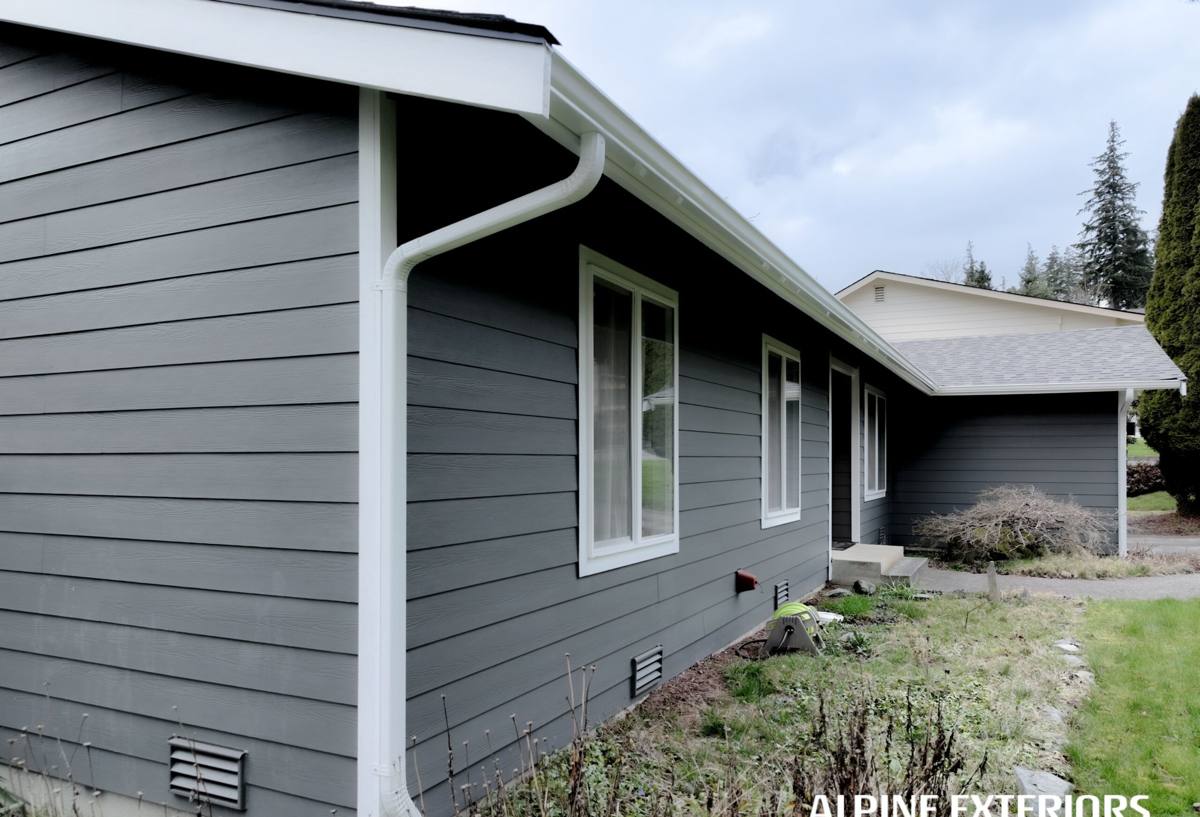
Why We Standardized on James Hardie Fiber Cement
We install James Hardie fiber cement siding exclusively — not vinyl, not LP SmartSide, not other fiber cement brands. That's a deliberate standard, not a default. Fiber cement itself is a mix of cement, sand, and cellulose fibers, which makes it dimensionally stable in a way wood-based and vinyl products aren't. It doesn't expand and contract with humidity swings the way wood does, it doesn't soften or delaminate when it stays wet, and it's non-combustible, which matters to insurers and to homeowners who want one less thing to worry about.
Within fiber cement, we've settled on James Hardie specifically because of the ColorPlus factory-applied finish and the HZ5 product line engineered for moderate, moisture-heavy climates like ours. ColorPlus finish is baked on in a controlled factory process rather than sprayed or rolled on site, which gives it better adhesion and fade resistance than field-applied paint — a real advantage when a wall is going to see years of salt spray and UV. HZ5 formulations are built with this region's rain and humidity in mind, and the backed transferable warranty gives homeowners recourse that off-brand or budget fiber cement products generally can't match.
What This Means Compared to Other Products
Vinyl siding can crack in freeze-thaw swings and tends to fade unevenly under coastal UV exposure, with no practical way to refinish it short of replacement. Wood and primed spruce products need ongoing paint maintenance and are far more vulnerable to the rot and moss growth that this climate encourages. LP SmartSide is a wood-strand product with a resin coating — better than raw wood, but still a wood-based substrate that behaves differently than cement in sustained wet conditions. We're not going to tell a homeowner one of these products is garbage — each has situations where it makes sense — but for the specific combination of salt air, driving rain, and a long moss season that Lummi Island deals with, fiber cement is the material we're willing to warranty our labor against.
What a Correct Installation Actually Involves
The siding material is only half the equation. Most siding failures we get called out to inspect — on any brand — trace back to installation shortcuts, not the product itself. On a marine-exposed property like a Lummi Island home, the details behind the siding matter as much as the panels themselves.
Moisture Management Starts Behind the Siding
Correct installation starts with a continuous weather-resistive barrier and a drainage gap or rainscreen behind the siding itself. That gap lets any moisture that does get past the cladding drain and dry out instead of sitting against the sheathing. In a climate where walls rarely get a long, dry stretch to fully dry out, that drainage plane is what keeps incidental moisture from turning into rot or mold inside the wall assembly.
Fastening and Flashing for Wind-Driven Rain
James Hardie specifies exact nailing patterns, fastener types, and clearances for a reason — get them wrong and you create entry points for wind-driven rain, which is exactly the kind of weather this island sees regularly. Every window, door, and penetration needs proper head flashing and kick-out flashing where a roofline meets a wall, directing water away from the assembly instead of into it. These are the details that separate a job that holds up for decades from one that starts showing staining and soft spots within a few winters.
Caulking Is a Backup, Not a Strategy
Sealant has a place at trim joints and penetrations, but it should never be doing the primary work of keeping water out — especially in a salty, humid environment where caulk breaks down faster than it does inland. A correctly installed system is designed so that flashing and lap geometry shed water on their own; caulking is the last line of defense, not the first.
Choosing the Right Hardie Products for This Climate
James Hardie makes several distinct product lines, and the right choice depends on the home's style, exposure, and the look a homeowner wants. Here's how the main options compare for a property like this:
| Product | Best Use | Why It Fits Lummi Island |
|---|---|---|
| HardiePlank Lap Siding | Traditional horizontal lap look | Most common choice; sheds wind-driven rain efficiently when lapped correctly |
| HardiePanel Vertical Siding | Modern or board-and-batten style | Fewer horizontal laps means fewer potential water-entry seams on exposed walls |
| HardieShingle | Accent areas, gables, cottage-style homes | Adds texture without sacrificing the moisture resistance of the plank/panel lines |
| HardieTrim | Corners, fascia, window and door trim | Matches the siding's stability so trim doesn't move independently and open gaps |
For color, ColorPlus finishes hold up better against salt spray and marine UV than field-applied paint, and they come with their own finish warranty. Darker colors on south- and west-facing walls will fade faster under sun exposure regardless of brand, so that's worth factoring into color choice on a property with a lot of open water views.
Our Process for a Lummi Island Project
Working on the island adds a logistics layer that a mainland Ferndale project doesn't have, and we plan around it rather than treating it as an afterthought.
- Site visit and assessment. We look at existing siding condition, sheathing access points, wall exposure to prevailing wind and rain, and any moisture or moss issues already visible.
- Material takeoff and delivery planning. Because materials have to make the ferry crossing, we plan quantities and delivery timing carefully to avoid multiple trips and delays mid-project.
- Tear-off and inspection. Old siding comes off in sections so we can inspect the sheathing and existing weather barrier underneath before anything new goes up — this is where hidden moisture damage, if any, gets caught early.
- Weather barrier, flashing, and drainage plane installation. This is the step that determines how the wall performs for the next 30-plus years, and it's not one we rush.
- Siding, trim, and finish installation. Panels, trim, and accessories go up to Hardie's fastening and clearance specifications.
- Final walkthrough. We review the completed work with the homeowner and register the manufacturer warranty.
What Affects Cost on a Job Like This
Every property is different, so we won't put a number on this page that doesn't reflect your specific home. What we can tell you is which factors tend to move the price up or down on an island siding project:
| Cost Factor | Why It Matters |
|---|---|
| Ferry-based material and crew logistics | Scheduling deliveries and crew time around ferry availability affects project timeline and staging |
| Condition of existing sheathing and wall assembly | Hidden moisture damage found during tear-off can add repair scope before new siding goes on |
| Home size and wall complexity | More corners, dormers, and trim details mean more cutting, flashing, and labor time |
| Product line and finish selection | Panel vs. lap vs. shingle profiles, and standard vs. premium ColorPlus finishes, price differently |
| Site access | Driveway, staging area, and how close a delivery vehicle can get to the home affect labor time |
Maintaining Fiber Cement Siding in a Salt-Air, Moss-Prone Climate
One of the advantages of fiber cement is that it needs far less upkeep than wood or vinyl, but "low-maintenance" isn't "no-maintenance," especially in this environment. A little attention once or twice a year keeps a correctly installed system performing the way it's supposed to for decades.
- Rinse salt residue off exterior walls periodically, particularly on sides facing open water
- Keep shrubs and trees trimmed back from siding so walls can air-dry between rain events
- Inspect caulking at trim joints and penetrations annually and re-caulk where it's cracked or pulling away
- Avoid high-pressure washing directed at seams and laps — it can force water behind the siding rather than off of it
- Watch shaded, north-facing walls for early moss or algae growth and clean it gently before it spreads
- Check touch-up needs on cut edges and fastener heads, which are the spots most likely to show wear first
Why It Matters to Hire a Crew That Already Works Lummi Island
A crew that's done work on the island already understands the ferry schedule, knows how to plan material deliveries so a project doesn't stall waiting on a boat, and has a feel for how exposed a given wall really is based on its orientation to the water. That local familiarity translates into fewer surprises mid-project and a more realistic timeline from the start. It also means we're not guessing at how Whatcom County's coastal conditions affect installation decisions — we've made those calls on homes like yours before.
Beyond logistics, working this area regularly means we're accountable to it. We're not passing through — Ferndale and the surrounding communities, including Lummi Island, are where we do business and where our name follows the work we leave behind.
If you're weighing a siding project on Lummi Island, we're happy to take a look at your home, walk you through what correct installation involves for your specific exposure, and put together a free, no-pressure estimate using the form below.