 Ferndale
 Roofing on the Semiahmoo Coast Wears Differently
Homes along Semiahmoo Bay and the surrounding Ferndale area sit in one of the more demanding roofing environments in Whatcom County. The salt-laden air off the water accelerates corrosion on fasteners, flashing, and any exposed metal. Wind-driven rain off the Salish Sea doesn't just fall straight down — it gets pushed sideways under shingle tabs and around poorly sealed penetrations. And the long, wet moss season here means organic growth has months on end to take hold on north-facing slopes and shaded valleys. None of this is dramatic on its own, but stacked together over 15-20 years, it's exactly the combination that shortens roof life and turns small maintenance issues into full tear-offs.
A roof built for a drier inland climate isn't automatically wrong for Semiahmoo, but it needs to be installed with these local stressors in mind from the first course of underlayment to the last ridge cap. That's the difference between a roof that looks fine for a few years and one that actually performs for its full service life out here.
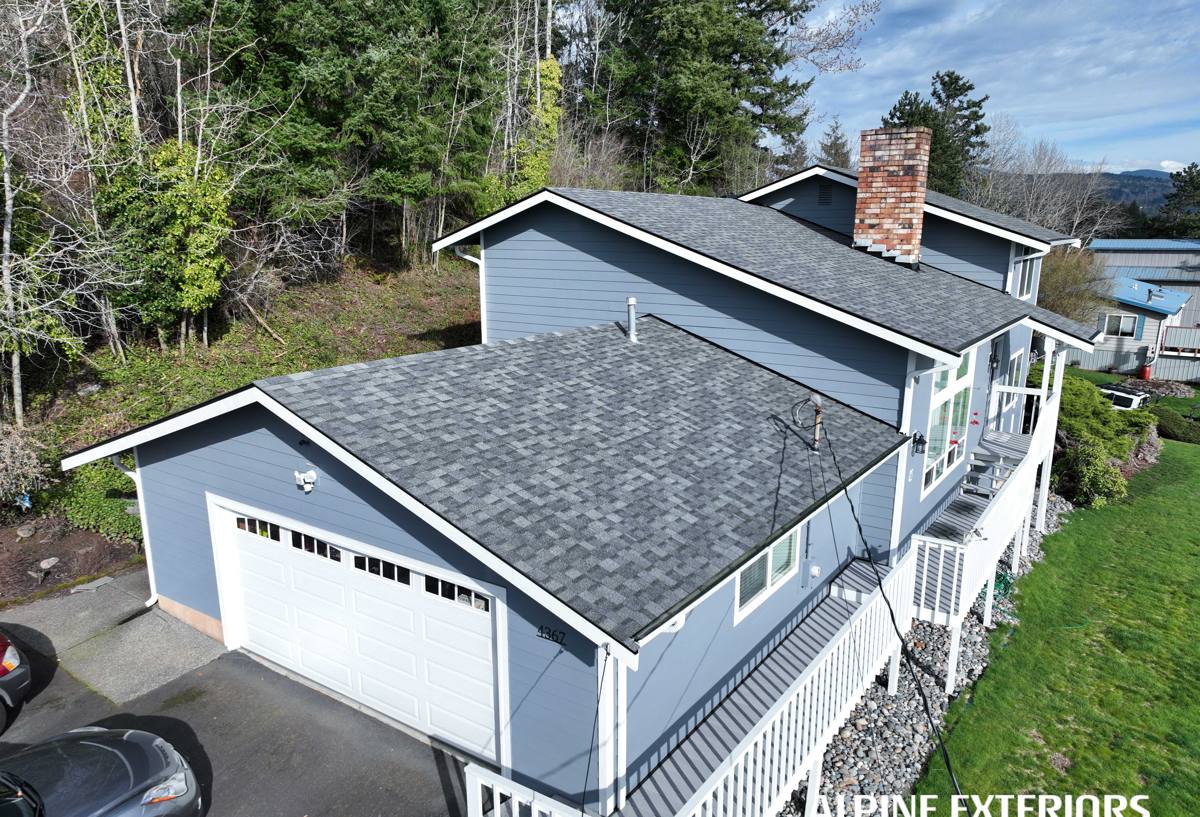
Signs a Semiahmoo Roof Needs Replacement, Not Another Patch
We get called out to a lot of roofs that homeowners assume just need a repair. Sometimes that's true. Other times the roof has quietly been failing from the inside — the mistake is judging it by what's visible from the driveway. Some signs that point toward full replacement rather than another round of patching:
- Granule loss heavy enough that you can see bare, shiny patches on south- and west-facing slopes
- Moss that has worked its way under the shingle tabs rather than just sitting on the surface
- Soft or spongy decking felt underfoot during an inspection, especially near valleys and eaves
- Rusted or lifting flashing around chimneys, skylights, and roof-to-wall transitions
- Staining or musty smell in the attic that tracks back to a specific area of the roof
- A roof already past 20-25 years old with asphalt shingles, regardless of how it looks from the ground
If more than one or two of these are present, patch repairs tend to become a cycle of chasing leaks rather than solving the underlying problem.
What a Correct New Roof Installation Actually Involves
Tear-Off and Deck Inspection
We remove the existing roofing down to the deck rather than layering over it. That's the only way to actually see the plywood or plank sheathing underneath, which matters here because moisture that's been getting in slowly — even without a visible leak — can soften decking over time. Any soft, delaminated, or rotted sections get cut out and replaced before anything new goes down. Skipping this step is one of the most common ways a new roof ends up with problems within a few years.
Underlayment and Ice-and-Water Protection
Given how much wind-driven rain this area sees, we don't treat underlayment as an afterthought. A synthetic underlayment across the full deck, with self-adhering ice-and-water membrane at eaves, valleys, and around every penetration, gives the roof a real second line of defense if wind pushes water past the primary roofing material. This is one of the details that separates a roof built for coastal exposure from one built to a bare-minimum code standard.
Flashing Details
Most roof leaks trace back to flashing, not the field of the roof. Chimneys, skylights, dormers, and any wall-to-roof intersection need step flashing and counterflashing installed correctly, not just caulked and hoped for. In a salt-air environment, we pay close attention to flashing material choice as well — some metals corrode faster near the water than others, and using the wrong one shortens the life of an otherwise good installation.
Ventilation
Proper intake and exhaust ventilation keeps the attic close to outdoor temperature and moisture levels. That matters for two reasons in this climate: it reduces condensation that can rot decking from underneath, and it keeps the roof surface from staying damp longer than it needs to — which is exactly the condition moss and algae need to establish.
Choosing a Roofing Material for a Salt-Air, High-Moss Climate
There isn't one "correct" material for every Semiahmoo home — it depends on budget, roof pitch, and how much maintenance the homeowner wants to take on. Here's how the common options actually perform in this specific climate:
| Material | Moss/Algae Resistance | Salt Air Performance | Typical Lifespan Here |
|---|---|---|---|
| Architectural asphalt shingle | Moderate — benefits from algae-resistant granules and good ventilation | Good; fasteners and flashing matter more than the shingle itself | 20-25 years |
| Standing seam metal | High — smooth surface sheds debris and dries fast | Depends heavily on coating/finish quality near the water | 40-50+ years |
| Cedar shake | Low without regular treatment; holds moisture and moss readily | Weathers naturally but needs upkeep in wet, salty air | 20-30 years with maintenance |
| Synthetic composite shake/slate | High — non-organic, doesn't feed moss growth | Very good; resists corrosion since it's not metal-fastened the same way | 40-50 years |
We're generally cautious about recommending untreated cedar shake for homes directly exposed to Semiahmoo's salt air and moss pressure — not because it's a bad product, but because it demands a maintenance schedule most homeowners underestimate, and the moisture retention that gives it its look also gives moss exactly what it needs. If a homeowner wants that appearance without the upkeep, synthetic shake products have closed a lot of that gap in recent years.
What Drives the Cost of a New Roof in This Area
Every roof is priced on its own specifics, but the factors that move the number the most are fairly consistent across Whatcom County coastal homes:
| Factor | Why It Matters |
|---|---|
| Roof size and pitch | Steeper roofs take longer to work safely and use more material per square |
| Number of layers to remove | Tear-off labor and disposal costs scale with how much old roofing comes off |
| Decking condition | Rotted sheathing found during tear-off has to be replaced, which isn't always visible beforehand |
| Material choice | Asphalt, metal, and synthetic products carry different material and labor costs |
| Roof complexity | Valleys, dormers, skylights, and multiple penetrations add flashing labor |
| Site access | Steep lots, limited driveway access, or long carry distances affect staging and disposal |
We'd rather walk a homeowner through these factors on their actual roof than quote a number that doesn't hold up once tear-off starts.
Our Installation Process
- On-site inspection and honest assessment of whether repair or replacement makes sense
- Written estimate that breaks out material, labor, and any anticipated decking work
- Material selection walkthrough based on the home's exposure, budget, and maintenance preferences
- Full tear-off and deck inspection, with any compromised sheathing replaced
- Underlayment, ice-and-water membrane, and flashing installed to handle wind-driven rain
- New roofing installed per manufacturer specifications to keep warranty coverage intact
- Ventilation check to confirm intake and exhaust are balanced for the attic space
- Site cleanup, including magnetic sweep for stray nails and haul-away of old materials
- Final walkthrough so the homeowner can see the finished work before we consider the job done
Moss Prevention Built Into the Install
You can't stop moss spores from landing on a roof in this part of the Pacific Northwest — the climate simply favors it too much. What you can control is how much of a foothold moss gets once it lands. That comes down to a few things we build into the installation itself: adequate roof ventilation so the deck and surface dry out between rain events, correct shingle overlap and fastening so moss can't work its way under tabs as easily, and, where appropriate, zinc or copper strips near the ridge that release trace metal ions with each rain to suppress regrowth. None of these are a substitute for periodic roof cleaning and gutter maintenance, but they meaningfully slow how fast moss comes back after a wash.
Why It Matters That a Crew Already Works Semiahmoo
A roof installed by a crew unfamiliar with this coastline tends to be built to a generic standard — technically code-compliant, but not accounting for the specific combination of salt exposure, wind-driven rain, and moss pressure this area sees. Working Semiahmoo and the broader Ferndale area regularly means we've seen how different materials and installation details actually hold up here over time, not just on paper. It also means we're not guessing at local permitting requirements or learning the area's wind and moisture patterns on your home for the first time.
A Homeowner's Pre-Installation Checklist
- Get a full roof inspection, not just a visual estimate from the ground
- Ask what happens if rotted decking is found during tear-off, and how that's priced
- Confirm what underlayment and ice-and-water protection is included, not just the visible roofing material
- Check that flashing replacement is part of the scope, not just reused
- Ask about ventilation — is it being assessed and corrected if needed, or left as-is
- Get the manufacturer warranty terms in writing, including what voids them
- Clarify cleanup and disposal responsibilities before work starts
- Confirm the crew carries proper licensing and insurance for work in Whatcom County
If you're weighing a repair versus a full replacement on a Semiahmoo home, or just want an honest read on where your current roof stands, we're happy to take a look. The estimate is free, there's no pressure attached to it, and you'll get a straight answer either way — just fill out the form below to get started.